The gospel of Mark 16:9-20 Inspired scripture?
Where does the gospel of Mark end? Is it verse 8, the shorter ending or are there actually another 12 verses and the Gospel ends at verse 20?
These verses are often used to discredit the reliability of the Bible and its inerrancy. This study, is not to defend the KJV only position, it is merely to demonstrate the authenticity, authority and originality of the final 12 verses of Mark. You do not have to be a KJV advocate in order to accept these verses as authoritative and part of the original text.
There is so much misinformation out there in relation to these verses and a lot and I mean HUGE amount of simple regurgitation of things people have read or have been told. The writings of Bruce Metzger seem to be a favourite source for a lot of the misinformation, people accepting his writings as fact rather than checking the claims themselves. Too often I have had Metzger thrown at me as proof these verses do not belong. This is simply parroting information. In this study we will look at the evidence itself and not simply the claims of what the evidence states. This includes the statements of Metzger (and yes I am aware Metzger is considered one of the best Scholars of all time and I am not).
It is often claimed that the verses did not form part of the original manuscripts and were added by scribes at a later date.
One argument against the non authenticity of Mark 16:8 is simply that it is a strange place for the gospel to end, especially as it would end with the Greek word Gar (for). The scribes thought this and so they added the ending.
This has to be inferred as even if they were added there are no notes as to why they were. It is an assumption, maybe an educated one but still an assumption nonetheless.
It must be pointed out that even in this belief there is an admission that Mark 16:8 would be a strange place to end the gospel and therefore although doesn’t automatically mean there has to be a “better” ending it does beg the question would Mark really end his gospel here? It is grammatically improbable that the text would in fact end with the Greek word gar. Thus the argument actually does demonstrate that verse 8 is in fact not where the text of Mark ends.
James White makes his own guess as to how the longer ending arose , he wrote :
What can we say, then, about Mark 16:9-20? we can speculate about how the longer ending arose. Did Mark issue two versions of his gospel, adding the longer ending later? No one can say, but that would certainly account for the various endings now in existence. More likely, early scribes felt the abrupt ending of Mark lacked the necessary proclamation of the resurrection, and hence some “parallel corruption” took place, drawing from oral stories and the other gospels to create the longer ending.
James White The King James only controversy page 257
It is clear that Mr White believes the passage non authentic and a later addition.
James White dedicates a little under 3 pages of his book to investigating the authenticity of this passage of scripture, which equates to approximately 750 words. (This presentation of the evidence is close to 12,000) . There is far more evidence available than what is presented in Mr Whites book. Of course, Mr white doesn’t claim to present all the evidence but seeing that he is investigating the readings as found in the KJV and his book is near on 300 pages it does, to me, seem to be a little “short” on support. Anyone who reads Mr Whites book thinking they are getting a full and honest evaluation of the evidence is going to end up very misinformed.
Most versions of the Bible do include verses 9-20 , KJV, NIV, ESV, NLT, NASB , ISV, Net Bible, NAS 1977, ASV, DOUAY-RHEIMS, DERBY, ERV and Young’s literal Bible versions plus the Catholic Vulgate to name just a few.
However, many include footnotes, brackets or italics to show that these verses may not actually belong at all.
The NIV footnote states “The most reliable early manuscripts omit Mark 16:9-20”
Bart Ehrman states that the verses are missing from the 2 oldest and best manuscripts of Mark.
“The verses are absent from our two oldest and best manuscripts of Mark’s Gospel, along with other important witnesses.”
Bart Ehrman misquoting Jesus page 67
It will be no surprise, to those that have studied this subject, that the manuscripts being referenced as the “most reliable and early” are Codices Sinaiticus and Vaticanus. It is, however, a surprise to me that these two manuscripts are still being referred to as such.
We shall look at the “other important witnesses” a bit later.
These are the ONLY 2 Greek manuscripts that clearly end at this point. There is a 3rd (304) which we will examine later. It is a medieval manuscript and certainly isn’t an early manuscript. While it does end at 16:8 it doesn’t clearly end at this point.
Norman Geisler in his book “When Critics ask”, stated that these verses are missing from MANY manuscripts:
Verses 9-20 are lacking in many of the oldest and most reliable manuscripts.
p377-378
2 is not many……
In 1952 the RSV removed the verses from scripture and placed them at the bottom of the page in small italic letters. The NRSV included them back into the text, however, they are in brackets and Italics. There is also a note “Some of the earliest manuscripts do not include 16:9-20.”
This footnote gives a false impression to its readers.
The SOME referenced there are actually really just 2, a couple, in more specific terms. Again Sinaiticus and Vaticanus as already stated.
Simply by the input of these brackets, italics and footnotes the verses are thrown into dispute and doubt is put into the mind of the reader a to whether or not these verses belong in the Bible or they were simply the work of scribes who added them at a later date.
Surely, if these verses are not inspired and do not belong in the Bible then the most sensible, the most honest position, would be to remove them altogether. It’s rather pointless to include verses, albeit with various ways of separating them, that were never intended to be there in the first place, are not inspired text and have been added at a later date. It can only lead to confusion and doubt. There really is no good argument to keep verses that don’t belong. If you are sure they don’t belong then remove them. If your Bible includes them and you don’t believe they are scripture….use a marker and erase them.
So have these verses actually been added to later manuscripts or removed from earlier ones? This is what this study is going to find out. We shall look at the evidence both for and against the inclusion, or non inclusion of the verses.
Let’s have a look at the chapter in question.
Mark 16:1 And when the sabbath was past, Mary Magdalene, and Mary the mother of James, and Salome, had bought sweet spices, that they might come and anoint him. 2And very early in the morning the first day of the week, they came unto the sepulchre at the rising of the sun. 3And they said among themselves, Who shall roll us away the stone from the door of the sepulchre? 4And when they looked, they saw that the stone was rolled away: for it was very great. 5And entering into the sepulchre, they saw a young man sitting on the right side, clothed in a long white garment; and they were affrighted. 6And he saith unto them, Be not affrighted: Ye seek Jesus of Nazareth, which was crucified: he is risen; he is not here: behold the place where they laid him. 7But go your way, tell his disciples and Peter that he goeth before you into Galilee: there shall ye see him, as he said unto you. 8And they went out quickly, and fled from the sepulchre; for they trembled and were amazed: neither said they anything to any man; for they were afraid.
And this is where many would argue that the Gospel ends.
As already stated the passage finishes with the word Gar
Mark 16:8 καὶ ἐξελθοῦσαι ταχὺ ἔφυγον ἀπὸ τοῦ μνημείου εἶχεν δὲ αὐτὰς τρόμος καὶ ἔκστασις· καὶ οὐδενὶ οὐδὲν εἶπον, ἐφοβοῦντο γὰρ
The shorter ending reads
“Everything that had been told to them, they related to Peter and those with him. And after this, Jesus Himself appeared to them and sent forth, through them, from east to west, the sacred and imperishable proclamation of eternal salvation. Amen.”
But here are the 12 disputed verses.
Mark 16:9 Now when Jesus was risen early the first day of the week, he appeared first to Mary Magdalene, out of whom he had cast seven devils. 10And she went and told them that had been with him, as they mourned and wept. 11And they, when they had heard that he was alive, and had been seen of her, believed not. 12After that he appeared in another form unto two of them, as they walked, and went into the country. 13And they went and told it unto the residue: neither believed they them. 14 Afterward he appeared unto the eleven as they sat at meat, and upbraided them with their unbelief and hardness of heart, because they believed not them which had seen him after he was risen. 15And he said unto them, Go ye into all the world, and preach the gospel to every creature.16 He that believeth and is baptized shall be saved; but he that believeth not shall be damned.17 And these signs shall follow them that believe; In my name shall they cast out devils; they shall speak with new tongues; 18 They shall take up serpents; and if they drink any deadly thing, it shall not hurt them; they shall lay hands on the sick, and they shall recover. 19 So then after the Lord had spoken unto them, he was received up into heaven, and sat on the right hand of God. 20And they went forth, and preached every where, the Lord working with them, and confirming the word with signs following. Amen.
So are the verses at the end of the gospel of Mark inspired or not? Has the KJV included uninspired scripture as scripture without any differentiation between the two? Obviously if it has this would most certainly cast doubt over the reliability of the KJV and would most certainly almost but destroy the stance of KJV only advocates that the KJV is the only correct translation of the Bible in English (or any language as some assert). In every single Greek manuscript that contains the shorter ending, the longer ending is also present. The shorter ending is found between verses 8 and 9.
One quick fact needs to be mentioned, while certainly in no way actually constitutes an actual argument for the inclusion of the verses it is interesting anyhow. If we add up all the verses from all the chapters in Mark including Mark 16:9 through 20 we get a total of 678 verses. If we remove the 12 disputed verses we actually get …….666 verses. So the number of the beast 666 just happens to show up in a book called MARK. Again, I reiterate I am not using this as anything more than a fact of interest (this most certainly is a fact of interest and I think it should be taken seriously).
So, let’s get back to the matter at hand. It has to be questioned are these manuscripts, the Sinaiticus and the Vaticanus, indeed the and “most reliable and early” manuscripts. I’m not going to go into full detail on these here, a full and concise argument is available in my other writings more specific to these Codices. Suffice to say, these manuscripts are NOT the oldest and they most certainly are not the most reliable. (they are the oldest Greek manuscripts of this portion of the text)
There is overwhelming manuscript support for the inclusion of the verses. There are over 1640 Greek manuscripts that include the verses and we have just 2/3 that omit them. Yes that is correct. Of the 1600+ Greek manuscripts that we have there are just 2/3 that omit the final verses of Mark 16. SO the SOME manuscripts that omit these verses are in fact 2/3. When referring to the some oldest and best manuscripts this is in no other terms just the two we have previously mentioned.
Furthermore, there are 8000 Latin manuscripts that include the verses. This is contrary to a claim made by John MacArther in a sermon which you can view here. He stated “We have all these ancient manuscripts that when compared all say the same thing.” His comment comes after he had just stated that Vaticanus and Sinaiticus both finish at verse 8 and that we have 8,000 copies of the vulgate (he also mentioned 350 copies of the Peshitta) His comment makes it appear that the 8,000 latin copies say the same thing as Vaticanus and Sinaiticus…..they most certainly do not. While he is correct in saying they all say the same thing, they say these verses are scripture. There is in fact only one latin manuscript, Codex Bobbiensis (k)(4th-5th Century), that omits these verses. Codex Bobbiensis is one of the worst copied manuscripts that we have….in any language. The manuscript was made in Egypt. I would suggest taking a more in depth look at this manuscript to see just how bad it really is.
There are so many textual errors in the manuscript that the text is simply unreliable.
For example. The copyist wrote in the shorter ending “from east to east” instead of “from east to west”. He also used “puero” which is child instead of “Petro” Peter. The names of the woman are removed from verse 1 and an interpolation is included in between verses 3 and 4. The phrase “neither said they any thing to any man; for they were afraid.” has been removed from verse 8. It would most certainly appear that the text of Bobbiensis is the work of a scribe that consciously altered the text.
Below is an image Codex Bobbiensis 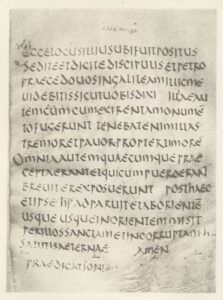
There are also about 100 Syriac manuscripts that contain the verses and just 1 that does not, this is the Sinaitic Syriac. You can view the manuscript at the Sinai Palimpsests project website here.
Sinaitic Syriac is a 5th century manuscript. The text of the manuscript is the “upper writing”. The “lower writing” can be detected on the manuscript but cannot be read. It must be noted that it is the earliest Syriac manuscript that we have containing the ending of Mark so it is an important witness. This most certainly would be one of those important witnesses mentioned by Bart Ehrman in his book.
Those that use this manuscript as evidence for the non authority of the Longer ending usually fail to mention the weight of Syriac manuscript evidence for the inclusion of the verses. They also usually fail to mention the writings of early Syriac writers.
Aphrahat, a very important Syriac writer known as the Persian sage quotes the passage in the 4th century. He was clearly using a Syriac text that pre dates the Sinaitic Syriac that included the longer ending. Aphrahat uses the text as if it is scripture and makes no mention of it being in doubt.
Mark 16:16-14 in the 17th paragraph of demonstration 1 on faith
ALL 200 (approx) Ethiopic manuscripts contain the verses.
The verses are also included in the Gothic version (around 350 Ad)
While this cannot be used as 100% undeniable “proof”, the weight of manuscript evidence based on the numerical witness some 99+% of all manuscripts including the verses would certainly fall on the side of the genuineness of the verses.
A closer look at Vaticanus and Sinaiticus
There are actually some rather strange goings on in these two manuscripts that differ from each other in some 30,000 places.
Again, although this isn’t a writing specifically about Codices Sinaiticus and Vaticunas, we do need to understand that it isn’t as simple as the omission of the verses in these two manuscripts.
Vaticanus dates to approx 325AD* and Sinaiticus dates to approx 350ad*
There is a third manuscript, Codex Alexandrinus that dates to somewhere around 400-440 Ad* that is viewed on an almost equal scale with the other two manuscripts in level of reliability and relevance by most Biblical scholars. Alexandrinus does include Mark 16:9 through 20 showing that even in the Alexandrian line the verses were being used.
*dates are approx
So let’s examine the claim the “earliest” manuscripts.
While these manuscripts are not the oldest Greek manuscripts in existence, we have at least 30 Papyri that pre date them, they are certainly the oldest nearly complete Codices we have. As already stated they are the oldest Greek manuscripts of this part of the text.
And what about the reliability of these manuscripts?
Firstly, it needs to be noted that BOTH the Sinaiticus and Vaticanus include Apocryphal books integrated into the canonical books. How reliable is the text contained therein if books that are not considered to be inspired texts are included as inspired texts? It would seem a little hypocritical to state that the omission of the last 12 verses of Mark is evidence that they don’t belong in scripture based on these reliable manuscripts to then also argue that the Apocryphal books that are included in these reliable manuscripts are not to be included as inspired texts. The manuscripts are either reliable and therefore everything in them is reliable which would include the Apocrypha books or they are not reliable because they contain the apocryphal books and therefore the omission of Mark 16:9-20 cannot be given the same authoritative position that it has been given.
It has to be said that to simply state that the “oldest and earliest” manuscripts omits these verses is a little bit disingenuous to say the least. When the manuscripts are actually analysed it actually isn’t as straightforward as the verses have simply been omitted or not included.
Vaticanus strangely has one single blank space (that cannot be accounted for) in the whole manuscript. It just happens to be at the point of the end of Mark 16:8. Normally a new book would simply follow the previous book (except between the Old and New Testaments, at 2 production seems and the end of Tobit where one copyist ends and another starts). This is not the case at the end of Mark. There is a blank column between Mark 16:8 and Luke 1:1.

Almost as if the scribe was aware of the verses, not included them but had left space for them anyway, this being called a memorial space. I say “almost like” but the copyist most certainly left space deliberately.
Some have argued that the space is not big enough to contain the LE of Mark. This is correct if the letters are written in the exact same way they are in the rest of the passage. However, there is enough space if the letters are slightly reduced. The assertion that there isn’t enough space would take the assumptive position that if the copyist was leaving room for the LE he would have counted out the exact amount of letters that would have been included within the space and then left that exact space, rather than making an estimated guess as to the space that would be required. Or that he did not wish to leave the space for it to be added but wished to leave space to indicate the awareness of the LE.
As for the Codex Sinaiticus at this point of the text (Mark 15:19 ) the letters suddenly become larger than have been previously used throughout the manuscript. They then revert back to normal size after. In Luke he uses around 15 letters per line however in Mark this is only around 8-10 per line. On some lines as low as 3-5. If the letters were of the size of the rest of the text again there would be sufficient space to include the 12 verses.


Mark 16 is also on a replacement page or cancel sheet, meaning that this page was not an original page but had been changed at a later date.(there are actually 4 pages replaced here (on one cancellation sheet). Mark 14:54 through Luke 15:6. Therefore, we do not know what the original text of this manuscript read, we do not know if it contained the Longer Ending or not. All we do know is that neither the LE nor the SE are included within the replacement pages. The original reading of Sinaiticus, therefore, is not a witness to either ending.
They are not written by the same copyist who wrote the rest of the manuscript. This means that ONE of the two “oldest and best” manuscripts does not even contain the original wording of that manuscript. As we don’t have the original text of this portion of the manuscript we cannot state whether or not it originally contained Mark 16:9 or not. This means that Sinaiticus cannot be used as an original witness , only that the replacement ends at verse 8. We do not know when this was done.
The copyist made a conscious decision NOT to leave a blank column between the text of the end of Mark 16:8 and the start of Luke 1:1. He did not want it to appear as a memorial space as we see in Vaticanus. This clearly indicates that the copyist was not only aware of the extra verses of Mark 16 but consciously chose not to include them.
The copyist also included an embellished arabesque, much larger than any other included in Sinaiticus, making sure that nobody added more at a later date.
The copyist makes some very odd mistakes on this replacement page.
He skipped most of Mark 16:1.
In Luke 1:26 And in the sixth month the angel Gabriel was sent from God unto a city of Galilee, named Nazareth,
The scribe wrongly used Judua instead of Galilee. A mistake no other manuscript makes. This therefore means the copyist had an exemplar that contained this mistake that no longer exists, this is very unlikely seeing this is found in no other manuscript, he deliberately changed the text or he simply made a mistake in copying his exemplar. In verse Luke 1:41 he adds the words “for joy” even though they do not belong.
Luke 1:41 And it came to pass, that, when Elisabeth heard the salutation of Mary, the babe leaped in her womb; and Elisabeth was filled with the Holy Ghost
The words “for joy” actually appear in verse 44
Luke 1:44 For, lo, as soon as the voice of thy salutation sounded in mine ears, the babe leaped in my womb for joy
Again this mistake is found in no other manuscript.
With such additions and differences it would seem far more likely that the copyist made these changes via his own conscious decision.
It has been noted that the handwriting of these replacement sheets is very similar to one of the copyists that worked on Vaticanus.
There are also other major omissions from both codices
Sinaiticus omits the last verse of the Gospel of John
John 21:25 And there are also many other things which Jesus did, the which, if they should be written every one, I suppose that even the world itself could not contain the books that should be written. Amen.
How many honest and consistent Biblical scholars would cast doubt over the authenticity of this verse. Should Bibles not include a note “one of the oldest most reliable and earliest manuscripts omits this verse.”
Sinaiticus also omits John 9:38
John 9:38 And he said, Lord, I believe. And he worshipped him.
Again we have to ask the same questions here.
The same problem arises with Vaticanus with its omission of Luke 23:34
Luke 23:34 Then said Jesus, Father, forgive them; for they know not what they do. And they parted his raiment, and cast lots
Sinaiticus includes this verse as does Alexandrinus.
This statement of Jesus is found nowhere else in the Bible. How many have listened to sermons preached on this very saying? Do we now doubt the very words of Jesus? Do we again include a note that one of the most reliable and earliest manuscripts omits this verse. Casting doubt over its authenticity?
It could be argued that 2 of the 3 include the verses so numerical advantage takes precedence. However, that argument would then also have to be applied to the ending of Mark and as we already know the numerical advantage isn’t just 66.6% but over 99%.
We would also have a problem with Luke 22:43-44 as both the Vaticanus and Alexandrinus. 2 of the 3 omitting these verses.
Luke 22:43And there appeared an angel unto him from heaven, strengthening him. 44And being in an agony he prayed more earnestly: and his sweat was as it were great drops of blood falling down to the ground
Again, how many have heard preaching on these very verses? How many have used them in their own evangelising? Do we now dismiss them? Stop using them as unreliable and potentially uninspired? If we are being intellectually, as well as scholarly honest, then using the same reasoning behind Mark 16:9-20 the only stance would be to hold these verses in Luke in the same light.
If you accept the verses in Luke then you should apply the same logic that brings you to that acceptance to the verses in Mark.
Early Attestation
Early attestation to the existence of the verses comes from the 2nd Century
Epistula Apostolorum English translation of the Coptic text Anthony Alcock
Written in the 2nd century but most likely BEFORE 150AD
.” We said to him, “Lord, is it not necessary once again that we take the cup and drink ?” He said to us, “Yes, it is necessary 17 until the day when I come together with those who have been killed for my sake.” We said to him, “Lord, the things which you revealed to us at the beginning are great things. In what sort of great power will you come ? Or what sort of perceptible state ?” He answered and said to us, “Amen, I say to you that I will come like the sun shining, I being light of seven times greater than it (sun) in my glory. The wings of clouds carrying me15 in glory and the sign of the cross before me, I will come upon the earth and give justice to the living and the dead.” We said to him, “Lord, after how many years will these things happen.” He said to us, ” If the part of a hundred and the part of twenty16 are complete in the middle of the Pentecost and the feast of the unleavened bread, the presence of the Father will take place.”
If we Accept Jesus died around the year 30(Give or take a few years) Then it we should infer that the writer of the work did so before the 120 part are complete. The writer believed that Jesus would return within 120 years. Therefore, the writer was assuming that Jesus would return within that time, and so was stating a time frame from which he would return, 30 + 120 = 150 years or 150AD. As the writer is writing with the belief that Jesus is to return in that time frame it stands to reason that he is writing within that time frame an event still to happen. This would make no sense if the writer is writing after the timeframe of which he believed Jesus would return and so it is far more logical that the writer was writing before this time frame had expired and so would give us a date of writing of before 150AD.
[…] 5 . They went to that place, walking,6 three women, Mary, Martha and Mary Magdalenê. They took an ointment to pour it 7on his body, weeping and grieving over what had happened. When they approached to enter the tomb, they looked inside but did not find the body. As they were grieving and weeping, the Lord appeared to them and said to them, “For whom are you weeping ? Stop weeping, I am the one you are looking for. Let one of you go to your brothers and say, ‘Come. The Master has risen from the dead.'” Martha came to us and told us. We said to her, “What do you want with us, woman ? This one who has died and been buried, is it possible for him to be alive ?” We did not believe her that the Saviour had risen from the dead.
The information regarding not believing that the Saviour had risen is found only in Mark 16:11
Mark 16: 9Now when Jesus was risen early the first day of the week, he appeared first to Mary Magdalene, out of whom he had cast seven devils. 10And she went and told them that had been with him, as they mourned and wept. 11And they, when they had heard that he was alive, and had been seen of her, believed not.
This explicetely attests to the existence of this verse.
Then 11 she went to the Lord and said to him, “None of them believed me that you are alive.” He said to her, “Let another of you go to them and tell them again.” Mary came and told us again, and we did not believe her. She went back to the Lord. She told him the very words. The Lord then said to Mary and her sisters, “Let us go to them.” He came and found us inside. He called us out. But we thought it was an illusion. We did not believe that he was the Lord. He then said to us, “Come. Do not be afraid. I am the Lord, the one whom, you Peter, denied three times and now still deny. We came to him, doubting in our heart that perhaps it was not the Lord. He then said to us 12 “Why do you still doubt and have no faith ? I am the one who spoke to you about my flesh, death and resurrection, so that you would know that it is I. Peter, put your fingers into the nails of my hands and you too, Thomas, put your fingers into the spear wounds of my side. You, Andrew, look at my feet. You will see that they do not stick to the ground. For it is written in the Prophet8 that an illusory demon’s foot does not stick to the ground.” We touched him that we might know truly if he had risen in the flesh and we threw ourselves on our faces, confessing our sins, for we had been faithless.
Again the information regarding Jesus “calling out” the disciples is found only in Mark 16:14
Mark 16: 14Afterward he appeared unto the eleven as they sat at meat, and upbraided them with their unbelief and hardness of heart, because they believed not them which had seen him after he was risen.
Early attestation
There are many early church fathers who quoted or alluded to Mark 16:9-20 long before the date of these 2 manuscripts. In fact, we have attestation that goes back to the turn of the 2nd century. For purposes of length I will include just a few.
Justin Martyr alluded to verse Mark 16:20 in his Apology 1 ch 45 in 151 AD
He wrote the apostles “going forth from Jerusalem preached everywhere”
Found in verse 20
Mark 16:20 And they went forth, and preached every where, the Lord working with them, and confirming the word with signs following. Amen.
Justin uses the words ἐξελθόντες πανταχοῦ ἐκήρυξαν This is the same as found in Mark 16:20 although in a slightly different order( ἐξελθόντες ἐκήρυξαν πανταχοῦ in Mark)
Justin also makes reference to believers being unable to be harmed found in MArk 16:18 .
F.J.A. Hort in 1881objected to Justin being evidence for the Longer ending of Mark. He stated that Mark 16:20 “does not contain the point specially urged by Justin.”
This objection is not valid as in 1888 an Arabic text of Tatians diatessaron was published. J. Rendel Harris found that the text does support the diatessarons inclusion of the term specified by Justin. Hort did not have access to this when he made his objection.
IRENAEUS 2nd century around 184 ad Against Heresies 111: 10:5-6
“Also, towards the conclusion of his Gospel, Mark says: ‘So then, after the Lord Jesus had spoken to them, He was received up into heaven, and sitteth on the right hand of God”
This is specifically quoting Mark 16:19.
So then after the Lord had spoken unto them, he was received up into heaven, and sat on the right hand of God.
Papias refers to verse 18 around 100 AD
This is recorded by Eusebius of Caesarea, in book 3, chapter 39 of his Church history
Vincentius quotes Mark 16:15-18 verses at the Synod of Carthage (256 AD)
“we have assuredly the rule of truth which the Lord by his divine precept commanded to his apostles saying go ye lay on hands in my name expel demons And in another place. Go ye and teach etc”
Tatian included all 12 verses of the passage in his Diatessaron. (172 AD)
The evidence for such is found in codex Fuldensis and also the commentary on the Diatessaron by Ephrem Syrus (360 AD) This is demonstrable proof that the Syrian text contain the Longer Ending long before the Sinaitic Syriac manuscript
Mark 16:16-14 in the 17th paragraph of demonstration 1 on faith
Aphrahat is also evidence of the Longer Ending of Mark being included in the Syrian text before the the Syriac Sinaticus, one of the manuscripts cited as evidence against the Longer reading.
Hierocles
Somewhere around the year 300 Hierocles a pagan writer, writing in modern day Turkey mocked the Christians by challenging them to choose their leaders by having poison drinking contests. Drinking poison is found only in the final 12 verses of Mark.
Again proving that these verses were in not only in existence but being accepted and used as scripture by the early church.
Palladius of Ratiaria
Palladius is a rather unknown source, however, he supports the longer ending of Mark.
Born sometime in the 4th Century, he was an arian theologian. He served as Bishop before the Council of Aquileia in 381.After the council he was removed of his position. James Snapp Jr has a writing detailing the evidence of Palldius
In an early fifth-century manuscript kept at the National Library of France – Manuscript Latin 8907 – several early theological works are preserved, including Hilary of Poitier’s De Trinitate, Contra Auxentium, and De Synodis, and the first two books of Ambrose of Milan’s De Fide. Also in MS Lat. 8907 is a record of the proceedings of the Council of Aquileia. Remarkably, this manuscript, produced in the early 400s, preserves writings and records of events from the 300s.
In part of the margin of MS Lat. 8907, there is what has been titled the Dissertation of Maximinus Against Ambrose, or “Arian Scholia on the Council of Aquileia,” which mostly constitutes a critique of the proceedings of the Council of Aquileia from an Arian point of view”
“The material from Maximinus (and his sources, including Palladius) in the margin of Latin MS 8907 thus forms an interesting witness to Arian theology in the first half of the 400s. Roger Gryson edited this material in 1980, with a French translation, in Scolies Ariennes sur le Concile D’Aquilée – Introduction, Texte Latin, Traduction et Notes, replacing an earlier (1899) edition of Maximinus’ dissertation against Ambrose by Friedrich Kauffmann. “
Tres etiam consessores, cum Spiritus Sanctus de unius eiusdemque sui domini predicauerit sede per Dauid dicens [or dicentem]: Dixit Dominus domino meo: Sede a dextris meis, sed et euangelista Marcus solum Ihesum Cristum ascendisse in caelum et ad dexteram Dei rettulerit sedere, dicens: Et dominis quidem Ihesus, postquam locutus est, receptus est in caelos et sedet ad dexteram Dei.
Gryson translated this as:
<< Trois qui siègent ensemble >> également, alors que l’Esprit-Saint a parlé clairement d’un unique siège, celui de son seigneur, en disant par la bouche de David : << Le Seigneur a dit a mon seigneur: Siège à ma droite >>, et que l’évangéliste Marc rapporte que seul Jésus-Christ est monté au ciel et siège à la droite de Dieu : << Et le seigneur Jésus, après qu’il eut parlé, a été accueilli dans les cieux et siège à la droite de Dieu. >>
I am not fluent in French but I think that in English this yields something like:
”Three who sit together: And while the Holy Spirit spoke clearly of a single seat, that of his lord, speaking by the mouth of David. “The Lord said to my lord: Sit at my right.” And the evangelist Mark relates that only Jesus Christ ascended into heaven and sits at the right hand of God: “And the Lord Jesus, after he had spoken, was received into heaven and was seated at the right hand of God.””
It is a very clear citation of Mark 16:19
Enzik of Golb
An Armenian writer in the early part of the 5th Century
“And again, ‘Here are signs of believers: they will dislodge demons, and they will take serpents into their hand, and they will drink a deadly poison and it will not cause harm.’”
De Deo 1:25,
This is only found in the Longer ending of Mark 16
While manuscript evidence is of vital importance, we cannot simply ignore the patristic attestation as it clearly echoes the evidence of the knowledge, acceptance and use, as scripture, of the longer ending.
Many people totally ignore these early attestations (or are totally unaware of them) based on the fact that they are simply looking at commentaries that fail to mention them. The NET bibles notes do not mention them. If your study into the historicity of these verses is dependent on commentaries then you will only know what the commentaries tell you. Proper study includes fact checking the claims made in commentaries….including this one.
A very common argument used is a statement made by Bruce Metzger.
“Clement of Alexandria, Origen, and Eusebius show no knowledge of the existence of these verses,” Bruce Metzger The Text of the New Testament p226
This statement, however, is rather basic and needs to be looked at in more detail.
While the reference to Clement may be factually correct, Clement didn’t quote from Mark 16:9-20, this statement is in itself rather misleading. It would lead the reader to assume that Clement deliberately refrained from quoting this passage or that he had no knowledge of its existence. This is an argument from silence. While I do take silence seriously when looking at evidence, it cannot simply be asserted here that Clements silence regarding the longer ending, means he knew not of its existence. If we are going to be honest then we need to delve deeper. The truth is that Clement of Alexandria hardly quoted the Gospel of Mark at all. Its not like Clement was constantly quoting Mark but failed to quote from 16:9-20. There are in fact no obvious quotations from the first 9 complete chapters of Mark. He also doesn’t quote from chapters 11, 12, 13, 14 or 15 of the Gospel of Mark. What is also rather important to note is that he doesn’t quote from the first 8 verses of chapter 16 either. There is NO quotation from any part of chapter 16 at all. Clement is therefore not a witness to the shorter ending of Mark either. In reality Clement made just one loose quotation of chapter 10. It is nothing less than disingenuous to claim the lack of quotation from the longer ending of Mark is evidence for its non authoritative status.
So we also need to look at the claim regarding Origen. Origen, while using Mark more often than Clement, himself, did not utilize the Gospel of Mark nearly as often as he did the other Gospels.
Origen doesn’t quote from Mark 1:36 through 3:16 a total of 54 verses or 3:19-4:11 which is 28 verses. He doesn’t quote for Chapter 5:2 through 5:43, 41 verses neither does he quote Chapter 8:7 to 8:29, 22 verses. So Origen not utilising 12 verses of the Gospel of Mark is no different than any of these other verses that he does not utilise.
There is, however, a possibility that Origen DID in fact reference this passage. This reference can be found in Philocalia, chapter 5. Origen wrote, “Let a man observe how the apostles who were sent by Jesus to proclaim the Gospel went everywhere, and he cannot help seeing their superhuman daring in obedience to the divine command.”
This may very well have been a reference of Mark 16:15, 16:18 and Mark 16:20.
Again it is simply disingenuous to assert the longer ending is non authoritative based on Origins supposed non quotation of it.
Many people simply regurgitate the statement of Metzger without actually studying the facts of the statement.
Eusebius most certainly was aware of the verses. The argument as to whether or not he accepted them as scripture is one thing but it is simply IMPOSSIBLE to argue that he was not aware of them as we shall see.
Even Metzger himself, in his later work, A Textual Commentary on the Greek New Testament written for the UBS, removed the reference to Eusebius on Page 123. He stated:
“Clement of Alexandria and Origen show no knowledge of the existence of these verses,”
This statement is the same as his previous statement minus the reference to Eusebius.
Some may be aware of the claim regarding Marinus and Eusebius.
Around the year 325 AD, Marinus had asked Eusebius about how to reconcile Matthew 28:1 and Mark 16:9 (Marinus had asked numerous questions not simply this one)
In his responding letter, titled to Marinus, Eusebius stated that one solution was to reject the ending of Mark based on the ending not being found in all manuscripts, that it is not found in accurate manuscripts or that it is seldom found in any manuscripts.
Now while this does sound like support for non inclusion of the verses as it would seem that Eusebius was claiming that the verse was not found in the accurate copies, this is not what Eusebius was in fact saying. He was not actually saying that this was in fact correct. He was actually only giving Marinus an option. Marinus COULD reject it on those grounds IF those grounds were correct. However, Eusebius also gave Marinus another option.
He stated that a person could harmonise the verses by simply punctuating Mark 16:9 Rising early, on the first day of the week Jesus appeared….
It is THIS option that Eusebius strongly suggested that Marinus take.
Obviously the fact that Marinus had asked Eusebius the question regarding Mark 16:9 meant that Marinus was fully aware of the longer ending of Mark. As we can see Eusebius was also fully aware of the verses. In his response to Marinus he quoted This being before Vaticanus or Sinaiticus having been written further highlighting the fact that the verses were not merely added at a later date by scribes who saw a problem with the shorter ending.
Later on to Marinus Eusebius makes reference to the some copies that say Jesus cast out seven demons from Mary Magdalene, which is also found in Mark 16:9 but more importantly ONLY here in this verse. Thus in his reply Eusebius literally quoted from Mark 16 verse 9.
It is evident that Eusebius was in two minds over the ending as when he made his canon-tables, he did not include the ending of Mark. What we do know is that Eusebius was aware of both endings and urged Marinus to accept the longer.
Jerome was unaware of the longer ending
Jerome is also used as evidence for the shorter ending. However, those that do are very likely simply repeating what they have heard or read and not doing so from an actual study of Jerome.
It is from his epistle to Hedibia where we find the so called evidence.
The lady, who the epistle is a response to, had asked some questions of Jerome. The third of those questions being-
Why do the evangelists speak differently about the resurrection of our Lord, and how he appeared to his apostles?
Jerome sub divided her question into 3 sub questions which just so happen to be the same as Marinus had asked of Eusebius. Jerome uses the answer by Eusebius as the source of his own answer.
“you first ask why Matthew says that our lord rose on the evening of the Sabbath! when the first day of the following week was just beginning to shine and Saint Mark on the contrary said that he arose in the morning. Jesus arising on the first day of the week in the morning appeared to Mary Magdalene from whom he had expelled seven demons And she departing told those who were his companions as they mourned and wept. And these hearing that he was alive and that she had seen him did not believe in him. This problem has a twofold solution Either we do not accept the testimony of Mark on the grounds that this final portion is not contained in most of the gospels that bear his name almost all the Greek codices lacking it or else we must affirm that Matthew and Mark have both told the truth! that our Lord rose on the evening of the Sabbath! and that he was seen by Mary Magdalene in the morning of the first day of the following week , So this is how this passage of Saint Mark should be read. ,Jesus arising, place a little pause here, then add ,on the first day of the week in the morning appeared to Mary Magdalene, so that being raised according to Saint Matthew in the evening of the last day of the week he appeared to Mary Magdalene! according to Saint Mark ,the morning of the first day of the week- which is how John also represents the events! stating that he was seen on the morning of the next day-
Jerome included the verses in his latin vulgate in 383 AD. HOW could Jerome include verses he was not aware of? The claim cannot be supported against such evidence. It must be noted that Jerome stated that he used ancient Greek manuscripts when he translated the latin vulgate. This was ancient manuscripts in 383AD….which means they were much older than any manuscript of Mark that is available to us today.
Neither Eusebius or Jerome reject the longer ending of Mark outright and in fact it can rather be argued that both asserted that it should not be rejected.
One claim I have seen online states that one important fourth century old latin manuscript does not include the last 12 verses.
As already highlighted earlier on in this study, this is Codex Bobbiensis. One manuscript from 8,000. It seems this manuscript is used as nothing more than to demonstrate evidence for the awareness of the shorter ending than offering support for the rejection of the longer ending. I have in no way tried to hide the fact that a shorter ending was in existence. We are not examining the knowledge of a shorter ending, which it is conceded was known, but trying to ascertain whether or not the longer reading is authentic. I’m not sure that arguing 1 of 8,000 manuscripts excludes the longer ending is evidence that the longer ending is not authentic.
The same online source claims that one valuable old Syriac manuscript from the fourth century does not include the last 12 verses. I have already highlighted this earlier in the study where I stated that about 100 Syriac manuscripts do include the longer ending. The same argument that I just used for the latin manuscript can be used, that it merely shows the existence of a shorter ending rather than support for the non authenticity of the longer ending.
The claim also states that at least 23 Greek manuscripts that include the longer ending have anomalies or notes that cast doubt over the authenticity of the longer ending. The source does not name these 23 manuscripts as it does not name any of the other manuscripts that supposedly cast doubt.
I shall name and look at some of the manuscripts here.
Codex D (Bezae) includes the longer ending although the page containing 16:15b-20 is non extant. This is due to damage, not that the manuscript did not contain these verses. The text doesn’t end here, it is missing. The fact that it does contain verses 9-15 means it is support for the LE, containing the LE even in its damaged form.
Manuscript 2386 no longer contains the verses but it did when it was first produced. The page was actually stolen as on the reverse side was a depiction of St Luke.
Manuscript 304, a medieval manuscript does not contain the longer ending of Mark. It contains commentary on the gospels of Matthew and Mark and the texts of these two Gospels. The text and the commentary on the texts are intermingled. The commentary is mainly that of Theophylact of Achrida. It does contain comments from a number of others, including but not limited to Origen and Eusebius. The commentary and the text are separated by Dark circles. There is no closing title after Mark 16:8 indicating, at least, that it is likely that the longer ending has been lost or that the copyist of 304 was using an exemplar where the longer ending of Mark was lost. It contains a commentary that also ends abruptly. It need be pointed out here that the original commentary of Theophylact that forms much of the commentary of manuscript 304 continues on past Mark 16:8 and includes Mark 16:9 through 20.
Codex Sigma (042).
It was claimed by Bruce Metzger in Manuscripts of the Greek Bible: An Introduction to Palaeography that this manuscript did not contain the longer ending. However, yet again this is factually incorrect.
Codex Sigma actually ends at Mark 16:14 the rest of Mark has been lost to damage but very clearly the longer ending was included here when it was originally produced. Metzgers claim is based on a typography error in F. H. A. Scrivener’s Plain Introduction to the Criticism of the New Testament 3rd edition. On page 158 the Roman numerals xvi (16) were misprinted as xiv (14). Thus it stated that the text of Mark in Sigma ended at Mark 14:14 instead of 16:14 as it actually does. Metzgers incorrect claim is still used by many who simply take Metzgers claim as authoritative and have not checked the facts of the claim, something I would urge all to do..you can do so here
There are 14 manuscripts that contain annotations at Mark 16:9. This actually does not mean that 14 copyists independently made a note here.
These annotations take 3 forms and are grouped in manuscripts that are related to each other.
These manuscripts have the Jerusalem Colophon at Mark 16:9 (or around this place) this meaning the text has been checked with the ancient copies at Jerusalem.
The note states “from here to the end forms no part of the text in some of the copies but in the ancient ones, it all appears intact.”
This annotation in these manuscripts, therefore, would seem to be authenticating the longer ending of Mark, which were found in the ancient copies, rather than bringing them into doubt.
These manuscripts have also have a note that states
This note really only attests to the fact that there were 2 endings known. Some didn’t include the ending but MANY did.
Manuscripts 15, 22, 1110, 1192, 1210
These carry almost an identical note to the previous 5 although they make no mention of Eusebius
“In some of the copies, the gospel is complete here, but in many, this also appears”
2 known endings some excluded the longer, MANY included it.
The notes in these manuscripts are not independent of each other, meaning they are not the independent wok of the scribe who wrote them. Each scribe did not come up with this note by himself. The scribe simply copied the note that came from his exemplar and so all attest to a common ancestor that included the note.
This leaves us with manuscript 199
This is a minuscule from the 1100’s.
It is related to uncial Codex Lambda. It has the Jerusalem Colophon at the end of each gospel. At the end of Mark 16:8 it also has a note
“In some of the copies this does not occur, but it stops here.”
Daniel Wallace identified 5 manuscripts in which he claimed contained asterisk that brought into doubt the authenticity of the passage. These manuscripts are 138, 264, 1221, 2346, and 2812. However, on closer examination of these 5 manuscripts we see that these asterisk do not in fact do as Mr Wallace asserts that they do.
Manuscripts 138, 2346 and 2812 have the Catena Marcum. The marks at the beginning of Mark 16:9 act just as footnote numbers. They bring the readers attention to the notes regarding the passage.
264, while it does have an asterisk at Mark 16:9, also has the same mark at Mark 11:12, and 14:12 and at other places. This is purely as part of the lectionary apparatus and does not serve to bring into doubt the passages where they are found.
The asterisk in 1221 are lozenge-dots and again serve as part of the lectionary apparatus. The same symbol is also found at Mark 2:12, halfway through Mark 5:24, and at Mark 6:7. The symbol also appears at the beginning of Luke 1:26, at the end of 1:56, and again after 2:40. These verses are not brought into dispute by the presence of the lozenge-dots and neither should Mark 16:9 by the presence of the symbol.
There is also ONE manuscript that has some extra wording included between verses 14 and 15 of Mark chapter 16. This manuscript is Codex (W) Washingtonienus. Dr Robert Grant erroneously describes this as having containing a completely different ending entirely. This is also a claim made by many that simply copy and repeat arguments that they have heard.
This is known as the Freer Logion. The wording is as follows:
“ακεινοι απελογουντο λεγοντες οτι ο αιων ουτος της ανομιας και της απιστιας υπο τον σαταναν εστιν, ο μη εων τα (τον μη εωντα?) υπο των πνευματων ακαθαρτα (-των?) την αληθειαν του θεου καταλαβεσθαι (+ και?) δυναμιν. δια τουτο αποκαλυψον σου την δικαιοσυνην ηδη, εκεινοι ελεγον τω χριστω. και ο χριστος εκεινοις προσελεγεν οτι πεπληρωται ο ὅρος των ετων της εξουσιας του σατανα, ἀλλὰ εγγιζει ἄλλα δεινα. και υπερ ων εγω αμαρτησαντων παρεδοθην εις θανατον ινα υποστρεψωσιν εις την αληθειαν και μηκετι αμαρτησωσιν ινα την εν τω ουρανω πνευματικην και αφθαρτον της δικαιοσυνης δοξαν κληρονομησωσιν”
“And they excused themselves, saying, “This age of lawlessness and unbelief is under Satan, who does not allow the truth and power of God to prevail over the unclean things of the spirits [or: does not allow what lies under the unclean spirits to understand the truth and power of God]. Therefore reveal thy righteousness now” – thus they spoke to Christ. And Christ replied to them, “The term of years of Satan’s power has been fulfilled, but other terrible things draw near. And for those who have sinned I was delivered over to death, that they may return to the truth and sin no more in order to inherit the spiritual and incorruptible glory of righteousness which is in heaven.”
The NET also incorrectly states that the Freer Logion is another ending.
The Freer Logion is not another ending to the gospel of Mark. It is in reality simply an interpolation into the longer ending of the Gospel of Mark. It does not stand as an ending. The ending of Mark 16 in Codex Washingtoniensis is the longer ending which simply includes a scribal interpolation within it.
It is also claimed that manuscripts L, 044(Ψ), 083, 099, 274, 579 contain a different ending. The reality is that this is NOT a different ending. This is simply the combined inclusion of the 2 endings. They include the short ending, and also the LE and thus are witnesses to both endings. The combination doesn’t make this a different ending. We shall take a look at these manuscripts.
Below is an image of Codex L 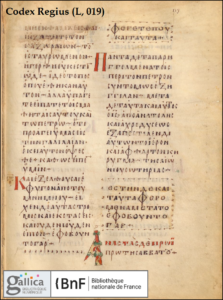
It clearly shows the text ends at verse 8, then there is a note that states “in some this appears”, then we have the shorter ending. After the shorter ending another note states that in others this also appears “Estin de kai tauta meta feromena.”. This is the manuscripts attestation to the two endings, the shorter and the longer, not the manuscript having a different ending.
044 (Ψ) Has the same note as L seen after the shorter ending. Unlike L it has no note at verse 8.
099 is a fragmentary manuscript. After Mark 16:8 there is a note that is no longer readable. This is followed by the shorter reading which in turn is then followed by most of verse 8 being rewritten which is immediately followed by verse 9 and the beginning of 10. The fragment is damaged from this point.
083 is another damaged fragment manuscript. It has the closing title of the Gospel of Mark at the end of verse 8. In the next column the text of the shorter ending can be found. The wording “there is also this appearing after ephobounto gar.” which appears after the shorter ending and before verse 9
L, Ψ and 083 share this note with Greek-Sahidic lectionary 1602.
Lectionary 1602 has Mark 16:8 finish at the bottom of a page. On the next page a note appears “In other copies this is not written.” The shorter ending then appears. So the note that some copies this is not written is directly linked to the shorter ending. Then comes the note shared by L and 083 which is then followed by the same repetition of the ending of verse 8 as found in 099 before the longer ending verses 9-20.
Below is an image of 1602 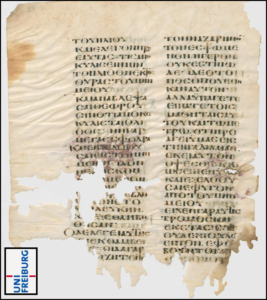
The notes in all these manuscripts did not all arise independently of one another, all are directly connected to one another.
Minuscule 274 has Mark 16:9 directly after mark 16:8. There is a single asterisk at Mark 16:8. The shorter ending in this manuscript actually appears at the bottom of the page alongside 5 asterisks, pointing clearly to the asterisk at verse 8, and so while the shorter ending is included in the manuscript, it appears more as a footnote than directly within the text itself.
579 is from the 1200’s and has the text of mark 16:8 followed by the shorter ending. The Longer ending Mark 16:9-20 then follows the shorter ending on the next page.
In ALL the manuscripts that have the shorter ending the longer ending either occurs in full or it is evident but missing through damage.
Mark 16:9-20 is missing from important Ethiopic codices
This claim, used by some, is simply the regurgitation of a statement made in a book by Metzger and Ehrman
“Mark 16:9-20 is omitted by important Ethiopic codices.” the text of the New Testament 4th edition p322 Metzger/Ehrman
This claim is yet again factually incorrect.
In 1980 Metzger himself stated that this “fact “ was inaccurate and was based on incorrect research conducted in the 1800’s.
Metzgers retraction can be found in chapter 9 of his book The Ending of the Gospel according to St. Mark in Ethiopic. Manuscripts.
“Previously published statements concerning the ending of the Gospel According to Mark in Ethiopic manuscripts are inadequate, confused and contradictory .”
“When the present writer (namely Metzger) made such a check, however, it turned out that the three manuscripts that are said to omit verses 9-20 in reality contain the passage.”
This retraction is also in the footnotes of A textual commentary on the Greek New testament (page 123).
“It has often been stated that three Ethiopic manuscripts, now in the British Museum, lack the last 12 verses of Mark. This statement, made originally by D.S. Margoliouth and reported by William Sanday, in his appendacies ad novum testamentum Stephanicum (Oxford 1889) p.195, is erroneous”
The 3 manuscripts in question ALL include the passage as do EVERY single known undamaged Ethiopic manuscript that contains the Gospel of Mark. Many Ethiopic manuscripts contain both endings. Metzger concluded that of 194 Ethiopic manuscripts that he consulted 131 included both endings.
Unfortunately, the original statement is still being circulated as factual by those that are unaware of the Metzgers later acknowledgement.
This just proves that if you simply regurgitate a supposed fact without actually studying whether or not that supposed fact is actually correct or not, you will end up with an understanding that is not based on fact but simply based on what you read. This makes you as incorrect as the fact you are regurgitating.
The Garima Gospels includes the longer ending of Mark. This manuscript previously thought to date to 1000Ad has now been dated to 430-540Ad.
It is not accurate to simply say that some Greek manuscripts bring into doubt the authority of the longer ending of Mark simply because they have an annotation at this point.
The evidence points heavily to the verses being part of the original text. The passage is evident in all lines of transmission except in a variant found only in Egypt. The longer ending of Mark was always in use as scripture in all other parts of the Roman empire. It is only in Egypt that we find the shorter ending. Outside of Egypt the longer reading was the only reading that was in use. It is therefore, very likely that this variant, the shorter ending, arose in Egypt and while it circulated in certain textual streams within Egypt the passage remained part of scripture that was utilised by all other areas and lines of transmission and later re-entered back into the transmission line in Egypt.
It would be my conclusion that these verses were removed in order to harmonise the Gospel of Matthew with Mark by a scribe that was unable to reconcile them with the ending of Mark included.
I am just going to finish on this note regarding the Armenian and Georgian manuscripts that are asserted by some to support the exclusion of the longer ending.
It is true that there are about 100 Armenian manuscripts that do not include the longer ending, as pointed out by Metzger, and the two oldest Georgian manuscripts do not include it either. BUT, there is more to the information that we need to be aware of. This is simply a one sided claim.
The information regarding these manuscripts comes from a 1930’s study by Ernest Cadman Colwell. There have been many Armenian manuscripts that have been discovered since this study.
There are in fact hundreds of Armenian manuscripts that do include the passage.
The Armenian manuscripts that exclude the longer ending all date from 897 AD – 913 AD.
Secondly, there are hundreds of Armenian manuscripts that include the verse. Even more have been found since this assertion was first made back in the 1930’s.
Thirdly, the Georgian text was translated using the Armenian text….Therefore, the Georgian is not a separate line of manuscript evidence they are simply an echo of the Armenian.
Importantly, around 440 Ad, Armenian writer Eznik of Golb used the contents of Mark 16:17-18 in his composition De Deo (also called Against the Sects) around 440. This is not long after the production of the Armenian version.
Internal evidence.
Mark makes mention in verse 16:7 that Jesus had instructed the woman to go to the disciples that he would meet them in Galilee
Mark 16:7 7But go your way, tell his disciples and Peter that he goeth before you into Galilee: there shall ye see him, as he said unto you.
Should Mark end at verse 8 as is asserted then what we have is Mark depicting the woman not in fact telling the disciples or anyone for that matter.
Mark 16:8 And they went out quickly, and fled from the sepulchre; for they trembled and were amazed: neither said they any thing to any man; for they were afraid.
Mark would not also record the meeting up of Jesus and his disciples as per verse 7.
Mark 16:7 But go your way, tell his disciples and Peter that he goeth before you into Galilee: there shall ye see him, as he said unto you.
Grammar
It is sometimes argued that the last 12 verses of Mark have many (16) non Markian words, i.e they are words that are used just once in the gospel of Mark. This argument was put forward by Metzger and has been repeated ever since.
Matt Slick of Carm.org states:
“What I will share next may not be very popular with some readers. Therefore, I need to say up front that I believe in the absolute inspiration and authority of the Bible. It is the word of God and what it says is authoritative. However, the simple fact is that there are textual variations within the biblical manuscripts. The originals are what are inspired – not the copies. We have copies of inspired documents. These copies are not perfect, but they are very close to it.
Again, I am not saying the Bible is untrustworthy. It is 98.5% textually pure. The remaining 1.5% of textual variation consists almost entirely of insignificant spelling errors and minor word omissions or additions that do not change the meaning of the text. However, Mark 16:9-20 is a significant textual variant. Many scholars, Christian scholars, consider the ending of Mark to lack authenticity. Please consider the following evidence.”
https://carm.org/doctrine-and-theology/baptism-and-mark-1616/
Matt then gives 3 points of evidence.
It is in point 3 he states
3) Vocabulary usage.
-
- There are 17 non-Marcan words used in a non-Marcan sense in these verses. In other words, in the last 11 verses under discussion, there are 17 “new” words that don’t occur in the entire gospel of Mark. It appears that someone wrote the ending of Mark and added it to the gospel because the style is different, and the vocabulary is different.
https://carm.org/doctrine-and-theology/baptism-and-mark-1616/
I shall just point out that the article on Matt Slicks site contains even less information than James Whites book.
Matt is simply regurgitating some information he found without even bothering to study it.
Bart Ehrman refers to this in his book Misquoting Jesus
“There is another problem with the Greek that makes the transition even more awkward); and there are a large number of words and phrases in the passage that are not found elsewhere in Mark. In short, the evidence is sufficient to convince nearly all textual scholars that these verses are an addition to Mark.”
Misquoting Jesus Bart Ehrman page 67
In 2019 a study by by Karim al-Hanifi showed that this argument is actually a non argument from the start. In his essay, The end of an argument on the ending of Mark, Karim al-Hanifi showed that when properly investigated non Markan words, or single use words, are found throughout the Gospel and at higher rate than in the last 12 verses of chapter 16.
If we divide the gospel of Mark into 12 verse segments starting at Mark 1:1 there are in fact 11 segments of 12 verses that contain more than 16 once used words. The highest being 24 in 15:37-16:1
1) 15:37-16:1: 24
2) 15:13-24: 23
3) 7:17-28: 21
3) 13:14-25: 21
4) 13:38-14:12:
5) 12:34-13:1:
5) 14:37-48:
6) 2:16-27:
6) 16:9-20:
There is nothing unique bout the unique words in this passage. Mark 16:9-20 doesn’t even get on the podium.
Furthermore, there is evidence, in a study by George Salmon that the language of Mark 16:9-20 IS very much Markan.
Let’s look at some specifics stated in these verses
Mark 16:11 And they, when they had heard that he was alive,
and had been seen of her, believed not.
Mark 16:13-14 And they went and told it unto the residue: neither believed they them.
Afterward he appeared unto the eleven as they sat at meat,
and upbraided them with their unbelief and hardness of heart,
because they believed not them which had seen him after he was risen.
So we see a number of references to unbelief, not believing and hardness of heart.
This is actually found numerous times within Marks Gospel.
Mark 3:5 And when he had looked round about on them with anger,
being grieved for the hardness of their hearts,
he saith unto the man, Stretch forth thine hand.
And he stretched it out: and his hand was restored whole as the other.
Mark 6:6 And he marvelled because of their unbelief.
And he went round about the villages, teaching.
Mark 6:52 For they considered not the miracle of the loaves:
for their heart was hardened.
It seems to me also that the hand of the writer of the concluding verses is to be found elsewhere in the Gospel.Three times in these concluding verses attention is called to the surprising slowness of the disciples to believe the evidence offered them (vv. 11, 13, 14). Now, you will find that the thought is constantly present to the mind of the second Evangelist, how slow of heart were the beholders of our Lord’s miracles; how stubborn the unbelief which the evidence of these miracles was obliged to conquer. Thus, in the account of the healing of the man with the withered hand (common to the three Synoptics), Mark alone relates (iii. 5) that before commanding the man to stretch forth his hand our Lord looked round on the bystanders ‘with anger, being grieved for the hardness of their hearts.’ Again, in Mark vi. 6 there is a note special to this Evangelist: ‘Jesus marvelled because of their unbelief.’ And in the history of the tempest on the lake of Gennesaret, told both by Matthew and Mark, there is a noticeable difference between the two accounts. Where Matthew (xiv. 33) tells of the conviction effected by the miracle in those who beheld it, Mark (vi. 52) has instead an expression of surprise at the stupidity and hardness of heart of those who had not sooner recognized our Lord’s true character.
A Historical Introduction to the Study of the Books of the New Testament … – George Salmon – Google Books
A further internal argument that has been postulated by Bill Wortman
Introduction
This section of the evidence does not attempt to offer a decisive or standalone proof of authenticity. Rather, it presents an internal literary argument — one that considers Mark’s structure, narrative design, and thematic symmetry. It is offered as a complementary consideration, strengthening the cumulative case for the authenticity of Mark 16:9–20.
1. Ancient Structure Without Chapters and Verses
The original Gospel manuscripts were not written with chapter and verse divisions. They were composed in continuous script. Yet ancient authors still structured their works deliberately.
In modern music, we recognize verses and choruses. In ancient narrative, structure appears through:
-
Repeated motifs
-
Framing devices
-
Thematic parallels
-
Narrative symmetry
Mark’s Gospel exhibits precisely this kind of literary intentionality.
2. Six Proclamation Movements in Mark
A striking pattern emerges when examining the Gospel’s larger movements. Mark appears to divide his narrative into six proclamation-centered sections.
Section 1 — The Announcement Begins
Mark 1:1 (KJV)
“The beginning of the gospel of Jesus Christ, the Son of God.”
John the Baptist is sent to proclaim (Mark 1:2–4).
This first movement closes with:
Mark 1:29–34 (KJV)
Jesus heals in the synagogue setting;
He takes Peter’s mother-in-law “by the hand” (v. 31);
Devils are cast out and “suffered not the devils to speak” (v. 34).
Notice the pattern:
-
Synagogue
-
Taking by the hand
-
Healing
-
Silencing spirits
Section 2 — Proclamation Expands
Mark 1:38 (KJV)
“Let us go into the next towns, that I may preach there also.”
This section closes in Mark 3 with:
-
Synagogue setting (3:1)
-
Healing of a withered hand (3:5)
-
Spirits restrained (3:12)
The same refrain-like elements reappear.
Section 3 — The Twelve Sent
Mark 3:14 (KJV)
“And he ordained twelve, that they should be with him, and that he might send them forth to preach.”
This movement culminates in Mark 5:
Mark 5:41–43 (KJV)
He takes the damsel “by the hand” (v. 41),
Raises her,
Commands that it be kept quiet (v. 43).
Again:
-
Synagogue ruler involved (5:22)
-
Taking by the hand
-
Healing
-
Silence
These recurring features act as structural closures.
Sections 4–6: The Intensified Mission and Its Climactic Closure
If Sections 1–3 are marked by proclamation and sending, Sections 4–6 show an intensification of that mission — particularly through the repeated pattern of sending two disciples and the movement toward Jerusalem and final authority.
Section 4 — Mission Sent Two by Two (Mark 6–9)
Opening: Paired Sending Introduced
Mark 6:7 (KJV)
“And he called unto him the twelve, and began to send them forth by two and two…”
Here the mission shifts in form.
Earlier sections showed:
-
John proclaiming
-
Jesus proclaiming
-
The Twelve appointed
Now the Twelve are sent in pairs.
This marks a structural development. The proclamation is no longer centered only in Jesus’ own movement — it is extended outward in organized mission form.
The paired sending introduces a new stage in the Gospel’s proclamation theme.
Closing: Seated Instruction and Authority
Mark 9:35 (KJV)
“And he sat down, and called the twelve…”
The section closes with Jesus seated, teaching authoritatively about discipleship and service.
The pattern is:
Opening: Mission sent.
Closing: Authority defined.
The proclamation theme continues, but now clarified under Jesus’ authority.
Section 5 — Journey Toward Jerusalem (Mark 10–13)
Opening: Major Narrative Transition
Mark 10:1 (KJV)
“And he arose from thence, and cometh into the coasts of Judaea… and, as he was wont, he taught them again.”
This verse functions as a major structural hinge:
-
Geographic shift
-
Movement toward Jerusalem
-
Renewed emphasis on teaching
Shortly after, the paired-sending pattern continues:
Mark 11:1 (KJV)
“And he sendeth forth two of his disciples…”
Again, two disciples are sent — now in preparation for the Triumphal Entry into Jerusalem.
The proclamation movement is now focused on the royal city.
Closing: Seated Prophetic Authority
Mark 13:3 (KJV)
“And as he sat upon the mount of Olives…”
Once again, Jesus is seated — delivering the Olivet discourse.
This section closes not merely with action, but with prophetic authority and eschatological teaching.
The pattern holds:
Opening: Movement toward Jerusalem and paired sending.
Closing: Seated prophetic authority.
Section 6 — The Passion and Final Fulfillment (Mark 14–16)
Opening: The Plot Introduced and Paired Sending Continues
Mark 14:1 (KJV)
“After two days was the feast of the passover… and the chief priests and the scribes sought how they might take him by craft, and put him to death.”
The narrative tension is introduced clearly: arrest and death are intended.
Shortly after:
Mark 14:13 (KJV)
“And he sendeth forth two of his disciples…”
For the third time in these latter sections, two disciples are sent.
The pattern of paired mission remains intact even as the Passion unfolds.
Closing (If Ending at 16:8)
Mark 16:8 (KJV)
“And they went out quickly, and fled from the sepulchre… for they were afraid.”
If the Gospel ends here:
-
No appearance
-
No renewed commission
-
No seated enthronement
-
No narrative resolution
The proclamation trajectory stops in fear.
Closing (With Mark 16:9–20)
Mark 16:14 (KJV)
“Afterward he appeared unto the eleven as they sat at meat…”
Mark 16:15 (KJV)
“Go ye into all the world, and preach the gospel to every creature.”
Mark 16:19 (KJV)
“So then after the Lord had spoken unto them, he was received up into heaven, and sat on the right hand of God.”
Now the structural elements resolve:
Opening: Paired sending continues.
Closing: Universal commission given.
Climax: Jesus seated at the right hand of God.
The seated motif that closed Sections 4 and 5 now reaches its highest expression — not seated to teach, but seated to reign.
The proclamation theme reaches its universal expansion.
Section 6 — The Final Movement (Mark 14–16)
Mark 14 introduces the plot:
Mark 14:1 (KJV)
“The chief priests and the scribes sought how they might take him by craft, and put him to death.”
From here, Mark presents a narrative sequence:
Arrest (Fulfillment of Intent)
-
Bethany (14:3)
-
The city (14:13)
-
Gethsemane (14:32)
-
Jesus arrested (14:46)
Death (Fulfillment of Intent)
-
Before the high priest (14:53)
-
Before Pilate (15:1)
-
Golgotha (15:22)
-
Jesus dies (15:37)
Reversal (Overcoming the Intent)
-
Tomb before Sabbath (15:42–47)
-
Tomb after Sabbath (16:1–6)
-
Exaltation
Theological and Narrative Completion
Last but not least it is VERY likely that Paul quotes Mark 16:15 in Colossians
Colossians 1:23 If ye continue in the faith grounded and settled, and be not moved away from the hope of the gospel, which ye have heard, and which was preached to every creature which is under heaven; whereof I Paul am made a minister;
Mark 16:15 And he said unto them, Go ye into all the world, and preach the gospel to every creature.
Paul states that the gospel was preached to every creature which is the instruction of Jesus in Mark 16:15.
A counter argument is that Paul actually used Mark 13:10
Mark 13:10 And the gospel must first be published among all nations.
This argument fails based on the vocabulary that Paul uses.
Paul uses the words πάσῃ κτίσει pase ktesei. ( all creation)
ἴγε ἐπιμένετε τῇ πίστει τεθεμελιωμένοι καὶ ἑδραῖοι καὶ μὴ μετακινούμενοι ἀπὸ τῆς ἐλπίδος τοῦ εὐαγγελίου οὗ ἠκούσατε τοῦ κηρυχθέντος ἐν πάσῃ τῇ κτίσει τῇ ὑπὸ τὸν οὐρανόν οὗ ἐγενόμην ἐγὼ Παῦλος διάκονος
This is the same vocabulary used in Mark 16:15
καὶ εἶπεν αὐτοῖς Πορευθέντες εἰς τὸν κόσμον ἅπαντα κηρύξατε τὸ εὐαγγέλιον πάσῃ τῇ κτίσει
Mark uses Pase ktesei in this verse.
However, when we look at Mark 13:10 Mark uses Panta ethne (all nations)
καὶ εἰς πάντα τὰ ἔθνη δεῖ πρῶτον κηρυχθῆναι τὸ εὐαγγέλιον
Based on vocabulary it is far more likely that Paul is utilising Mark 16:15 than 13:10.
There are many reasons that have been put forward as to why Mark would end his Gospel like this……none can be substantiated beyond conjecture.
Without the longer ending of Mark the Gospel contains no resurrection of Jesus. While of course, we have accounts elsewhere in the Bible is it really possible that a Gospel account would not contain an account of the resurrection? What if someone only had access to the Gospel of Mark, they would not find the resurrection within its texts. It is only after the books were correlated into what we now call the New Testament would the resurrection be stated.
Paul stated that the resurrection was part of the Gospel of Jesus Christ.
1 Corinthians 15:1 Moreover, brethren, I declare unto you the gospel which I preached unto you, which also ye have received, and wherein ye stand; 2 By which also ye are saved, if ye keep in memory what I preached unto you, unless ye have believed in vain. 3 For I delivered unto you first of all that which I also received, how that Christ died for our sins according to the scriptures; 4 And that he was buried, and that he rose again the third day according to the scriptures:
Further internal evidence can be found in Acts chapter 10 when Peter is addressing the gentiles.
Church history would assert that the Gospel of Mark is, in fact, the memoirs, or teachings of Peter, that Mark wrote down and Peter, himself, approved of.
In his address to the Gentiles in Acts 10 Peter first speaks of the word which he is telling them, that began after the Baptism of Christ. Christ then went about doing good and healing the oppressed. Peter then refers to the crucifixion of Jesus and then his resurrection from the dead, where certain people were witness to this fact. Peter also states that remission of sins is for those that believe.
Acts 10: 34Then Peter opened his mouth, and said, Of a truth I perceive that God is no respecter of persons: 35But in every nation he that feareth him, and worketh righteousness, is accepted with him. 36The word which God sent unto the children of Israel, preaching peace by Jesus Christ: (he is Lord of all:) 37That word, I say, ye know, which was published throughout all Judaea, and began from Galilee, after the baptism which John preached; 38How God anointed Jesus of Nazareth with the Holy Ghost and with power: who went about doing good, and healing all that were oppressed of the devil; for God was with him. 39And we are witnesses of all things which he did both in the land of the Jews, and in Jerusalem; whom they slew and hanged on a tree: 40Him God raised up the third day, and shewed him openly; 41Not to all the people, but unto witnesses chosen before of God, even to us, who did eat and drink with him after he rose from the dead. 42And he commanded us to preach unto the people, and to testify that it is he which was ordained of God to be the Judge of quick and dead. 43To him give all the prophets witness, that through his name whosoever believeth in him shall receive remission of sins.
Thus, for Peter the word preached starts at the Baptism, includes the good works and healings of Jesus, the death and then resurrection of Christ which was witnessed to and an explicit mention of belief.
When we look at Marks Gospel we see that it starts at the Baptism of Christ, (Mark 1), includes the good works and healings performed by Jesus, includes the death of Jesus upon the cross (Mark 15) and then concludes in chapter 16:9- with the resurrection of Jesus and this being witnessed to. In this chapter of Marks Gospel there is also an emphasis on the requirement for belief. Which also is supported by the works of George Salmon and the Markan wording of this chapter.
This online may also be noted in Acts chapter 1. Peter stood up and spoke amongst the disciples. In this he outlines the parameters as the Baptism unto the ascension (the ascension found in Mark 16:19) Peter also refers here to the resurrection.
Acts 1: 21 Wherefore of these men which have companied with us all the time that the Lord Jesus went in and out among us, 22 Beginning from the baptism of John, unto that same day that he was taken up from us, must one be ordained to be a witness with us of his resurrection.
Thus here we see baptism to ascension (Mark chapter 1 – Mark chapter 16)
If the Longer ending of Mark is scripture, then this would align with both Acts 1 and 10 and also 1 Corinthians 15.
Gnosticism
It should be noted that the gnostic Gospels do not contain an account of the resurrection. The possibility of gnostic influence on the Gospel of Mark should not be ignored, especially when taking into account the form and location of the text of the two Greek manuscripts that omit the longer ending.
A gospel without the resurrection is not a gospel.
What has been included here as Evidence for the inclusion is not, in fact, all that could have been cited but for sake of length I have not included the lectionary or full patristic evidence (I am happy to go into more detail if anyone should require such).
Regardless of your stance on the KJV, if we believe the Bible to be the inherent word of God, then not only is there more than enough evidence to be confident that the words recorded in Mark 16:9-20 are genuine, inspired and belong in our Bibles as scripture without need for doubt just as the KJV would assert, the evidence is overwhelming for its authenticity.
The reality is that the rejection of the Longer ending of Mark is almost entirely down to the witness of Vaticanus and Sinaticus.
I hope the information provided has been of help.
If you liked this study please subscribe here
Join our Patreon membership here
here
0 Comments