Vowel pointing before the Masoretes
The Masoretes added the vowel pointing to the Hebrew Consonantal text somewhere between the years 700AD-1000AD, the exact dates are not known.
Like me, I am sure you have heard this claim before. While the dates may vary, some claim the dates could be as early as 500AD, the claim remains the same. Before the Masoretes invented and added the vowel pointing to the Hebrew text, the biblical Hebrew text was written only in consonant form. The vowel sounds were not written down but rather passed on through oral tradition. The vowels were not part of the original written text.
I took these claims as truth, without question. Maybe, just like me, you did also. But how accurate are these claims? What is the evidence for the claims and how reliable is it?
In this study we will seek to answer these questions and more.
What is the Masorah? The Masorah comprises the accent/vowel system (Tiberian points and ṭeʿamim), plus micro- and macro-notes that preserve spelling counts, unusual forms, and reading traditions. It is a guardian apparatus for the consonantal text, not a rewriting of that text. The best-preserved witnesses to Tiberian Masorah are the Aleppo Codex (c. 930 CE) and Leningrad B19A (1008 CE).
The brief Masoretic annotations that run along the side margins of a manuscript are called the Masorah Parva (Mp). The longer, fuller annotations placed at the top and bottom margins are the Masorah Magna (Mm). Each major Hebrew manuscript carries its own Masorah—its own curated set of these notes—so the wording and coverage can vary from codex to codex.
Not everyone holds to the view that the vowel pointings were added by the Masoretes, there are many, especially in the Jewish scholarly community that believe that the vowel pointing was given at Mount Sinai some believe that they were formalised by the men of the Great Synagogue gathered by Ezra the priest after the Babylonian captivity.
The truth is that while there are no vowels actually written in the Torah, it is not accurate to say that the Torah has no vowels. Although the vowels, or nekudot, were never actually marked in the Torah itself, the nekudot are of divine origin just as the letters are. The nekudot were given by G‑d to Moses on Mount Sinai and were passed down orally from leader to leader as part of the Oral Torah, until they reached Ezra the Scribe, who revealed and taught them to the Jewish nation. Up until that point, Hebrew was never written down with vowels.
https://www.chabad.org/library/article_cdo/aid/3087993/jewish/Why-No-Vowels-in-the-Torah.htm
Evidence
The first pieces of evidence we must look at are the Dead sea scrolls and the Leningrad and Aleppo codices.
The Aleppo codex, which, until it went missing after a fire in 1947 of the Synagogue of Aleppo where it was housed before being found 1958 was the oldest (nearly) complete Hebrew manuscript of the Old Testament, dates to around 930AD. Roughly 40% of the manuscript is missing today. The Leningrad codex, which is now the oldest nearly complete manuscript that we have of the Hebrew Old Testament, dates to around 1008 AD.

The Aleppo Codex Joshua 1:1
Both of these manuscripts are considered “Masoretic” meaning they contain vowel pointing within the text. The vowels are written in the manuscripts text along with the consonants.
However, the dead sea scrolls, which date to around 1000-800 years before these two manuscripts, contain a Hebrew text that does not include any vowel pointings at all. The text of the dead sea scrolls is a Hebrew consonant only text. The dead sea scrolls have dates generally accepted as being between the 3rd Century BC- 2nd century AD.
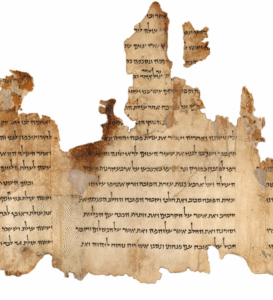
Dead Sea scroll Temple Scroll
This of course, supports the assertion that the vowel pointing was added at a later date. The Hebrew text without vowel pointing was in use long before we see any physical evidence with the vowel pointing included.
While this is evidence, it is not all the evidence that we have available. We should not assume that just because we hold to a belief that this belief is accurate without first investigating it in light of all the evidence available.
We should note that while the Dead Sea Scrolls are fully consonantal, they make heavy use of matres lectionis (yod, waw, he) as vowel letters and show regular word-spacing. This demonstrates a developed orthographic strategy for representing vowels long before the Masoretes, even though the diacritic pointing system familiar today is not attested in the DSS. It must be understood that the reading aids within the DSS are not comparable to the full “Masoretic” diacritic system.
What are Matres Lectionis?
The term matres lectionis (Latin for “mothers of reading”) refers to the use of certain consonant letters—primarily א (ʾalef), ה (he), ו (waw), and י (yod)—to indicate vowel sounds in Hebrew writing.
-
Yod (י) often indicates /iː/ or /eː/ (e.g., בית = bayit, “house”).
-
Waw (ו) indicates /oː/ or /uː/ (e.g., קול = qol, “voice”).
-
He (ה) is sometimes used at word-final position for an /aː/ sound.
-
Alef (א) can function as a vowel carrier in some positions (especially medial or final).
These consonantal “vowel letters” emerged in First Temple times but became increasingly common in later Hebrew texts.
Matres Lectionis in the Dead Sea Scrolls: General Features
The DSS (3rd century BCE – 1st century CE) show a more liberal and consistent use of matres lectionis than earlier biblical manuscripts, but still less systematized than the medieval Masoretic pointing system.
Key observations from Emanuel Tov and others:
-
The Qumran scribes expanded the use of matres beyond what is typically seen in the traditional Masoretic Text (MT).
-
Their spelling system often reflects actual pronunciation more transparently than the MT, which preserves older, more conservative orthography.
-
Some scrolls even show attempts at fuller, more phonetic spellings, sometimes called “Qumran orthography.”
-
א (ʾalef) sometimes acted as a vowel carrier,
-
ה (he) was often added at the end of words to show an “a” sound,
-
ו (waw) showed “o” or “u” sounds,
-
י (yod) showed “i” or “e” sounds.
Examples
Here are a few illustrative examples comparing MT and DSS spellings:
| Word | Masoretic Text (Consonantal) | DSS Orthography | Notes |
|---|---|---|---|
| דבר (dbr, “word”) | דבר | דבור | Waw is added to indicate /oː/ |
| מלך (mlk, “king”) | מלך | מליך | Yod indicates /iː/ vowel |
| עבד (ʿbd, “servant”) | עבד | עובד | Initial waw shows /o/ sound |
| אלהים (ʾlhym, “God”) | אלהים | אלוהים | Fuller spelling with waw for /oː/ |
Example: In 1QIsaᵃ (the Great Isaiah Scroll), words like שלום (šālôm) often appear with waw consistently, whereas MT sometimes writes them defectively or haser. (שלם).
Variability Within the Scrolls
Not all DSS manuscripts use matres lectionis the same way. Scholars usually distinguish three broad spelling traditions:
-
Conservative / “Proto-MT”: Close to MT, using matres sparingly.
-
Qumran Practice / “Full Spelling”: Expansive, phonetic, frequent use of waw and yod.
-
Mixed / Intermediate: Somewhere between these two extremes.
This variability reflects different scribal schools or geographical traditions.
Interestingly, we actually have some Hebrew manuscripts of a much later date than the DSS that are not complete Old Testaments, but are worthy of noting as they provide us with evidence in this particular matter.
There is a scroll of Genesis, Taylor-Schechter NS 1.3, dated to around the year 900AD. This Hebrew manuscript does not contain vowel pointing. This manuscript is housed at the Cambridge UL, Taylor-Schechter Genizah collection.
If it is accurate that the Masoretes started to produce the vowel pointing from the 700’s AD (maybe even before this) then this would demonstrate to us that even after the supposed invention of the vowel pointing, Hebrew manuscripts were being produced that did not include vowel pointings.
This complicates the standard narrative. If Hebrew consonant only manuscripts were being produced after the vowel pointings were invented, then the dead sea scrolls not containing vowel pointing would not necessarily prove that vowel pointing did not exist at that time. All this would suffice to prove is that the consonant only hebrew text existed at this time, it would not necessitate that a consonant only text was the only text in existence, as we have clear evidence that while a vowel pointing text was in existence, so too was a consonant only text, they clearly coexisted together at the same time.
While we could not definitively prove that vowel pointings were in existence in manuscript form at the time the dead sea scrolls were produced as we have no hard physical evidence to make such a claim, based on manuscript Taylor-Schechter NS 1.3, it could not be categorically ruled out as a possibility.
It should now be noted that the majority of Hebrew writings today are not written using vowel pointings.
As with many early Semitic alphabets, one who is fluent in Hebrew can, for the most part, read it without vowels, which is why even nowadays the overwhelming majority of Hebrew literature is written without vowels.
https://www.chabad.org/library/article_cdo/aid/3087993/jewish/Why-No-Vowels-in-the-Torah.htm
This of course, does not in any way prove that vowel pointings do not exist in the 21st Century, it only goes to show that writings and documents can exist in a time when vowel pointings are proven to exist and no logical and evidential contestation about their existence based on texts that exclude them can be made. It is simply a fact that texts without vowel pointings can and do exist in a time, where, vowel pointings exist.
Here, I will make note of a manuscript, Codex Hillel that does not exist today but we have historical attestation to its existence. It has either been lost, destroyed or has simply disintegrated over time. While we cannot confirm the claim beyond the claim it is at least a historical piece of recorded evidence that should be taken into account.
Codex Hillel was a manuscript supposedly produced in the 6th Century AD that included the vowel pointing. The Braginsky Pentateuch manuscript produced in the first half of the 14th Century in Spain was supposedly copied from the Hillel codex. It is not hard evidence due to its nonexistence and is only attested to having existed by later writers.
Around 1500 Abraham Zacuto (1452–ca. 1515), astronomer to Kings John II and Manuel I of Portugal, wrote in his Sefer ha-Yuhasin (Book of Family Relations): “On … [14 August 1197] there was a great persecution of the Jews in the kingdom of Léon at the hand of the two kingdoms that came to besiege it. At that time they removed from there the 24 holy books that were written some 600 years before. They were writ- ten by R. Hillel ben Moses ben Hillel, and his name was given to the codex, which was called ‘Hilleli.’ It was extremely correct and all other codices were revised after it. I saw the remaining two parts of it, containing the Former and Latter Prophets, written in large and beautiful characters. These had been brought by the exiles to Portugal and sold at Bugia in Africa, where they still are, having been written about 900 years ago. [David] Kimhi in his grammar on Numbers 10:4, says that the Pentateuch of the Hillel Codex was extant in Toledo.”
https://braginskycollection.com/p3 sortfolio/pentateuch-based-on-the-hillel-codex/
Now, taking that one bit of evidence as a starting point, we must now look and see if there is any other evidence that could help us with this investigation.
So we should start with the claim itself, that the Masoretes were responsible for the invention and inclusion of the vowel pointings. What actual evidence is there for this claim?
From what I can find, the first person to make this claim, or at least the first we have recorded having made the claim that the vowel pointings did not originate at Mount Sinai but rather were the creation of the Masoretes in Tiberias, is rabbi Ibn Ezra in the 12th Century. (If this is shown inaccurate at any time I will update this writing).
1. Ibn Ezra, Yesod Mora ve-Sod ha-Torah (Foundation of Reverence and the Secret of the Torah)
-
Chapter 1 (or §1 in some editions) — He explicitly says that the vowel points (niqqudot) and accents (ṭeʿamim) are not from Sinai but were invented by the sages of Tiberias.
“Know that the vowel points and accents were not given to Moses on Sinai. Rather, the wise men of Tiberias invented them, and their tradition spread throughout Israel.”
Citation:
-
Ibn Ezra, Yesod Mora ve-Sod ha-Torah, ed. & trans. I. Last (Berlin, 1840), p. 8.
-
Also in the standard Mikraot Gedolot commentary collections.
2. Ibn Ezra, Commentary on Exodus 25:31
-
Here Ibn Ezra again affirms that the accents (ṭeʿamim) are post-Sinaitic and man-made:
“The accents were not from Sinai, but the sages of Tiberias made them, and they were accepted by all Israel.”
Citation:
-
Ibn Ezra, Commentary on Exodus 25:31, in Perush R. Avraham Ibn Ezra al ha-Torah, ed. Asher Weiser (Jerusalem: Mossad Harav Kook, 1977), vol. 2, p. 283.
3. Ibn Ezra, Commentary on Deuteronomy 3:11 (and elsewhere)
He sometimes makes passing remarks denying that vowels/accents are “divine”:
“The vowels are signs added later, they are not from Moses.”
Citation:
-
Ibn Ezra, Commentary on Deuteronomy 3:11, ed. Weiser (Jerusalem: Mossad Harav Kook), vol. 5, p. 29.
Rabbi Ibn Ezra was a Jewish scholar who was born in Tudela, Spain, lived from around 1092-1164 AD.
It must be noted this does not mean that Rabbi Ibn Ezra was the first to speak about the vowel pointings, only that he is the first to assert the origins of the pointings were attributed to the Masoretes in Tiberias.
Prior to this there were discussions regarding whether or not vowel pointings were allowed to be put in a Torah scroll.
Natronai II ben Hilai the Gaon of Sura in the 9th Century AD stated:
“…since the law, as give to Moses on Sinai, had no points, and…having been invented by the sages, and put down as signs for the reader; and moreover since it is prohibited to us to make any additions from our own cogitations, lest we transgress the command ‘Ye shall not add’…; hence we must not put points to the Scrolls of the Law.”
MACHZOR VITRY in the 12th Century stated:
“In the [unspecified] Teshuvot ha-Geonim… the Torah that was given to Moses at Sinai did not contain nekkudot, and in fact the nekkudot were not even given at Sinai. . . therefore we do not place nekkudot in the sefer Torah.
Later Jewish scholars challenged this view
R. Azaria dei Rossi in the 16th Century, for example addressed Eliyahu Bachur and hiis claims that the vowel pointings were not given given at Sinai.
Thus, Bachur’s view is patently undermined since we have intimations to prove that the different kind of vowels and accents were in existence not only before the close of the Gemara, but even before the composition of the Mishnah.
And if he were with us today, he would certainly submit to our view.
Me’or Enayim, R. Azariah di Rossi, Warsaw 1899 p. 413.
The idea of the Masoretes being the ones who invented the vowel pointing was made popular in the 16th Century by Elias Levita a Hebrew grammarian in his work Massoreth ha-Massoreth. He claimed thar the Masoretes created the vowel pointing in the 5th Century AD after the Babylonian Talmud was completed . Many Jews were opposed to this view, claiming that the vowel pointings were much more ancient than what Elias was postulating.
“the Targumists most unquestionably wrote their paraphrases without points, which had not then been invented … the most ancient codices are all without the points; for the Massorites, who pointed the Hebrew Scriptures, did not point the Chaldee paraphrases. These were pointed much later, by one or more individuals…”
(Ginsburg 1867, pp. 69)
Today, most scholars hold that the Tiberian pointing system was devised and standardized by Masoretes in Tiberias (7th–9th c.) as a graphic codification of an older oral reading, not specifically an invention of “vowels” ex nihilo.
Vowel pointings before the Masoretes?
So now we must look and see if there is any historical evidence for vowel pointing being in existence prior to the Masoretes.
Firstly, it goes without saying, although I think people forget it, or do not take it into consideration, that even if the vowel pointing was not within the written text itself was not invented until the Masoretes, the vowel sounds within the spoken word most certainly did. Jews were not speaking the words in consonants only. They may have read a consonant only text, but when they vocalised it they certainly spoke the words with the vowels.
This obviously demonstrates that the words were understood and recognisable within an oral transmission of the text, which would have had to have existed at the time of the writing of the text or otherwise it would have been unreadable.
The vowels, even if they had not been written would have been known. Thus the Masoretes did not invent the vowels, they can only be responsible for creating the writing system that included the vowels within the written text.
This I think is sometimes forgotten or maybe better, not taken into thought when claiming the Masoretes added the vowel points, especially by those that use this to argue that the Masoretic text has been corrupted.
Now, having said that, there is evidence that the vowel pointing of the Hebrew Text in a written form did exist prior to the Masoretes.
We have Talmudic writings that preceded the Masoretes that discussed the vowel pointings. We should ask as to how there would be discussions of such kind,if they did not exist until after the Talmud was completed.
From where the translation? Rebbi Ze`ira in the name of Rav Ḥananel: They read in the Scroll of the Torah, that is the reading. Explained, that is the translation. Making sense, these are the accents. And understood the reading, this is the Masora, and some say, these are the decisions, and some say, these are the starts of verses.
Megilah 4.1:
Dated to around 350-400 AD
Granted, according to the one who says that the payment is for teaching punctuation of the text with cantillation notes, this is the reason that he shall not teach him Bible, as teaching punctuation is a component of teaching the biblical text.
Nedarim
around 300AD
Rabbi Yudan said: From here there is a source from the Torah for translations [of the Torah]. That is what is written: “They read in the scroll of the Torah of God, [explicated, providing insight, and they elucidated the reading]” (Nehemiah 8:8). “They read in the scroll of the Torah of God” – this is the biblical text itself; “explicated” – this refers to translation; “providing insight” – this refers to the cantillation notes; “and they elucidated the reading” – this refers to [the demarcation of the] beginnings of the verses. Rabbi Huna ben Luleyani says: This refers to the delineation [of verses] and proofs. The Rabbis of Caesarea said: From here, the [concept of the] Masoret is derived.
Bereshit Rabbah 36:8
300-500AD
The writing may have a date that could be dated as late as 500AD, which is still prior to the Masoretes, but the quote is attributed to Rabbi Yadan who lived in the 4th Century.
“They said to him [elav]: Where is Sarah your wife?” The letters alef, yod, vav are dotted; lamed is not dotted. Rabbi Shimon ben Elazar said: Wherever you find the number of undotted letters greater than the number of dotted letters, one expounds the undotted letters. If the number of dotted letters is greater than the number of undotted letters, one expounds the dotted letters. Here, where the number of dotted letters is greater than the number of undotted letters, one expounds the dotted letters, [which spell out]: ‘Where is he [ayo] – Abraham?’ Rabbi Azarya said: Just as they said [to Abraham]: “Where is Sarah?” so they said to Sarah: ‘Where is Abraham?’
Bereshit Rabbah 48:15
This quotation is said to have been made by Shimon ben Elazer, which would date the actual quote to the 2nd Century.
The puncta extraordinaria (dotted letters) attested to here are not vowel points; they’re a different, older scribal phenomenon but they show that graphic conventions marking interpretation predate the Masoretic dots.
“They gave their father wine…[and when she arose [uvkuma]]” – there is a dot over the vav of uvkuma, [intimating] that when she lay he was not aware, but when she arose he was aware.
Bereshit Rabbah 51:8
This text is not attributed to any particular Rabbi, thus can only be dated to the writing of Bereshit Rabbah between 300-500AD.
“Not one letter is able to signify one thing or another without the points. All the letters without the points, are like the body without the soul; when the points come, then the body stands in its station.”
“Rav Ḥisda raises a dilemma: This verse, how is it written, i.e., how should it be understood? Should the following verse be read as two separate halves, with the first part consisting of: “And he sent the young men of the children of Israel, and they sacrificed burnt-offerings” (Exodus 24:5), which were sheep; and the second part consisting of the rest of the verse: “And they sacrificed peace-offerings of bulls to the Lord,” i.e., these peace-offerings alone were bulls? Or perhaps both of these were bulls, as the term: “Bulls,” refers both to the burnt-offerings and the peace-offerings. The Gemara asks: What is the practical difference between the two readings?Mar Zutra said: The practical difference is with regard to the punctuation of the cantillation notes,” (Tractate Chagigah, 6b.13)
So there are allusions to the vowels of the Hebrew text that existed prior to the time when it is claimed that they became part of the Hebrew text.
These statements could only exist if the Hebrew text already had some sort of vowel pointing, whether this be in a “proto” Masoretic form which the Masoretes simply solidified and updated or whether it was in a state that is attributed to the Masoretes is not something that can be demonstrated in any certain way. What does seem certain is that the vowels in some sort of a written form existed prior to the Masoretes.
Origen’s Hexapla (3rd c.) records a Hebrew text and a transliteration into Greek letters (the Secunda) that mirrors Hebrew pronunciation, indicating a stable oral vocalization tradition centuries before the Masoretic dots were standardized. It could also be witness to a Hebrew text that contained vowel pointing as the Greek transliteration contained Greek vowels, though this in no way can be used as proof it simply offers a possibility.
For accessible overviews of Masoretic notes that cite older vocalized manuscripts (e.g., Jericho, Hillel), see Yeivin and Dotan.”
In his book Evidences for the Inspiration of the Hebrew Vowel Points, Thomas D Ross states that there are pointed manuscripts that the Masoretes appealed to in their Masorah.
“the
Masoretic note on Genesis 2:3 explicitly states that the Hebrew text follows the
vocalization of the ancient and now lost Jericho manuscript (Ngnm wjyryk Nk). The note
on Exodus 18:10 mentions that the same MS had the accent revi (oybr . . . wjyry).Leviticus 8:13 demonstrates that the Jericho MS had the vowel shewa, and Leviticus
10:13; 21:10 that it had the accent gaya (ayogb . . . wjyryb). Leviticus 25:11 comments
on its use of zaquef qaton ($ ). Leviticus 26:21 comments on the sound, musical phrase,
or accent in the MS (Mynwgn . . . wjyryb). Numbers 4:4 and 10:21 demonstrate that
Jericho contained the hateph qametz, Genesis 28:3 and Numbers 16:21 the tsere (yryx . .
. wjyryb), and Numbers 34:28 the pathach (htp . . . wjyryb). The note on Deuteronomy
25:7 even indicates that the Jericho MS had the accent geresh (% ) on the final syllable of
the word rather than on the antepenult (h∂rVo%AÚvAh), as in the reading within the text of
Scripture itself (orlm . . . wjyry). Deuteronomy 30:17 explicitly states that the Jericho
MS contained the points (wjyryb . . . Ngwnm).
The note on Exodus 21:37 indicates that bDnVgIy was the vocalization contained in
the ancient and now lost Hillel and Zanbuqi MSS (yqwbnzbw yllhb . . . bDnVgIy). If the
Hillel MS dates to the time of R. Hillel (c. 60 B. C. – A. D. 20), “the great Jewish Rabbi
who lived immediately before the beginning of the Christian era,”87 the Masorah here
affirm that the vowels were extant in pre-Christian times. Exodus 30:14 proves that the
Hillel MS had the tsere (yrxb . . . yllhb”
Page 24
He gives many more examples.
Johannes Buxtorf also makes note in his his works.
XVII. The points before
the Masoretic Notes. Another example hereof is Genesis 19:2. It is written נהֶּ הִ ;the Masoretes, every נהֶּ הִ of the meaning of הןֵ with kametz (the little I. tzere) except this one. Wherefore in so many places have they printed this word always alike, this one place excepted? Wherefore have they, if themselves were authors of this punctuation, showed their
novelty by their gloss? Why the Masoretes seeing this word in their
copies printed so in this place formerly by others, added their note that none might alter it, which every one might most easily have done
according to grammar. Many more examples are set down
Masora
ָמֹסָרה
A collection out of
the learned master
Johannes Buxtorf’s
Commentarius Masorethicus
This demonstrates that the Masoretes were discussing vowel pointing and divergencies from the usual text, based on prior manuscripts that already existed and were already pointed before the Masortes supposedly created the vowel pointing. This would rather support the Masoretes not as inventors of the vowel pointing but rather standardisers of the vowel pointing.
The claims made by Elias Levita, and Rabbi Ibn Ezra are just that, claims, they do not cite any historical evidence for the claims, they simply make the claim as if it is true. We do not have any historical evidence that shows that the Masoretes created the vowel pointing. We have no Jewish documentation for such a project, including from the Masoretes themselves. There are no specific dates or names attached to the creation and inclusion of the vowel pointing. We do not know when the project started or finished. We only have the assertions of these two men that it was created at some point from 500-1000AD. This does not, in fact, prove that this assertion is accurate. It is just taken as if it were. We must also accept that the vowel pointings and masora became authoritative through all Judaism, all Jews everywhere accepted these vowel pointings created by one group of Jewish scholars in one specific area without any record of this act having been done or being accepted by the rest of Judaism. The evidence for the Masoretes having created the vowel pointing does not come from written records from Jewish or Christian sources of the time but rather is based on later medieval assertions regarding the creation of the vowel pointings which asserted the Masoretes were responsible.
It should be noted that from around the 9th Century it is generally accepted, that there were 3 different schools which included vowels, the Babylonian school which had 6 vowels, the Palestinian had 5 vowels and the Tiberian school had 7 vowels. The Tiberian vowel pointings is the one in use by Jews today.
The Tiberius school also used cantillation marks which indicate the tune the text is to be recited in.
| System | Locale | Mark Placement | Vowel Inventory | Notes / Witnesses |
|---|---|---|---|---|
| Babylonian | Babylonia | Supralinear | ~6 | Used in prayer books; later than DSS; fragments in Genizah. |
| Palestinian | Land of Israel | Supralinear | ~5 | Earlier/sparser; Genizah fragments. |
| Tiberian | Tiberias | Sublinear (with some supralinear signs) | 7 | Fully developed system; Aleppo, Leningrad; Ben-Asher line. |
Interestingly, again, even if the Masoretes had in fact, created the vowel pointing, there is no condemnation of their work. This would show that what they had produced, even if it had not been in written form prior to its creation, matched the oral reading used by Jews in every way and in every place as to be accepted as authoritative by all Jews everywhere without contestation, including from within Christianity. Had such a project happened and a radical change to Jewish scriptures had taken place, especially to “hide” the messianic passages, which some later Christian groups asserted, surely history would tell us such.
There is no such historical voice proclaiming the corruption of the Jewish scriptures at this time, or even that they had been altered in any way. The silence to such an assertion speaks for itself, especially when we take into account the intense Jewish–Christian polemical environment of Late Antiquity and the early Middle Ages and the debates and antagonism that existed between the two religions. Any assertion that a project that altered the Hebrew text in light of such antagonism and silence in regards to any outcry over such a project must ignore the reality of the state of the tension between the two religions at the time the project is asserted to have taken place.
Thus, this would show that the vowel pointing was an accurate written form of the Hebrew text with the oral tradition that existed before the vowel pointings were created. So even if the written text with vowel pointing did not exist in any form prior, it must have accurately represented the Hebrew text and oral tradition of the way in which it was pronounced that did exist prior.
Even Levita stated that the Masoretes did not create any new readings with the vowel pointing system that he attributed to them but rather their system with all possible accurately expressed the reading that had been orally passed down and was accepted buy all Jews.
when I say that the points were invented and added to the consonants by the Massorites of Tiberias, I do not mean, as I have stated before, that the reading of the sacred text was invented by them out of their own brain, and that they fixed; according to their own will and fancy, what these points denote and express ; but what I mean is, that they express by these marks of their own invention the reading of the sacred text which obtained everywhere among the Jews, which they themselves had been taught by their masters in the.scholastic institutions, which they had received by oral tradition from the Fathers, and which reading the Jews believed to be the same ancient and authentic reading of Moses and the prophets. Since, therefore, these Tiberian masters did nothing more than express, with all possible accuracy, the reading which they had been taught, which they had received from their ancestors, by tradition from the Fathers, and which all the Jews believed to be the very ancient and authentic reading of Moses and the prophets, by signs of vowels and accents of their own invention, there is no reason why this reading should not be accepted by all the Jews
(Ginsburg 1867, pp 56
Here I am going to post an entire chapter of a book by Johannes Buxtorf.
XIX. The Accents Noted.
Also from the different use of the accents and the notes upon them, it appears that the inventors of the accents, and the authors of the Masora, were not the same persons; but the Masoretes, as they saw the use of the accents in the books afore pointed, so wrote the Masora of them in Genesis 30:19. Upon שיִּׁ שִׁ -בןֵּ the sixth son, the Masoretes note, every ben before makkaph, has pathach (the little I. Saegol) except four; the other three are
extant, 1 Samuel 22:20, 2 Samuel 9:12, Ezekiel 18:20. Again, בןֵּ with an accent has always tzere,
except six, which with an accent have saegol, just as if they were before makkaph: the places are cited in the Masora. Psalm 27:4 is written ייַּ חַ in the Masora. It is not found elsewhere with
pathach and athnach. If these Masoretes were also the printers, why did they not point it as
elsewhere ייָּ חַבְּ, as in Psalm 104:34? What they found in their books that they noted.
Masora
ָמֹסָרה
A collection out of
the learned master
Johannes Buxtorf’s
Commentarius Masorethicus
Conclusion.
To conclude this study, I do not think there is enough evidence to say that the original Hebrew text contained vowel pointings, but there was obviously some form of vowel recognition that allowed scribes and priests to read the texts accurately. I do, however, believe that there is enough evidence to assert that there was vowel pointings of some sort in the Hebrew texts prior to the Masoretes. It is likely that this was a form that was updated and formalised by the Masortes form between 500AD and 1000AD. Sometime around 900AD, other groups such as in Babylon and Palestine, did make their own updated versions of these vowels points but it was the system that was formulated by the Masoretes that was accepted as being the best and accurate form throughout the Judaic world.
The “Masoretic text” did not change the text that existed prior to the inclusion of their vowel pointing system, but rather simply created a universally accepted form of integrating vowels into the already accepted Hebrew text.
This study will be updated.
Suggested sources
-
Israel Yeivin, Introduction to the Tiberian Masorah (trans. N. Snoy).
-
Geoffrey Khan, A Short Introduction to the Tiberian Masoretic Bible; The Tiberian Pronunciation Tradition of Biblical Hebrew.
-
Aron Dotan, Ben Asher’s Creed; articles on Tiberian pointing.
-
Angel Sáenz-Badillos, A History of the Hebrew Language (esp. chs. on vocalization).
-
Emanuel Tov, Textual Criticism of the Hebrew Bible (DSS orthography; matres lectionis; MT standardization).
-
S. Morag, studies on Babylonian vocalization.
-
Ibn Ezra, Yesod Mora (Last ed., p. 8); Comm. Exod 25:31 (Weiser vol. 2, p. 283); Comm. Deut 3:11 (Weiser vol. 5, p. 29).
-
Elias Levita, Massoreth ha-Massoreth (Ginsburg ed./trans.,
If you liked this study please subscribe here
You can buy my books on Amazon there is a link here
Help me keep this site free for all. Join our Patreon membership here
1 Comment
ljthriepland · October 9, 2025 at 8:49 am
Thank you for all the support 🙂