Psalm 22:16 Like a lion or pierced? What is the correct reading?
Psalm 22 is one of the most well known of all the Psalms. It was quoted by Jesus while he was upon the cross to bring attention to the Psalm itself.
Matthew 27:46 And about the ninth hour Jesus cried with a loud voice, saying, Eli, Eli, lama sabachthani? that is to say, My God, my God, why hast thou forsaken me?
This is the opening to Psalm 22
Psalm 22:1 {To the chief Musician upon Aijeleth Shahar, A Psalm of David.} My God, my God, why hast thou forsaken me? why art thou so far from helping me, and from the words of my roaring?
Commonly known as the “crucifixion Psalm” it is seen by Christians as being a prophetic Psalm that foretells the death of the Messiah by way of crucifixion. Jesus quoted the Psalm that spoke about him to bring attention to the Psalm that he was now fulfilling in front of the very eyes of those that sought to kill him.
In verse 16 in the Christian Bible which is verse 17 in the Jewish Tanakh, we are told about the piercing of the hands and the feet of the Messiah.
Psalm 22:16 For dogs have compassed me: the assembly of the wicked have inclosed me: they pierced my hands and my feet. KJV
This verse is used by Christians to prove that Jesus is the Messiah having fulfilled the Psalm when his hands and feet were pierced as he was nailed to the cross.
However, this verse is subject to great controversy and debate as to what is the correct reading. It is, in fact, often used by many Jews, as a counter argument against Jesus being the Messiah and to demonstrate that Christians changed the Jewish scriptures in order to make the Psalm “fit” the crucifixion of Jesus and so retrospectively inserting the crucifixion into the Psalm.
The reading in the Jewish Tanakh is quite different from that which is found in the Christian Bible.
Psalm 22:17 in the Tanakh, rather than reading pierced, actually reads like a lion.
This reading is based upon the Masoretic Hebrew Texts that reads as follows
Psalm 22:17 (Hebrew text) כִּ֥י סְבָב֗וּנִי כְּלָ֫בִ֥ים עֲדַ֣ת מְ֭רֵעִים הִקִּיפ֑וּנִי כָּ֝אֲרִ֗י יָדַ֥י וְרַגְלָֽי׃
Here we can see Masoretic Text clearly has כָּ֝אֲרִ֗י kā-’ă-rî,
Kā-’ă-rî, means like a lion, there is no argument against this. Ari ă-rî, means lion and the prefix kā Ka means like. The literal translation is like a lion.
Rabbi Tovia Singer stated in his book Lets get biblical
“The king James version deliberately translated the Hebrew word kaari as “pierced” rather than “like a lion” thereby drawing the reader to a false conclusion that this Psalm is describing the Crucifixion.”
Let’s get Biblical Vol 2 page 22
Rabbi Singer also goes on to state:
“Bear in mind, this stunning mistranslation in the 22nd Psalm was not born out of ignorance. Christian translators were well aware of the correct meaning of this simple Hebrew word. They fully understood the meaning of the word כָּ֝אֲרִ֗י and deliberately twisted their translations of this text. The word Kaari can be found in many other places in the Jewish scriptures and they correctly translated כָּ֝אֲרִ֗י “like a lion” in all places in Christian Bibles where this word appears with the exception of Psalm 22– the Church’s cherished “Cricifixion Psalm.” ”.
Let’s get biblical vol 2 page 22
This is correct. The word kaari is translated with the understanding of like a lion elsewhere in the KJV, Isaiah 38:13 being one such place as Rabbi Singer mentions in his book.
Isaiah 38: 13 I reckoned till morning, that, as a lion, so will he break all my bones: from day even to night wilt thou make an end of me. KJV
The translation “as a lion” in this verse is from the Hebrew kā-’ă-rî,
So we can see that the translators of the KJV clearly understood this to mean like a lion. So why did they decide to translate kā-’ă-rî, in Psalm 22 as pierced rather than like a lion? Was it really to twist the meaning of the Psalm to fit the crucifixion of Jesus?
It must first be noted that although Rabbi Singer specifically mentions the KJV, the translation “pierced” in Psalm 22 isn’t a specific KJV issue. Many modern English versions of the Bible read pierced here in this verse. The NIV for example.
Psalm 22:16 Dogs surround me, a pack of villains encircles me; they pierce my hands and my feet. NIV
Pierced is also the reading found in the NASB, ASV, and ERV to name a few.
However, it’s more of a worthy note to point out that some English translations of the Bible prior to the KJV also have the reading pierced.
The Coverdale 1535 Bible reads pierced
Psalm 22:17 They pearsed my hondes and my fete, I might haue tolde all my bones: as for them, they stode staringe and lokinge vpon me. Coverdale 1535
As does the Geneva Bible 1560
Psalm 22:16 For dogges haue compassed me, and the assemblie of the wicked haue inclosed me: they perced mine hands and my feete. Geneva Bible 1560
Also reading pierced we have the Bishops Bible 1568
Psalm 22:16 For dogges are come about me, the assemble of the wicked lay siege agaynst me: they haue pearced my handes and my feete, Bishops Bible 1568
So it wasn’t just the translators of the KJV in 1611 that used pierced. Pierced had been a reading in the English language for over 70 years prior to the KJV.
Furthermore, the so called Greek Septuagint has the word ὢρυξαν, ōruxsan, which actually means “they dug”
Psalm 22:16 ὅτι ἐκύκλωσάν με κύνες πολλοί, συναγωγὴ πονηρευομένων περιέσχον με· ὤρυξαν χεῖράς μου καὶ πόδας.
Brenton translates this as pierced
Psalm 22:16 For many dogs have compassed me: the assembly of the wicked doers has beset me round: they pierced my hands and my feet.
The Latin vulgate has the reading Foderunt, they dug although in the English it is translated as they pierced.
Psalm 22:16 (21:17) Quoniam circumdederunt me canes multi ; concilium malignantium obsedit me. Foderunt manus meas et pedes meos,
Psalm 21:17 For many dogs have encompassed me: the council of the malignant hath besieged me. They have dug my hands and feet.
The Catholic Douay- Rheims Bible actually reads they dug
Psalm 22:16 For many dogs have encompassed me: the council of the malignant hath besieged me. They have dug my hands and feet. DR Bible
The Syriac Peshitta also reads they dug, the word being בזעו (b’za)
Psalm 22:16 (Syriac Peshitta) – For dogs have encompassed me, and a congregation of evil ones has gone around me. They pierced my hands and feet.
While none of these readings are “pierced”, it could be argued that they do have a similar implied meaning. This has led many to claim that the KJV translators did not use the Hebrew Masoretic reading but rather used the Septuagint reading in this verse to come to the reading pierced.
It has postulated by some that assert the reading pierced, that the so called Septuagint and Latin text represent a more ancient Hebrew reading, כארו Kaaru, which means to pierce, than the much later Masoretic reading כָּ֝אֲרִ֗י Kaari, like a lion.
Moshie Rosen, the founder of Jews for Jesus argued that rather than the Christian reading having been altered to read Kaaru, it was actually a scribe that changed the Hebrew text from Kaaru to Kaari by failing to attach a vertical ascending line of the vav and therefore making a yod instead.
“We can probably best understand what happened when we realize that, in Hebrew, the phrase “they have pierced” is kaaru while “like a lion” is kaari. The words are identical except that “pierced” ends with the Hebrew letter vav and “lion” with a yod. Vav and yod are similar in form, and a scribe might easily have changed the text by inscribing a yod and failing to attach a vertical descending line so that it would become a vav.”
Moshe Rosen Jews for Jesus. Yshua: The Jewish Way to Say Jesus
Rabbi Singer, however, argues against this asserting that there is no such word as Kaaru in the Hebrew language
“Transforming Kaari into Kaaru by changing the letters Kaf, Alef, raish, yod, which means like a lion”, into Kaf, alef, raish, vav does not create the Hebrew word for “pierced” as Rosen argues.
In fact, kaaru doesn’t mean anything. In other words, this kaaru does not exist in the Hebrew language; it’s little more than Semitic gibberish.”
While this may well be true today, this does not necessarily mean that the word Kaaru has never been used in biblical Hebrew.
In fact, we may have historical evidence that Kaaru was a reading in Psalm 22:16/17 in ancient Hebrew.
Manuscript 5/6HevPs, that is often incorrectly asserted as being from Qumran, it is actually from Nahal Hever, it most likely reads כארו Kaaru.
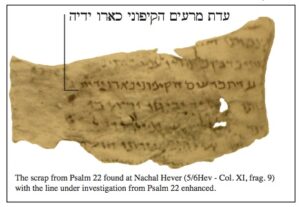
https://dssenglishbible.com/scrollnhpsalms.htm
Although it is dated to the second half of 1st century AD, and so after the birth, death and resurrection of Jesus, the manuscript is not Christian but is a Jewish construct and supports the reading Kaaru and predates any Masoretic text of this verse that we have by almost 1000 years.
I will just make note that although many scholars do assert that the reading here is Kaaru, such as Professor Flint, mentioned by Rabbi Singer in his book, it is also true that some scholars do claim that it is not possible to ascertain the true reading of this manuscript as it is very faded.
There is another manuscript found at Qumran, 4Q88Pslamsf that also reads they Piereced
https://dssenglishbible.com/scroll4Q88.htm
But we also have further manuscript support for the reading Kaaru, contrary to the claims of Rabbi Singer.
In an online teaching that can be easily found on Youtube, Rabbi Tovia Singer claims that there is not one Bible (Hebrew Text) that has ever been found that reads anything other than Kaari.
This is simply incorrect. While the overwhelming Masortic manuscript evidence does read Kaari, there are in fact some Masoretic manuscripts that read Kaaru in Psalm 22:17. These are Manuscript 39, 267, 270, 277, 288, 660 as shown in the Kennecott collection of Hebrew Masoretic manuscripts.
So although it is not a widely supported reading, there is at least some manuscript evidence for the reading Kaaru in Psalm 22.
We must here note that the normal Hebrew word for pierce is not Kaaru but rather נָקַב naqab as used in many places such as 2 kings 18:21 and translated as pierced in the KJV
2 Kings 18:21 Now, behold, thou trustest upon the staff of this bruised reed, even upon Egypt, on which if a man lean, it will go into his hand, and pierce it: so is Pharaoh king of Egypt unto all that trust on him.
Kaaru, if such a word existed, more than likely would not actually mean they pierced, it is more likely to be derived from the Hebrew root כּרה karu, to dig as so would rather mean they dug. This then could explain where the Septuagint reading comes from.
The Masoretic text:
When we look at the Masoretic text we must notice there is no verb after Kā-’ă-rî, so the Masoretic Hebrew text literally reads:
Like a lion my hands and my feet. Without the verb here the literal translation of this verse makes no sense.
Rabbi Tovia Singer himself adds to the text to give a “correct” reading of the verse. He states:
“The Hebrew word does not mean pierced but plainly means “like a lion”. The end of Psalm 22:17, therefore, properly reads, like a lion they are at my hands and my feet.”
Let’s get biblical Vol 2 page 22
However, as we have already seen this is NOT the “correct” reading of the Hebrew. Rabbi Singer adds “they are at” in his translation of the verse as these words are not found in the Hebrew text. Rabbi Singer arbitrarily adds these words in order to give his correct translation of the Hebrew.
This is because Rabbi Singer himself knows that the literal translation without a verb makes no sense. The verb is either missing and so by necessity we have to apply a verb or there is something being implied in the Hebrew text itself regarding the lion at the hands and feet that makes the verb unnecessary in the Hebrew. Hebrew of course is an Elliptical language whereas English is not.
So while Rabbi Singer accuses the Christians of changing the text to fit their narrative, he himself adds to the text to give the correct meaning, of course, in order to fit his own narrative.
Rabbi Singer is not the only one that adds to the Hebrew text here.
“They are at”, is also the reading of the JPS Tanakh 1917
Psalm 22:16 For dogs have encompassed me; A company of evil-doers have inclosed me; Like a lion, they are at my hands and my feet.
Many Jewish commentators have also added to the text to explain the meaning of the text.
““Like a lion [they are gnawing at] my hands and my feet.” This is the clearest exposition of the text.”
Gerald Sigal, Jews for Judaism, The Crucifixion of Jesus and PSalm 22, chapter 37d
Unlike Rabbi Singer or the JPS translation at least Gerald Sigal puts the added words into brackets to show that they are added and not part of the Hebrew text.
Rabbi Rashi also expounded upon the meaning of the verse.
like a lion, my hands and feet As though they are crushed in a lion’s mouth, and so did Hezekiah say (in Isa. 38:13): “like a lion, so it would break all my bones.”
Rashi on Psalms 22:17
Clearly then, even in the Jewish understanding of this verse. The “lion” was causing some kind of damage to the hands and feet.
While Rashi understands the verse to mean the hands and feet being crushed in the lions mouth, what is clear is that he understood the meaning of like a lion to refer in some way to the lions mouth and clearly a reference to the lion biting the hands and feet in order to crush them as does Gerald Sigal with his added words “they are gnawing at” .
Indeed, the ancient Targum to Psalm 22 has biting my hands and feet like a lion.
Psalm 22:17 Because the wicked have surrounded me, who are like many dogs; a gathering of evildoers has hemmed me in, biting my hands and feet like a lion. Targum to Psalm 22
While the Hebrew does not include a verb it is evident, even by the Jewish understanding of this verse, that the implication within the text is that there is some attack upon the hands and the feet that is “like a lion biting, gnawing or at, the hands and feet”. Would a lion not “pierce” the hands and feet with its teeth when biting?
Even Rabbi Singer clearly understood this to refer to some kind of attack on the hands and feet by the lion which he understands is not a literal lion but a metaphorical lion that refers to enemies as he states:
“It is obvious when reading this larger section of the 22nd Psalm that King David is using animal motif–most commonly lions–as an animated literary device, in order to describe his pursuers and tormenters. This striking style is pervasive in this section of the Bible. In fact, each and every time the word “lion” appears in the Book of Psalms, King David is referring to a metaphoric lion, rather than a literal animal.”
It is clearly understood, even by those that would argue against the English translation “pierced” that the lion is metaphorical referring to an enemy that would in some way cause some damage to the hands and feet like a lion biting at them. So while arguing against the reading pierced, the counter argument would assert an implied attack being made on the hands and feet. Why then would “they are at”, gnawing or biting be a correct interpolation but “pierced” be a twisted rendering?
When we understand the implied meaning of the Hebrew, “Pierced” is not actually such a “deliberately twisted” translation as Rabbi Singer would assert. Pierced in the English simply gives the explanation of the implied meaning found in the Hebrew.
The enemies of Jesus certainly were at his hands and feet like a lion when they pierced them when they nailed him to the cross.
It could very well be then that the KJV translators did use the Hebrew Masoretic text when they translated Psalm 22:17 and not the Septuagint reading after all and that Kaaru itself was an attempt to explain kaari.
Conclusion:
I would actually postulate that the correct Hebrew is most likely Kaari and the meaning of Kaari being “like a lion”. However, I would also argue that those that have “changed” this to “ pierced” did not do so out of a desire to change or twist the meaning of the text, but rather they did so in order to more accurately explain the meaning of what is clearly a difficult verse to understand, that a literal translation of the Hebrew would not, nor could not, fully convey.
If you liked this study please subscribe here
You can buy my books on Amazon there is a link here
Join our Patreon membership here or you can buy me a coffee through paypal
0 Comments