Is the image of Jesus Christ modelled upon Cesare Borgia?
Please consider supporting my work https://cash.app/LJFollowInTruth
Many Hebrew Israelites claim that the image of Jesus that is commonly used throughout Christendom today was actually modelled upon a man named Cesare Borgia.
They will often use a picture that has 2 side by side images to support their claims. Something like these images below.


They claim that Jesus was a so called “black” man and that his image has been whitewashed.
My book the Holy Bible vs The Hebrew Israelites

You can buy my book on Amazon (here is a link to the Amazon.com site)
Amazon.co.uk
But how true are these claims?
In this study, I will show that the claims made by the Hebrew Israelites are not based upon facts but assertions made in spite of the facts. They have an agenda to keep and dealing with the actual facts is not part of that agenda. They simply only give the information they wish to use, and twist the truth to make it appear to support their claims.
The truth.
Firstly, let’s find out who Cesare Borgia was.
Cesare Borgia was born on 13th September 1475 in Italy. This is nearly 1500 years after Jesus lived.
He was the illegitimate son of Rodrigo de Borgia, who would later become Pope Alexander VI. His mother was Giovanna dei Cattanei (better known as Vannozza dei Cattanei), one of the many mistresses of Rodrigo.
Cesare Borgia died on 12th March 1507. This date is important.
It is claimed that Pope Alexander VI did not like the images of Jesus as a Jewish man and so commissioned Leonardo Di Vinci to produce new paintings of Jesus , which used his son, Cesare, as the model to base the images on. After doing so he ordered the destruction of the images that depicted Jesus as a Semitic looking man.
These claims are attributed to having first being made by French novelist Alexandre Dumas, yes the same Alexandre Dumas that wrote The Three musketeers and The Count of Monty cristo.
The Hebrew Israelites simply follow these “claims” made by Dumas as fact, they do not actually prove the claim beyond making the assertion itself, and then use these “facts” in their own argument. Try it, ask them to prove this claim and see what evidence you are given.
Alexandre Dumas did NOT , however, make these claims at all. In his writing, Celebrated crimes Vol 1, the Borgias, which is where the claim is supposedly found, Alexandre makes no mention of the image of Jesus being modelled on Cesare. There is no mention of Pope Alexander VI dislike of the “Jewish” looking Jesus,. No mention of his commission of Leonardo Di Vinci to paint Jesus in the likeness of Cesare or his destruction of images that portrayed Jesus as Semitic. The claims have NO factual basis in reality at all. They are simply unsubstantiated and baseless statements that must be taken as fact without any investigation.
I challenge anyone to provide the actual evidence of the claims and where exactly in the writings of Alexandre Dumas we can find his claims, BOOK, CHAPTER AND PAGE NUMBER PLEASE>>>>
You can read the entire book here for yourself. (I do not ask you to just take my word for it)
Celebrated Crimes Alexandre Dumas (Gutenberg)
Lets also have a closer look at the image used by the Hebrew Israelites.

This painting used by the Hebrew Israelites to support their claim is called Portrait of a Gentleman.
The painting is traditionally believed to be a painting of Cesare Borgia although nobody knows for certain if it actually is.
This painting was painted in 1513 by Alberto Melone. This was 6 years AFTER Cesare Borgia had died, he died in 1507, I said that date would be important. Cesare most certainly did not sit for this portrait.
Pope Alexander VI was also long dead by this time having died in 1503 and could not have commissioned the image himself.
It cannot go without notice that the picture does NOT depict the gentleman, even if this is Cesare Borgia, with a full beard. The image is of a man with a Goatee style beard and moustache not the beard that Jesus is usually depicted as having. The person in the picture has dark eyes, whereas Jesus is usually depicted with blue eyes. Also the hair is very different as Jesus is commonly depicted with much lighter coloured hair than the man in the picture.
While the image of Jesus and the image of “Cesare” are similar , similar as in they are both depicted in their images as being of pale complexion with facial hair and long hair on their head, it does not follow that the image of Jesus is dependant upon the image of “Cesare”.
In fact, again the actual FACTS disprove the claims.
We do have a Bible verse that would support Jesus the Messiah having a beard. In a prophecy about the Messiah we see that the Messiah gave his “cheeks to them that plucked off the hair:”
Isaiah 50:6 I gave my back to the smiters, and my cheeks to them that plucked off the hair: I hid not my face from shame and spitting.
While the renaissance period did produce many images of Jesus, the image of Jesus with beard, moustache, long hair and a more “pale” complexion was in circulation long before the renaissance period and therefore, Cesare, or in fact his father, were born…a LONG time before.
We have an image from the 4th century which can be found in the Catacomb of Commodilla on the Via Ostiensis. It is one of the earliest depictions of a bearded Jesus. Notice also that this image depicts Jesus with long hair, a moustache. The image certainly does not give Jesus a dark complexion.

The following image is from the 5th Century (approx 400-410 AD). It is of Christ Pantocrator. It is a Roman mosaic found in the church of Santa Pudenziana, Rome.

Here is a close up of Jesus in the image.

Jesus has long hair, a beard and moustache. Again he does not have a dark complexion.
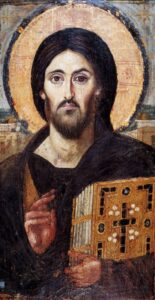
The image below is called Pantocrator. It is from the 6th Century AD. That is approximately 900 years or so before Cesare Borgia lived. Again, Jesus is depicted as having a beard, Moustache, long hair and a “pale” complexion.
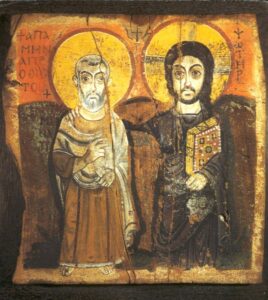
Here is a Coptic Image from the 8th Century that comes from the Apollo monastery in Bawit, Egypt. It is now housed in the Louvre Museum in Paris. It is called Icon of Christ and Abbot Mena
Jesus healing a leaper is an image from the medieval period, dated to the 12th/13th century. This is 200-300 years before Cesare. It is a Mosaic found in the Cathedral of the Assumption, Monreale, Sicily.
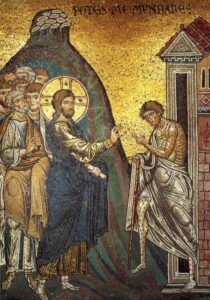
These are just a sample of the images of Jesus being depicted as having full facial hair, long hair upon his head and of a paler complexion, that can be found in existence before the 15th Century.
In each one of these pictures the Jesus depicted is easily recognisable and resembles the depictions of Jesus today.
Even if the pictures of this era, were styled upon Cesare Borgia, for which there is no credible evidence, this would not at all support the claim that the image that is commonly used by Christendom today is based upon him or that this was at the bequest of his father. ALL this would actually demonstrate is that Cesare Borgia resembled the already used depicted image of Jesus. The image of a long haired, bearded, pale Jesus had been in use for over 1000 years before the image, used by Hebrew Israelites to assert their claims, came into existence.
It is worthy of note that Cesare Borgia suffered from Syphilis that that left him so badly disfigured that he wore a leather mask to cover half of his face. It may very well be that the common depiction of Cesare Borgia is actually based upon Jesus rather than the other way around, to hide the disfigurement. While I wouldn’t go as far as to categorically claim this as a truth, it is at least a possibility (and is supported by as much evidence as that of the Hebrew Israelite claims, as in none).
When correctly analysed the claim made by Hebrew Israelites just doesn’t hold up.
If you liked this study please subscribe here
You can buy my books on Amazon there is a link here
Help me keep this site free for all. Join our Patreon  membership here
0 Comments