Integrity Syndicate and the false claims against the KJV
There are many claims made against the KJV and its textual readings. I have dealt with numerous claims and attacks against the KJV on this website in a great deal of writings. In this particular study I will be going through the claims made on the Integrity Syndicate website. You can view the claims made here under the title KJV is corrupt https://integritysyndicate.com/kjv-is-corrupt/
Before I start, it still makes me scratch my head in amazement, that many of the accusations that anti-KJV proponents make against the KJV are just as viable, sometimes even more, against the modern versions, than they are against the KJV. I also find that many arguing against the KJV have not actually studied the subject of Textual criticism in any great detail and are simply repeating what they have read in some book as if it is fact without actually checking the information being stated. Of course, the appeal to scholars is often the way in which these accusations are made, yet many also will disagree with those some scholars when they say something that goes against what they believe. Selective scholarship is a big problem. Unfortunately, as we will see, Josiah is not really any different.
So lets start.
In the section “What is the King James Version?” Josiah states:
The King James Version (KJV), Originally known as the Authorized Version, is an English translation of the Christian Bible for the Church of England completed in 1611 under the sponsorship of king James of England, Ireland, and Scotland.”
The KJV was not originally known as the authorised version. It was actually called the “New translation”. It was also known as “our English translation”. It later became known by the term King James’ Bible, an appellation first given by the Scots to distinguish it as the Bible of King James from the other Bibles in use at that time, primarily the Bishop’s Bible and the Geneva Bible. It isn’t until later in the 16th century that the title “authorised” would be attached to the name. Even then it is not until at least the 17th but maybe even the 18th century that this becomes the standard epithet.
Instructions were given to the translators intended to limit the Puritan influence on this new translation. The translators were not allowed to add marginal notes like the Geneva Bible had.[4] King James cited two passages in the Geneva where he found the marginal notes offensive to the principles of divinely ordained royal supremacy”
Actually, the rules were given in order to prevent any translational bias from any group. It’s one of the reasons so many translators were used in its creation, including Puritans. It was specifically meant to stop bias and allow for the true reading to be accurately preserved. The Geneva Bible included many Calvinistic and Puritan biased notes, which gave interpretations of scripture. These were removed for purposes of the accuracy of the text and unbiased interpretation of the text. Unless Josiah is himself a Calvinist, I am sure he would agree that biased notes should not be included. Had it simply been a method to limit Puritan influence then it would have been an easy task of allowing notes that were not influenced by the puritans, or indeed, not including Puritans on the translation committee.
King James didn’t like many of the marginal notes, although it is true that he did make note of a couple that would be regarded as “anti king”. It was, however, not limited to these particular notes or otherwise he would simply have stated that these notes were to be removed.
“In January 1604, King James convened a conference to lay the ground work for a new translation in response to the use of the Geneva Bible by the Puritans”.
This is factually incorrect. The Conference was not convened in order to lay the groundwork for a new translation at all. Anyone saying so has not studied or understood the calling of the conference.
Here I shall copy from an already written work I have done elsewhere.
In 1603 King James VI of Scotland succeeded to the English throne after the death of Queen Elizabeth I and became King James I of England.
As King of England , James would become the head of the Anglican Church. However, King James would inherit a divided church, split between 2 disagreeing factions, the Godly as they called themselves and were known by at the time, we know them better today as the Puritans, and the traditionalists. After the reformation had started and England had split from the Catholic Church, England had become a protestant country, although during her reign as Queen Mary I, “bloody Mary” desired to bring England back under the reign of Rome. She ordered the burning of English Bibles, and also those that were reading them, including John Rogers, who had translated the Matthew’s Bible under the Pseudonym Thomas Matthews.
The Godly, Puritans, pushed for continued reform while the traditionalists believed the reform had gone far enough. Immediately on his succession, the Puritans petitioned King James regarding the need for greater reform, specifically in the areas of rituals, government of the church and preaching.
1 That the Doctrine of the Church might be preserved in purity according to Gods Word.
2 That good Pastors might be planted in all Churches to preach the same.
3 That the Church government might be sincerely ministered according to Gods Word.
4 That the Book of common Prayer might be fitted to more increase of Piety.
Summe and Substance of the Conference Page 23
King James called a conference at Hampton Court Palace in order to discuss complaints about the Church and to resolve the issues of the Puritans. It was attended by the Puritans, councillors, Bishops and other senior clergymen and also lawyers. Some of the attendees included (although the number and the attendees is recorded to have differed on different days:
Charles Blount, earl of Devonshire; the lord treasurer, Thomas Sackville, first Baron Buckhurst; the secretary of state, Robert Cecil; the lord chancellor, Thomas Ellesmere, first Baron Ellesmere; Charles Howard, first earl of Nottingham; Henry Howard, earl of Northampton; the lord chamberlain, Thomas Howard, first earl of Suffolk; Sir John Popham, the lord chief justice; and Edward Somerset, fourth earl of Worcester. They were joined by Roger Wilbraham, a master of requests. Also present were Archbishop Whitgift and eight bishops—Richard Bancroft (London), Gervase Babington (Worcester), Thomas Bilson (Winchester), Thomas Dove (Peterborough), Tobie Matthew (Durham), Henry Robinson (Carlisle), Anthony Rudd (St David’s), and Anthony Watson (Chichester); the ‘Anonymous account’ adds John Thornborough (Bristol), probably in error. Also invited were nine deans—George Abbot (Winchester), Lancelot Andrewes (Westminster), William Barlow (Chester), Richard Edes (Worcester), John Gordon (Salisbury), James Montagu (the Chapel Royal), John Overall (St Paul’s), Thomas Ravis (Christ Church, Oxford), and Giles Tomson (Windsor)—and one archdeacon, John King (Nottingham). Four clergy represented the puritan cause: Laurence Chaderton, master of Emmanuel College, Cambridge, John Knewstub, rector of Cockfield, Suffolk, John Rainolds, president of Corpus Christi College, Oxford, and Thomas Sparke, who was beneficed at Bletchley, Buckinghamshire.
https://www.oxforddnb.com/view/10.1093/ref:odnb/9780198614128.001.0001/odnb-9780198614128-e-92779
We have approximately 11 recorded accounts of the conference. These accounts vary in length and detail.
The longest and most detailed account comes to us by William Barlow, who attended the conference, in his semi official “Summe and Substance of the Conference”
The conference was set over 3 non consecutive days. They met on the 14th,16th and 18th January 1604.
Some of the topics of discussion at the conference were church doctrine, liturgy, discipline, and pastoral provision.
At the conference the Puritans were represented by four spokesmen, these men were
Laurence Chaderton, master of Emmanuel College, Cambridge, John Knewstub, rector of Cockfield, Suffolk, Thomas Sparke, who was beneficed at Bletchley, Buckinghamshire.
and the main spoksman for the puritans, John Rainolds, president of Corpus Christi College, Oxford.
King James was himself a protestant. Furthermore, at this time, Scotland had already rejected many of the liturgical practices that were still being practised in England.
James, however, mostly sides with the traditionalists. He is recorded as having stated:
“no bishop, no king”.
Summe and Substance of the Conference Page 36
The requests for reform put forward by Rainolds were rejected one by one.
However, and quite contrary to the claim regarding King James’ desire for a new translation, at the last minute, it was Reynolds himself that made a petition to the conference that there be a need for a new translation of the Bible. While this request had not been one of the original points of discussion, it did happen to be the only point that Rainolds was successful in putting forth.
“To the former, Doctor Reinolds did add the profanation of the Sabbath day and contempt of his Majesties Proclamation, made for the reforming of that abuse, of which he earnestly desired a straighter course for reformation thereof, and unto this he found a general and unanimous assent.
After that,he moved his Majesty , that there might be a new Translation of the Bible,because,those which were allowed in the reign of King Henry the Eighth and Edward the sixth, were corrupt , and not answerable to the truth of the Original. For example, first Galatians 4. 25. the Greek word….is not well translated, as now it is ; Bordereth , neither expressing the force of the word, nor the Apostles sense, nor the situation of the place.”
Summe and Substance of the Conference Pages 45/ 46
King James is recorded as having thought that the Geneva Bible was the worst of the English translations:
“(professing that he could never, yet, see a Bible well translated in English, but the worst of all his Majesty thought the Geneva to be )
Summe and Substance of the Conference Page 47
While it is then true that King James did think that the Geneva Bible was the worst of the English translations, it is evident that he also did not think that any translation of the Bible into English at the time was translated well. We must also note that unlike today where we have hundreds of English translations, at the time of King James there were in reality less than 10 and only 2 were in any major use, the Bishops Bible, used primarily by the church authorities and the Geneva Bible as used by the Puritans.
As we can clearly see, the idea for a new translation of the Bible was not that of King James. Contrary to the claim, King James did not authorise a new translation based on his dislike of the Geneva Bible nor was it in response to the use of the Geneva Bible by the Puritans. The granting of a new translation by King James was actually because of a direct request made by the Puritans themselves that there be a need for a new translation.
English Bibles prior to the KJV
“The Geneva Bible, originally published in 1560, was a revision of Tyndale’s Bible and the Great Bible and was also based on the original languages”
This is because both the Tyndale , The Great Bible and the Geneva Bible are based upon the TR which was translated from the original languages. The KJV itself was a Revision of these Bibles as it was a revision of the Bishops Bible, which was a revision of The great Bible. All of these Bibles were based on the TR. All English Bibles after the Wycliffe Bible that preceded the KJV were based on the TR. The Wycliffe Bible was translated from the Latin Vulgate.
After Elizabeth I took the throne in 1558, the monarchy and the Church of England had issues with both the Great Bible and the Geneva Bible, especially considering the Geneva Bible did not “conform to the ecclesiology and reflect the episcopal structure of the Church of England and its beliefs about an ordained clergy”.[13] In 1568, the Church of England responded with the Bishops’ Bible, a revision of the Great Bible in light of the Geneva version.[14] All the official Bible of the Church of England, the Bishops’ Bible failed to displace the Geneva translation as the most popular English Bible of the age.[15]
The thorough Calvinism of the Geneva Bible (more evident in the marginal notes than in the translation itself) offended the high-church party of the Church of England, to which almost all of its bishops subscribed. Though most mainstream English clergy agreed with much of Calvin’s theology, the majority did not approve of his prescribed church polity, Presbyterianism, which sought to replace government of the church by bishops (Episcopalian) with government by lay elders. However, they were aware that the Great Bible of 1539—which was the only version then legally authorized for use in Anglican worship—differed, in that much of the Old Testament and Apocrypha was translated from the Latin Vulgate, rather than from the original Hebrew and Aramaic. In an attempt to replace the objectionable Geneva translation, they circulated one of their own, which became known as the “Bishops’ Bible”.Wikipedia
All the official Bible of the Church of England, the Bishops’ Bible failed to displace the Geneva translation as the most popular English Bible of the age.
The Bishops Bible was a church Bible to be read in churches, a pulpit Bible so to speak. It replaced the Great Bible as the Bible read in church by the Bishops, hence the name. The Geneva Bible was not a church Bible and so they were not really in “competition” with one another. The KJV was itself meant to be read in the churches over the Bishops Bible. When the KJV was produced it was a Bible that was to be read in the Churches as a replacement for the Bishops Bible. It later became the home Bible of choice. This, however, was a longer process.
Geneva Bible – principal rival and motivation for the KJV (This section seems to have been updated since I first wrote and so I may have addressed previous points here, I will try and address all new statements)
The Geneva Bible proceeded the King James Version by 51 years. [16] It was the most widely read and influential English Bible of the 16th and 17th centuries and was published from 1560 to 1644 in over 150 different printings.
To claim that the Geneva Bible was the most widely used Bible of the 16th and 17th Century is an overstatement and misleading. The Geneva Bible was not even translated until 1560, which meant for the first 60 years at least of the 16th Century it was not the Bible of choice. It did not arrive in England until after the death of Archbishop Parker in 1575. It was last printed in 1644 and was almost certainly overtaken by the KJV by this time. Even if we said that the Geneva Bible remained popular after its last print it certainly had been overtaken by the 2nd half of the 17th Century. Thus in reality it was likely less than 100 years that the Geneva Bible was the most popular Bible (more likely much less than this).
As a product of the best Protestant scholars of its day, it became the Bible of choice for many of the greatest writers, thinkers, and historical figures of the time. The Geneva Bible was the primary Bible of 16th-century English Protestantism and was used by William Shakespeare, [18] Oliver Cromwell, John Knox, John Donne, and John Bunyan, author of The Pilgrim’s Progress (1678).[19] The Pilgrims brought the Geneva Bible with them on the Mayflower to Plymouth in 1620.[20] The religious writings and sermons published by the members of the Plymouth colony suggest that the Geneva Bible was used exclusively by them.[21] William Bradford cited it in his book of Plymouth Plantation.[22] The Geneva Bible was the Bible that Puritans endeared, not the Authorized Version of King James.[23] The Geneva Bible’s popularity was greatest, wherever a strong Protestantism prevailed and was the preferred Bible of the Puritan clergy in England, Scotland, and America at the time.[24]
Its interesting that Josiah, it wruleould seem, at least, is showing the Geneva Bible in a better light, or maybe better put, elevating the Geneva Bible above the KJV here. This is often done by those who attack the KJV not actually realising the implications of this attack.
The Geneva Bible’s popularity was actually greatest wherever Calvinism was the prevalent belief.
The fact is the Geneva Bible was translated from the TR just like the KJV. While there are many differences in the translation choices between the 2 Bibles, the text is fundamentally the same. They both contain all the verses that Josiah will later say are corrupt additions. We must also note who these scholars were.
The Geneva Bible was not a church Bible (except in Scotland where it was officially used as the church Bible, one of the reasons why the Scots gave the KJV the designated name King James’ Bible, the Geneva Bible was the Bible of Scotland at the time. A law was even passed in 1579 that required every household of sufficient means to purchase a copy. We shouldn’t ignore the appeal of the involvement of John Knox and John Calvin ). It was the Bible that was used in homes, unlike the Bishops Bible. Josiah would have it seem like the Geneva Bible was chosen over the Bishops Bible as the Bible of choice. Yes, the Geneva Bible was the Bible most people used in their homes this was because it was a home Bible while the Bishops Bible was read in churches. The Geneva Bible was not read in the churches, except in Scotland. They were two different Bibles and actually served two different purposes. They each served the purpose they were created for. The Geneva Bible was produced at a price accessible to many common people at the time. It also included the notes which were deemed helpful. Its language was much more readable than the Great Bible. This was all during a time when people were just starting to be allowed own Bibles in English for their own usage. The Geneva Bible was in this sense, built for purpose, giving it an advantage over any previous English Bible. It was also the first Bible to be broken down into chapter and verse, making it easier for people to read. Furthermore, it included cross verse references helping the reader study the Bible like never before. The Geneva Bible also included illustrations, maps, indexes of names, and other helpful information. All of which helped with its popularity.
Unlike what Josiah claims on his website “As a product of the best Protestant scholars of its day, it became the Bible of choice for many of the greatest writers, thinkers, and historical figures of the time.” The New Testament was translated in 1557 almost entirely by one man, William Whittingham. The Old Testament was also translated by Whittingham but he was helped, most likely by Miles Coverdale, Anthony Gilbey, Christopher Goodman, Thomas Sampson, and William Cole.
The KJV was translated by at least 47 of the best protestant Scholars of its day and has itself become a loved and beloved Bible of choice for hundreds of years.
” The Pilgrims brought the Geneva Bible with them on the Mayflower to Plymouth in 1620.”
While this is correct, the statement is disingenuous. It gives the impression that the Geneva Bible was the only Bible in use and taken. The KJV was also taken upon the Mayflower. John Alden’s KJV is on display in the Pilgrim Hall museum today.
https://pilgrimhall.org/ap_religion.htm#:~:text=King%20James%20authorized%20a%20new,chose%20to%20join%20the%20community.
The statement should acknowledge that the KJV was taken also.
It IS possible (technically) to argue that the KJV owned by Alden was not brought on the Mayflower but imported later. There was no list of items that each pilgrim carried with them. Thus it could be argued that the Bible was brought in later.
John Adlen died in 1687 so we know by this time the KJV had been brought over. However, it could be argued on the same basis that the Geneva Bible was not brought over on the Mayflower as we have no recorded list of items. Both are non arguments. It is far more likely, that both the Geneva and the KJV were carried on the Mayflower.
What is sure is that the KJV certainly replaced the Geneva Bible in the New world despite the claims of the Pilgrims preference for the Geneva, they soon changed to the KJV as the Bible of choice.
We must also note that the now infamous Mayflower Geneva Bible 1588 has been proven to have been a fake. The Bible is in the Harry Ransom Library at the University of Texas. The evidence that the Geneva Bible was “the” Bible of choice may not be quite as strong as people like to assert that it was.
It was the KJV and not the Geneva that was in use at the time of the declaration of independence in 1776.
The last Geneva Bible was printed some 132 years earlier in 1644. By 1776 the KJV had become the Bible of the USA.
John Bunyon and the Geneva Bible.
It is a common claim that John Bunyon the author of Pilgrims Progress used the Geneva Bible only. However, when this claim is actually examined, as many have, this claim doesn’t actually stand up to scrutiny.
In fact, when John Bunyons quotations of the Bible are examined we actually see that on many occasions he actually quotes the reading as found in the KJV and not the Geneva Bible. This is not to say that he did not use the Geneva Bible, he most certainly did, what it does show is that John Bunyon did not only use the Geneva Bible, and there is no actual evidence that this was even his preferred Bible. (There seems to be no evidence for the claim.)
It is very likely that those making the claim have not actually studied the works of Bunyon to see if the claim is true.
Here we shall look at some examples of where the KJV is quoted.
In his work The Work of Jesus Christ, as an Advocate, Clearly Explained, John Bunyan, London: Dorman Newman, 1688, Bunyon quotes 1 John 2:1. When we examine the quote we cam see that he quotes it using the word righteous. This is the reading of the KJV NOT the Geneva Bible that actually reads just.
And if any man sin, we have an Advocate with the Father, Jesus Christ the righteous: (page 1 after contents)
1 John 2:1 My little children, these things write I vnto you, that ye sinne not. And if any man sinne, we haue an Aduocate with the Father, Iesus Christ the righteous: KJV
1 John 2:1 My little children, these things write I vnto you, that ye sinne not: and if any man sinne, wee haue an Aduocate with the Father, Iesus Christ, the Iust. Geneva Bible
In his work Solomon’s Temple Spiritualized, John Bunyan, London: George Larkin, 1688, Bunyon comments on 2 Chronicles 3:6 (And he garnished the house with precious stones for beauty) He states: “The line saith, garnished; the margin saith, covered.”
The margin note that Bonon refers to here is found in the KJV https://archive.org/details/1611TheAuthorizedKingJamesBible/page/n541/mode/2up
In his word Seasonable Counsel: Or, Advice to Sufferers, John Bunyan, London: Benjamin Alsop, 1684, Bunon quotes 1 Peter from the KJV Page 1 Using the word (Keeping)
1 peter 4:19 Wherfore, let them that suffer according to the will of God, commit the keeping of their soules to him in well doing, as vnto a faithfull Creator. KJV
1 Peter 4:19 Wherefore let them that suffer according to the will of God, commit their soules to him in well doing, as vnto a faithfull Creator. Geneva Bible
Page 5 (Arise)
Psalm 17:13 Arise, O Lord, disappoint him, cast him downe: deliuer my soule from the wicked, which is thy sword: KJV
Psalm 17:13 Vp Lord, disappoint him: cast him downe: deliuer my soule from the wicked with thy sworde, Geneva Bible
Page 6
Zechariah 11:5 Whose possessours slay them, and hold themselues not guiltie: and they that sell the say, Blessed be the Lord; for I am rich: and their owne shepheards pitie them not. KJV
Zechariah 11:5 They that possesse them, slay them and sinne not: and they that sell them, say, Blessed be the Lord: for I am riche, and their owne shepherds spare them not. Geneva Bible
A Discourse of the House of the Forest of Lebanon. John Bunyon
He clearly states some older Bibles have shield instead of target.
1 Samuel 17:6 And he had greaues of brasse vpon his legs, and a target of brasse betweene his shoulders. KJV
1 Samuel 17:6 And he had bootes of brasse vpon his legs, and a shield of brasse vpon his shoulders. Geneva Bible
The Marginal note in the KJV at that verse reads or Gorget (as per the margin note referenced.
https://archive.org/details/1611TheAuthorizedKingJamesBible/page/n387/mode/2up
There are many other quotations of scripture that match with the KJV https://www.textandtranslation.org/john-bunyan-geneva-bible-only/
William Shakespear died in 1616, just 5 years after the KJV was printed. It is not hard to see why he would have used the Geneva Bible rather than the KJV seeing for most of his life the KJV did not even exist (born 1564)
The primary reason it became the most popular version of its time is the more than 300,000 marginal notes included to explain and interpret the scriptures for the common people. It is these study notes that were considered a threat to the monarchy.[25] Because the Geneva Bible was the preferred Bible of Anglican and Puritan Protestants, King James I opposed it and expressed his views at the Hampton Court Conference of 1604 saying, “”I think that of all, that of Geneva is the worst.”[26] He felt strongly many of the annotations were “very partial, untrue, seditious, and savoring too much of dangerous and traitorous conceits…” In all likelihood, he saw the Geneva’s interpretations of biblical passages as anti-clerical “republicanism”, which could imply church hierarchy was unnecessary.
The Anglicans did NOT, in fact, use the Geneva Bible, despite the claim to the contrary, the Anglicans used the Bishops Bible as their main Bible. The Bishops Bible was created in 1568 in response to the Puritans use of the Geneva Bible and its many marginal notes (although many marginal notes did remain)
“The Church of England recognized the scholarship and caliber of the Geneva Bibles. Many clergymen objected to the study notes it included, particularly the promotion of elder-led church government. Furthermore, the accuracy of translation in the Geneva version highlighted some translation errors in the Great Bible. In response, Matthew Parker, Archbishop of Canterbury, led a project to update the Great Bible. Scripture was divided into sections and distributed to Anglican scholars, mostly Bishops (hence the name), who were to independently review and update their portion. Parker compiled these changes into the Bishops’ Bible.”
https://www.antiquebible.com/bishops-bible-a-response-to-geneva?srsltid=AfmBOoqED–6LhnAe-hawIWCHQldLkYTE44ED6D4qYAc1Jlh1vtx5GPW
King James is recorded as having thought that the Geneva Bible was the worst of the English translations:
“(professing that he could never, yet, see a Bible well translated in English, but the worst of all his Majesty thought the Geneva to be )
Summe and Substance of the Conference Page 47
But he did not say this because the Anglicans and the Puritans were using the Geneva Bible. This is yet another false statement by Josiah.
While it is then true that King James did think that the Geneva Bible was the worst of the English translations, it is evident that he also did not think that any translation of the Bible into English at the time was translated well. We must also note that unlike today where we have hundreds of English translations, at the time of King James there were in reality less than 10 and only 2 were in any major use, the Bishops Bible, used primarily by the church authorities and the Geneva Bible as used by the Puritans.
But this in no way is an argument against the KJV itself. Despite King James’ obvious dislike of the marginal notes in the Geneva Bible, many of which are, in fact, very swayed towards calvanistic theology , King James was not a Calvinist, and the prohibition from including marginal notes within the new translation, contrary to the claim made, the marginal notes in the Geneva Bible were not in any way the reason for the translation being carried out in the first place. It is simply false to claim otherwise, either through an incorrect understanding of why the translation came to take place or through deliberate deception in order to create an argument against the KJV, which in reality is a straw man argument. It can also be argued that many Christians today, even those that use this as an argument against the KJV would not agree with many of the notes that are found within the Geneva Bible. The argument is irrelevant to the argument of whether the KJV is a reliable translation or not. It should be pointed out that it was not just King James who did not like the Marginal notes but the traditionalists in the church also did not like them. The puritans held many Calvinistic beliefs, that formed much of their theology, one of the main factors behind their usage of the Geneva Bible.
Here I shall give some examples of the Calvinistic notes in the Geneva Bible
Romans 9:15 “election and reprobation: so his free mercy in Christ is an
inferiour cause of salvation, & the hardening of :the heart,
an inferiour cause of damnation.”
! pETER 1:2 “”The free election of God is the effecient cause of our
salvation, the material cause is Christes obedience, our effec
iuall callying is the formall cause, and the finall cause is our
sanctification.””
John 6 :37: “God doeth regenerate his elect, and calleth
them to obey the Gospel!.”
John 10 :26: “The cause wherefore the reprobate cannot
believe” (i.e., because they are not of Christ’s sheep).
Acts 13 :48: “None can believe, but they whome God doethappoint before al beginnings to be saved.”
[
Romans 9 :7: “The Israelites must not be esteemed by their
kindred, but by the secret election of God, which is above the
external vocation.”
Romans 11 :29: “To whome God giveth his spirit of adop
tion, and whome he calleth effectually, he cannot p~rish: for
Gods eternall counsell never changeth.”
Ephesians 1 :4 : “This election to life everlasting can never
be changed : but in temproall offices which God hath appointed
for a certaine space, when the terme is expired, he 1
changeth
his election, as we see in Saule and Judas.”
Ephesians 1 :4: “The principall end of our election is to
praise and glorifie the grace of God.”
Titus 1 :2: “Hath willingly, and of his meere liberalitie
promised without foreseeing our faith or workes as a cause
to move him to this free mercy.”latin
On Salvation
1 Timothy 4:10 “”The goodnes of God declareth itself to
wards all men, but chiefly towarde the faithfull by preferring
them: and here he meaneth not of life everlasting.”
The Bishops Bible removed many of these Calvinistic annotations, yet in some places they were retained such as in 1 Peter 1:2.
King James commissioned and chartered the new Bible translation that would be to his satisfaction, first known as the Authorized Version – authorized to be read in churches.
It was actually originally known simply as the new translation. Later becoming known as King James’ Bible by the Scots before this became the King James Bible. Despite its name as the AKJV it was technically never actually officially “authorised” as the Bible by the King. It was called authorised by the people due to the King’s decree of producing it.
Rather than being an original inspired work, the KJV was a minimal revision with the primary motivation of suppression of the truth in rendering various passages in a way that was favorable to the established monarchy and religious order of the time.
This statement by Josiah is again dishonest. While it was true the KJV was indeed a minimal revison the primary motivation was not to suppress truth.
Then we come to notes that are simply theologically incorrect.
Daniel 10:13 But the prince of the kingdom of Persia withstood me one and twenty days: but, lo, {i} Michael, one of the chief princes, came to help me; and I remained there with the kings of Persia.”
The notes to this verse in the Geneva Bible reads as such>
“(i) Even though God could by one angel destroy all the world, yet to assure his children of his love he sends forth double power, even Michael, that is, Christ Jesus the head of angels.”
Here we see that the Geneva Bible says that Jesus is Michael, who is head of the angels. This would likely be accepted by Jehovah’s Witnesses but for others this would simply be false.
Influence of Latin and the Catholic Rheims New Testament
Despite the instructions to use the Bishops’ Bible as a base text, the New Testament of the KJV is especially influenced by the Catholic Rheims New Testament, whose translators had also attempted to find English equivalents for Latin terminology
The first question that should be asked here is where in the Bible were the translators especially influenced? Josiah makes no specific mention of any time he believes this has taken place.
The KJV translators had access to the readings of the Latin Vulgate and the Douay- Rheims Bibles, but it is simply a false statement that the KJV was especially influenced by either. Many “Latin” readings such as Lucifer in Isaiah 14:12 were already in the Bishops Bible that the translators followed. Lucifer is also in the Geneva. In fact Lucifer is in the Coverdale Bible also. I have used the example of Lucifer as Josiah didn’t give any and Lucifer is a common accusation against the KJV having used a Latin term.
But lets here what the KJV translators themselves said about using translations and the original languages.
If you aske what they had before them, truely it was the Hebrew text of the Olde Testament, the Greeke of the new. These are the two golden pipes, or rather conduits, where-through the olive branches emptied themselves into the golde. Saint Augustin calleth them procedent, or originall tongues; Saint Hierome, fountaines. The same Saint Hierome affirmeth, and Gratian hath not spared to put it into his Decree, That as the credit of the old Bookes ( he meaneth of the Old Testament) is to bee tryed by the Hebrew Volumes, so of the New by the Greeke tongue, he meaneth by the originall Greeke. If trueth be to be tried by these tongues, then whence should a Translation be made, but out of them ? These tongues therefore, the Scripture wee say in those tongues, wee set before us to translate, being of the tongues wherein God was pleased to speak to his Church by his Prophets and Apostles.
Neither did wee thinke much to consult the Translators or Commentators, Chaldee, Hebrewe, Syrian, Greeke, or Latine, no nor the Spanish, French, Italian, or Dutch; neither did we disdaine to revise that which we had done, and to bring backe to the anvill that which we had hammered: but having and using as great helpes as were needfull, and fearing no reproch for slownesse, nor coveting praise for expedition, wee have at the length, through the good hand of the Lord upon us, brought the worke to that passe that you see. (From the Translators to the Reader,
The KJV translators did not think much about using the translations of the original languages. They stuck mainly with the original Hebrew and Greek.
The Title page of the KJV has the following statement
THE Holy Bible
CONTAINING THE
OLD AND NEW TESTAMENTS
TRANSLATED OUT OF THE ORIGINAL TONGUES:
AND WITH THE FORMER TRANSLATIONS
DILIGENTLY COMPARED AND REVISED
BY HIS MAJESTY’S SPECIAL COMMAND
APPOINTED TO BE READ IN CHURCHES
Josiah is not the only one that makes the claim regarding the use of the Latin Catholic Bibles. When pushed for an example many will often cite the last 6 verses of the book of Revelation, Revelation 16:5 and 1 John 2:23
Even if these examples were correct, 8 verses would not really constitute as being “especially influenced by the Catholic Rheims New Testament,” as Josiah would assert. (Unless of course Josiah has a whole list of verses that he has not cited. We of course would have to examine the validity of such claims.
I would suggest reading my writing on the last 6 verses of Revelation here. https://www.followintruth.com/book-of-life-or-tree-of-life
Every English Bible that precedes the KJV reads book of Life in Revelation 22:19 and the readings of the last 6 verses are almost identical in each.
As for Revelation 16:5 I would suggest a delve into Nick Sayers work on this verse. He has a book available on Amazon or he has lots of information on his website https://textus-receptus.com/wiki/Revelation_16:5
As for 1 John 2:23 we shall look into the reading of this verse.
1 John 2:23 Whosoever denieth the Son, the same hath not the Father: (but) he that acknowledgeth the Son hath the Father also.
The King James Version puts the word in red (and blue) in italics.
Most modern versions include these words in their text also
1 John 2:23 No one who denies the Son has the Father. Whoever confesses the Son has the Father also.ESV
1 John 2:23 No one who denies the Son has the Father; whoever acknowledges the Son has the Father also.NIV
So why does the KJV include these words but also put them in italics?
It is asserted, by some that the KJV translators included the words as they were found in the Latin Vulgate but not the Textus Receptus and so this is evidence that the KJV translators used the Vulgate. The words are not included in the editions of Tyndale and they are not found in the Geneva Bible showing that the TR was not used by the KJV translators here.
This is actually incorrect.
The words are also found in the Old Latin, the Syriac and Ethiopic editions. The words are also quoted by Origen, Athanasius, Cyril, Cyprian and Hilary of Poitiers.
So we see that the evidence for the words as being scripture.
Furthermore, although the words are not found in the first edition of Beza, they are actually found in the 1598 edition of Beza’s Textus Receptus (4th), the edition that was primarily used by the KJV translators, so while it is true they are not found in the majority of TR editions, they are in the edition used by the KJV translators. The words are also found in the Great Bible and importantly also in the Bishops Bible, which the KJV translators were to follow wherever it was possible to do so.
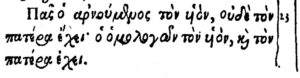
Beza 4th edition 1 John 2:23
The KJV translators put these words in italics to indicate their own uncertainty as to whether they were part of the original text or not, seeing they were not in the majority of Greek manuscripts of the time. They included them as it is likely they believed that they were scripture but as the words were not found in most Textus receptus editions wanted to indicate this to the reader that there were at least some doubts over their originality.
The words are found in both Vaticanus and Sinaticus (not discovered at the time of the KJV) and also found in Codex Alexandrinus. The actions of the KJV translators including the words have been vindicated, but the Italics show that at the time it was not a unanimous decision as to whether they were original. This is one of the times where the KJV translators did not go with the majority reading. The Geneva Bible followed the majority text here.
The words are found in most modern versions as authoritative and original words. So even if the KJV had used the Latin Vulgate here instead of the Greek, they would have been correct to do so, this itself would show that readings that are predominantly preserved in the Latin and not the Greek can be scripture, which supports 1 John 5:7, a verse I have dealt with in great detail elsewhere.
When it comes to the influence of the latin Vulgate, in reality it is not readings that are different in the Vulgate from the Greek that is really being referred to, the KJV most certainly was not influenced by the Vulgate including different readings from the Greek that are found in the Vulgate, rather the KJV has used some latinised words. This is correct. The KJV did use some words that were more latin. We have to remember again that the English language was being formalised. Using a latinised word does not in fact have any impact on the meaning of the verse. Many of the words are used today in both Biblical and non biblical usage.
Lets look at some examples.
The Word Bishop
The word Bishop in the KJV is translated from the Greek ἐπισκοπή episkopé. However, the KJV was not in any way the first Bible to use the word Bishop.
The Wycliffe Bible, the Tyndale Bible, Coverdale, Great Bible, Matthews Bible, Bishops bible and the Geneva Bible ALL use the word Bishop. (1 Timothy 3:1 as an Example)
The word Deacons
The word deacon is translated from the Greek διάκονος diakonos. However, again, the KJV was not the first English Bible to use the word Deacon.
The Wycliffe, the Tyndale, the coverdale, the Great Bible, The Matthews Bible and the Geneva Bible ALL use deacon (1 Timothy 3:8 as an example)
The Coverdale, the Great Bible and the Bishops Bible have ministers in this verse.
It must be noted that the Great Bible and the Bishops Bible both render diakonos as Deacons in 1 Timothy 3:12.
THe word Justification
The KJV translates this from the Greek δικαίωσις dikaiósis. The KJV is not the first English Bible to have used the word justification.
The Wycliffe, the Tyndale, the great Bible, the Matthews Bible, the Geneva Bible and the Bishops Bible ALL have the word Justification (Romans 4:25 as an example)
The word is used in many modern versions such as the NIV ESV, NASB, Net Bible, NRSV and ASV
The word Salvation
The KJV trsnalstes this from the Greek σωτηρία sótéria. The KJV is not the first English Bible to use the word salvation.
The Tyndale Bible, The Coverdale, The Matthews Bible, The Great Bible, the Geneva Bible, the Bishops Bible ALL use the word Salvation (Luke 1:69 as an Example)
The word is used in most modern versions such as the NIV, Esv, NET Bible, NASB, ASV, ERV and many more.
Here are just a few more
- Repentance – Derived from paenitentia, meaning “regret” or “remorse.”
- Grace – From gratia, meaning “favor” or “kindness.”
- Church – While rooted in Greek (kuriakos), its Latin equivalent is ecclesia, meaning “assembly” or “gathering.” ***
- Sacrifice – From sacrificium, meaning “offering to the gods.”
- Redemption – From redemptio, meaning “buying back” or “ransom.”
- Glory – Derived from gloria, meaning “renown” or “splendor.”
- Judgment – From judicium, meaning “the act of judging.”
- Sanctification – Derived from sanctificatio, meaning “making holy.”
*** I have a separate writing on the word Church.
As for influence of the Catholic Bible, we should actually look at the text that the modern Bibles are translated from and their connection to the Catholic Church.
On Page 45 of the NA27/USB4 text we have very clear evidence that the modern versions are working alongside the Catholic Church.
“The text shared by these two editions was adopted internationally by Bible Societies, and FOLLOWING AN AGREEMENT BETWEEN THE VATICAN AND THE UNITED BIBLE SOCIETIES IT HAS SERVED AS THE BASIS FOR NEW TRANSLATIONS AND FOR REVISIONS MADE UNDER THEIR SUPERVISION. THIS MARKS A SIGNIFICANT STEP WITH REGARD TO INTERCONFESSIONAL RELATIONSHIPS.
Collaboration for the Diffusion of the Bible
“Following the responsibility undertaken by the then Secretariat for the preparation of the dogmatic Constitution on Divine Revelation, the PCPCU was entrusted with promoting ecumenical collaboration for the translation and diffusion of Holy Scripture (Dei Verbum, n. 22). In this context, it encouraged the formation of the Catholic Biblical Federation, with which it is in close contact. TOGETHER WITH THE UNITED BIBLE SOCIETIES IT PUBLISHED THE GUIDELINES FOR INTERCONFESSIONAL COOPERATION IN TRANSLATING THE BIBLE.” (1968; new revised edition 1987).
The United Bible Societies Vice-President is Roman Catholic Cardinal Onitsha of Nigeria. On the executive committee is Roman Catholic Bishop Alilona of Italy and among the editors is Roman Catholic Cardinal Martini of Milan. Patrick Henry happily claims, “Catholics should work together with Protestants in the fundamental task of Biblical translation …[They can] work very well together and have the same approach and interpretation … This signals a new age in the church.” – Patrick Henry, New Directions in New Testament Study (Philadelphia: Westminster Press, 1979), 232-234.
Here is the United Bible Societies own website where they announced in March of 2013 the news of the new Pope Francis’ longtime support of the UBS.
https://www.unitedbiblesocieties.org/united-bible-societies-welcomes-pope-francis/
United Bible Societies welcomes Pope Francis
MARCH 15, 2013 – The election of Pope Francis, ‘a long-time friend of the Bible Societies’, is an encouragement to United Bible Societies (UBS) to work even harder to make the Bible available to everyone.
“He is a man of the UNIVERSAL CHURCH with an ECUMENICAL spirit and he is a pastor, who knows the reality of ‘simple’ people. The new Pope is a truly biblical person whose faith and actions are deeply rooted in the Bible and inspired by the Word of God.”
“As a long-time FRIEND of the BIBLE SOCIETIES Pope Francis knows that our raison d’être is the call to collaborate in the incarnation of our Christian faith,” says Mr Perreau. “WE ASSURE POPE Francis of our RENEWED AVAILABILITY to SERVE the CATHOLIC CHURCH in her endeavours to make the Word of God the centre of NEW evangelisation.”
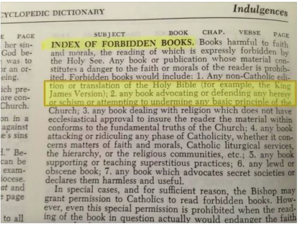
The KJV is a book that has been condemned by the Catholic church.
It should also be noted that the Vulgate was the Bible of the church for over a thousand years so it is not a surprise that we would find limited Greek manuscripts during this time seeing the vast majority of the church would have used this version. Also, just because the Vulgate has errors within its text does not mean that all of the text has erors.
This is because the Geneva Bible could use a common English word and describe its particular meaning in a marginal note, whereas the reader of the KJV could not benefit from notes and thus the translation itself required more technical terms from Anglicized Latin.”
Maybe Josiah does not know, or at least, has never read the rules given to the translators.
It clearly allowed marginal notes when a word needed to be explained.
Rule 6) No Marginal Notes at all to be affixed, but only for the explanation of the Hebrew or Greek Words, which cannot without some circumlocution, so briefly and fitly be expressed in the Text.
The KJV does have some marginal notes, that do exactly this (Rhinocerots and Unicorn being one example) https://www.followintruth.com/are-there-really-unicorns-in-the-bible-100-yes
The KJV translators were not allowed to include theological interpretative marginal notes like the Geneva Bible had (calvanistic in their readings and interpretations).
There are approximately 190 readings where the Authorized Version translators depart from Beza’s Greek text to maintain the wording of the Bishop’s Bible and other earlier English translations.
Again this is simply not true. The figure 190 actually comes from the text of Frederick Henry Ambrose Scrivener who created a TR Edition in 1881 using the 1598 edition of Beza. The text produced by Scrivener has 190(approx) differences from this text of Beza.
The KJV itself departs from Beza much less, around 20 places of any translatable differences. The Greek text of the KJV was never published. Had it been, then it would have differed from that of Scriveners.
The KJV incorporates readings form a wide variety of 16th century Greek manuscripts and also exhibits several dozen readings that were in no printed Greek text. In these cases, the English of the KJV derives directly from the Latin Vulgate.
The source of this information is presented as being Scrivener.
Here I would invite Josiah or anyone else to show where Scrivener stated the above. What he actually says is:
It may be useful to subjoin a list, probably quite an incomplete one, of places in which the translators of 1611 have apparently followed the Latin Vulgate, mostly after the example of Tyndale, sometimes, of versions later than his.
It is probable that at least some of the passages collected in the first section of the present Appendix, wherein the text of the text of the Authorised version is supported by Compl, Vulg, only, were derived from the Vulgate rather than from the Complutensian.
Although at least 80% of the KJV New Testament text is unaltered from Tyndale’s translation, the KJV borrows significantly from the Latin Vulgate and the Catholic Rheims New Testament.The KJV incorporates readings form a wide variety of 16th century Greek manuscripts and also exhibits several dozen readings that were in no printed Greek text. In these cases, the English of the KJV derives directly from the Latin Vulgate.[37] Since the KJV is supposedly, translated from original languages, it may be alarming to some that numerous words and phrases in the KJV were from the Latin Vulgate and not any Greek Manuscript.
Again…..WHERE….which readings are being referred to here.? It must be noted that about 70-80% of the Geneva Bible is taken directly from Tyndale. THe Geneva Bible and the KJV are practically identical with limited differences. The main difference is the marginal notes.
Thus the same argument would and should be presented against the prior Bibles to the KJV.
Inclusion of the Apocrypha
The Apocrypha are noncanonical books which were published in the original 1611 King James Bible and was a part of the KJV for 274 years until being removed in 1885 A.D.[45] Many of these books are called deuterocanonical books by some including the Catholic church. It has been argued that the Apocrypha should have never been included since Protestants reject it as Scripture. The inclusion of the Apocrypha is an indication that KJV’s should be questioned as being God-inspired. For example, Tobit 6:5-8 has a reference to magic and is inconsistent with the rest of the Bible. 2 Maccabees 12:45 teaches purgatory. Although the 1560 Geneva Bible contained the Apocrypha, it was separated from the rest of Scripture and contained almost no marginal notes. Many later editions of the Geneva Bible did not contain the Apocrypha
Much of what is stated here is a distortion of the truth. Just like the Geneva Bible (and the Bishops Bible) The KJV never included the Apocrypha as scripture. It was separated and distinguished from scripture. The KJV followed along the tradition of including the Apocrypha for purposes of study, but not including it as text.
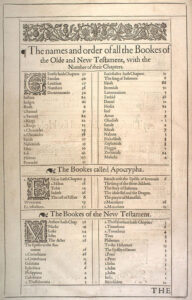
Its also interesting that both Codex Vaticanus and Sinaticus, both of which have formed arguments against the KJV in the claims of Josiah (seeing they are the manuscripts referred to as the oldest and best and on which the modern versions are predominantly based) contain Apocrypha books that are not separated from the rest of the text. They are intermingled with scripture. The two foremost manuscripts that are used in the Critical text both include Apocrypha books….a little hypocritical of anyone who points this out regarding the KJV and its “inclusion” of the Apocrypha. Anyone arguing against the Apocryphal books should provide a sufficient answer as to why these 2 manuscripts should be deemed as authoritative when they both include the books that are used to argue against the KJV.
The KJV contains 26 verses and passages that are not original and thus are are omitted or bracketed in modern translations. These verses include Matt 17:21, Matt 18:11, Matt 20:16, Matt 23:14, Mark 6:11(b), Mark 7:16, Mark 9:44, Mark 9:46, Mark 11:26, Mark 15:28, Mark 15:28, Mark 16:9-20, Luke 4:8(b), Luke 9:55-56, Luke 17:36, Luke 23:17, John 5:3-4, John 7:53-8:11, Acts 8:37, Acts 9:5-6, Acts 13:42, Acts 15:34, Acts 23:9(b), Acts 24:6-8, Acts 28:29, Rom 16:24, and the Comma Johanneum of 1 John 5:7-8.[63] With respect to the long ending of Mark (16:9-20), there is strong reason to doubt that the words were part of the original text of the Gospels, as it has been stated by a notable critic, “According to the judgment of the best critics, these two important sections are additions to the original text from the apostolic tradition.” [64]
Basically all of these verses are found in the Geneva and Bishops Bible because they are part of the Byzantine text on which the TR is based.
Josiah here has asserted that these are not original. That is a claim, he has not provided the evidence against these verses and shown that they are, in fact, not original. Each verse and passage would have to be broken down individually and demonstrated through supporting evidence as being non original. I have personally written arguments for the originality of most of these verses in depth on this blog.
The KJV also exhibits orthodox corruptions in which verses were changed in support of Trinitarian theology. Twelve examples of theologically motivated corruptions in the KJV include Matthew 24:36, Mark 1:1, John 6:69, Acts 7:59, Acts 20:28, Colossians 2:2, 1 Timothy 3:16, Hebrews 2:16, Jude 1:25, 1 John 5:7-8, Revelation 1:8, and Revelation 1:10-11.[65]
There are a number of issues with this claim.
Firstly it asserts, without providing evidence, that the verses are, in fact, trinitarian in their reading as found in the KJV, something I disagree with and have written on. It also assumes without evidence that they are corruptions and not the original reading. Even if they were trinitarian readings you cannot assert the corruption is in making them trinitarian simply because you do not agree with the theology. The Bible says what it says and you cannot base readings on personal theological beliefs. Theological beliefs should come from and be based on the Biblical readings.
Secondly, it is disingenuous not to point out the trinitarian readings found in modern versions. This suggests an argumentational bias.
There are many places where modern versions read in a more trinitarian way than modern versions, such as Jude 1:5, Romans 9:5 and John 1:18. (many others could be cited)
The source New Testament Greek texts used to produce the KJV were mainly dependent on manuscripts of the late Byzantine text-type.[66] With the more recent identification of much earlier manuscripts, modern textual scholars most carefully consider the evidence of manuscripts which belong to the Alexandrian family as earlier witnesses to the original text
Its interesting that when the Alexandrian text goes against what Josiah believes or wishes to assert he rejects that same text and those early manuscripts. The genealogy of Luke is a prime example. The Alexandrian text type, just like the Byzantine text type includes this genealogy.
Notice that yet again, Josiah has simply asserted that manuscripts of the Alexandrian text type are earlier witnesses to the original text. This again is something I disagree with and have written on. As the Byzantine Text type is almost identical and in agreement most(some 95%+) of the time, regardless of when the manuscript was produced, it is almost irrelevant as to whether than manuscript is from the 16th or 6th century. The text of the 16th Century manuscripts has been shown to read almost identically to any Byzantine text manuscript that was produced before it, regardless of age.
However, this is just simply false. The first edition of Erasmus was created using limited manuscripts available to him at the time. However, this is just not true for his subsequent editions. Erasmus travelled far and wide taking reading from manuscripts throughout Europe. Furthermore, the TR was edited by Stephanus and Beza. Beza had the text of Codex Beza available to him, the codex is named after him. We also know that Stephanus used Codex L which is from the 700’s and is widely regarded as one of the best Gospel manuscripts that we have, Erasmus was given 300 readings from Codex Vaticanus.
Now we need to ask the question why do scholars consider the Alexandrian text type the superior, something I have addressed elsewhere.
It also needs to be asked as to why when the Alexandrian text type goes against what Josiah believes he rejects the reading? It seems that Josiah is being disingenuous with the information.
For the New Testament source text, the KJV translators primarily used the 1598 and 1588/89 Greek editions of Theodore Beza, that also presented Latin texts alongside Greek ones [34] . The translators also conducted all discussions amongst themselves in Latin.
No evidence is provided that the KJV translators spoke to each other in Latin, although it is very possible seeing that the common language of the time (the Lingua Franka) would have been Latin at that time. This would not have had any effect on the translation and any claim that it would have would require evidence. The native tongue of the translators was English and they all were highly skilled in the Biblical languages of Hebrew and Greek.
Bart Ehrman, one of the world leading Scholars, and who is himself studied in Greek stated that the KJV translators were in fact, highly skilled in Greek, even surpassing his own Greek knowledge. Learning Greek is what they did….
“There are questions among scholars about how many people actually participated in the translation; but the best answer is that there were forty-seven translators, who were all skilled, highly skilled, in Greek and Hebrew. Today when somebody is highly skilled in Greek, like Jeff Siker and me, we’re considered highly skilled – that means we can kind of slosh our way through a Greek text if we have a good dictionary sitting next to us. These guys, including King James, could speak Greek and did speak Greek to each other when they felt like it. They could read Hebrew like the newspaper. These were serious serious scholars. They didn’t have TV – no ESPN. So what did they do? They sat around and studied Greek. This is what they did. And Latin, and Hebrew…”
“Manifold Greatness” exhibition at Loyola Marymount University in 2013.
It is available online Bart Ehrman: What Kind of a Text is the King James Bible? (Manifold Greatness exhibition opening)
“The sad reality is that the average so-called Greek professor could not have been hired as a tutor to a high school student one hundred years ago. The average janitor at the Helenikon International Airport in Athens is more fluent in the ancient Greek tongue than most supposed experts in the Greek language…”
Dr John M. Asquith (Pastor), Further Thoughts on the Word of God, p.35
KJV vs. Aramaic Peshitta
Before we look into this part of the argument as presented by Josah, it is important to note that the Peshitta was predated by the Diatessaron (2nd Century) and the Old Syriac preserved in 2 manuscripts, the Syriac Sinaiticus and the Curitonian (4th and 5th century) (+ 1 Lectionary) . The Old Syriac was a translation of the 4 Gospels. The date of the origination of the Peshitta is debated amongst scholars, which varies between the 2nd and 4th Centuries.
Job 19:18
Peshitta: Yea, even the wicked despise me; when I rise, they speak against me.
KJV: Yea, young children despised me; I arose, and they spake against me.
Basically every single modern version reads in the same way as the KJV….because this is translated from Hebrew not Syriac.
Ecclesiastes 2:4
Peshitta: I multiplied my servants …
KJV: I made me great works …
Basically every single modern version reads in the same way as the KJV….because this is translated from Hebrew not Syriac.
This includes the LXX and JPS Tanakh 1917
Isaiah 10:27
Peshitta: … and the yoke shall be destroyed from your neck because of your strength.
KJV: … and the yoke shall be destroyed because of the anointing.
Isaiah 29:15
Peshitta: Woe to them who act perversely to hide their counsel from the Lord; and their works are in the dark, and they say, Who sees us? And, Who knows what we do corruptly?
KJV: Woe unto them that seek deep to hide their counsel from the Lord, and their works are in the dark, and they say, Who seeth us? And who knoweth us?
Basically every single modern version reads in the same way as the KJV….because this is translated from Hebrew not Syriac.
This includes the LXX and JPS Tanakh 1917
Jeremiah 4:10
Peshitta: Then I said, I beseech thee, O Lord God, surely I have greatly deceived this people and Jerusalem; for I have said …
KJV: Then said I, Ah, Lord God! Surely thou has greatly deceived this people and Jerusalem, saying …
Basically every single modern version reads in the same way as the KJV….because this is translated from Hebrew not Syriac.
This includes the LXX and JPS Tanakh 1917
Obadiah 1:21
Peshitta: And those who are saved shall come up to mount Zion to judge mount Esau …
KJV: And saviours shall come up on mount Zion to judge the mount of Esau …
Basically every single modern version reads in the same way as the KJV….because this is translated from Hebrew not Syriac.
and JPS Tanakh 1917
Micah 1:12
Peshitta: For the rebellious inhabitant is sick of waiting for good; for disaster is come down from the Lord to the gate of Jerusalem.
KJV: For the inhabitant of Maroth waited carefully for good; but evil came down from the Lord unto the gate of Jerusalem.
Basically every single modern version reads in the same way as the KJV….because this is translated from Hebrew not Syriac.
and JPS Tanakh 1917
Habakkuk 3:4
Peshitta: And his brightness was as the light; in the city which his hands had established shall he store his power.
KJV: And his brightness was as the light; he had horns coming out of his hand: and there was the hiding of his power.
The Septuagint reads as the KJV
The “horns” are beams of light the Hebrew is Horn
The KJV as divine inspiration
It has been suggested by some of those who advocate for KJV only, that the decisions to use Latin rather than Greek sources were divinely inspired.[38] Some go as far to state that the AV/KJV is a “new revelation”, or “advanced revelation” from God.[39] A common argument is that if God provides truth through scriptural revelation, God must also ensure a preserved and uncorrupted transmission of his revelation. Their dogma of providentially preserved transmission gives them the presumption that Textus Receptus must be the closest text to the Greek autographs.[40] This is counter to modern textural criticism which has demonstrated that the texts were corrupted over centuries of transmission. Textural criticism has given us a systematic approach to evaluating what is likely the original reading in providing both a restored critical text and a critical apparatus for identifying significant variants.[41]
Regardless of what KJV advocates say (even though many would not say what has been asserted in the above claims), these arguments have nothing to do with the KJV itself. It is the text itself that is either correct or not, the beliefs of those that use the KJV is actually irrelevant.
It must also be noted that if people believe that the Textus Receptus is closest to the originals, this is not an argument against the KJV itself. It is only those that do not believe that the Textus Receptus is the closest to the original that would have issues with this statement. Wewould have to address modern textual criticism in order to address this claim, something I have done in many other writings.
That is why the King James translators immediately started to make changes for the 1611 edition and came out with another in 1613 and another in 1629.
The KJV translators did not start to make changes, they started to correct the printing errors that had occurred in the first printing of the KJV.
Although some King James only folks think that the KJV translators were divinely inspired, the translators themselves did not. They wrote, “The original thereof being from heaven, not from earth; the author being God, not man; the writer the Holy Spirit, not the wit of the Apostles or Prophets.”[42] Later they wrote that “all truth must be tried by the original tongues, the Hebrew and Greek.” Thus, the King James translators believed that the authority of Scripture was in the original manuscripts of the original languages.
The KJV translators also expressed that other English Bibles were inspired, even the poorest translations. They wrote, “Nay, we affirm and avow that the meanest (worst) translation of the Bible in English is the Word of God.”
Here Josiah contradicts himself. He says that the KJV translators did not think they were inspired and yet he then says that the KJV translators believed all translations in English were inspired, which would mean the KJV also.
I shall update this writing as and when new arguments or evidence are provided.
If you liked this study please subscribe here
You can buy my books on Amazon there is a link here
Join our Patreon membership here or you can buy me a coffee through paypal
0 Comments