Forgive or not to forgive?
Is Mark11:26 scripture or not?
Another verse under the scrutiny of textual criticism is Mark 11:26. In this verse it is recorded that Jesus states if you do not forgive then your father in heaven will not forgive
Mark 11:26 But if ye do not forgive, neither will your Father which is in heaven forgive your trespasses.
However, this verse is missing from many of the modern versions of the Bible such as the NIV, ESV and Net Bible.
It is not included in the NA28/UBS5 Greek text.
So should this verse be considered scripture and included in the Bible just as it is in the KJV or omitted like it is in the majority of modern versions?
Let’s take a look at the evidence.
The verse is included in the vast majority of Greek manuscripts, including Codex Alexandrinus. It is also included in C, D, E, F, G, H, K, M, N, U, V, X, Y, Gamma, Theta, Pi, Sigma and Omega.
The ESV footnotes states that “SOME manuscripts add…..
Some manuscripts add verse 26: But if you do not forgive, neither will your Father who is in heaven forgive your trespasses
https://www.esv.org/Mark+11/
SOME…SOME…..its in over 96% of all Greek manuscripts, this footnote is not giving readers the truth.
The verse is absent in Codex Vaticanus and Codex Sinaiticus. (Also excluded in W Cesarean in Mark ) L Aexandrian , Δ which has a mixed text but is alexandrian in Mark Ψ Alexandrian in Mark , 055 Byzantine
This evidence goes against the claim of Bruce Metzger that the exclusion of this verse is found in early manuscripts that include all text types. It is clear that the early manuscript evidence for the exclusion is Alexandrian.
Although it might be though that the sentence was accidently omitted because of homoioteleuton ts absence from early witnesses that represent all text-types makes it highly probable that the words are inserted by a copyist in imitation of Mt 6:15
A textual commentary on the Greek New Testament : a companion volume to the United Bible Societies’ Greek New Testament (fourth revised edition) Bruce Metzger
https://archive.org/details/textualcommentar0000metz/page/110/mode/2up
NONE of the Papyrus contain this portion of the text, either from Damage or they are none existant at this portion of text.
In Addition to the Greek manuscripts the verse is also found in ancient translations such as the Gothic, Peshitta and the Vulgate. It can be found in old latin manuscripts a, b, c, d, f, ff2, m, q and r1.
This shows a wide and early transmission line from ancient Greek where the verse was clearly part of the text.
We also have early patristic attestation to the verse being used that pre-date Codices Vaticanus and Sinaticus.
In the middle part of the 3rd Century, Cyprian bishop of Carthage cited the verse in one of his works. this is our earliest witness to the verse.
“In the Gospel, in the daily prayer: ‘Forgive us our debts, even as we forgive our debtors.’ Also according to Mark: ‘And when you stand for prayer, forgive, if you have ought against any one; that also your Father who is in heaven may forgive you your sins. But if you do not forgive, neither will your Father which is in heaven forgive you your sins.’ Also in the same place: ‘In what measure you mete, in that shall it be measured to you again.’”
Treatise XII, Book 3, in chapter 22,
Cyprian specifically states that this was according to Mark, this eliminates the possiblity that he was citing Matthew 6:15. Cyprian was writing in North Africa.
The Greek of Matthew 6:15 and Mark 11:26 are actually very different (depsite the last 8-9 words which we will address in a moment) . So different that it really cannot honestly be argued that either is copying the other.
καὶ ὅταν στήκητε προσευχόμενοι ἀφίετε εἴ τι ἔχετε κατά τινος ἵνα καὶ ὁ πατὴρ ὑμῶν ὁ ἐν τοῖς οὐρανοῖς ἀφῇ ὑμῖν τὰ παραπτώματα ὑμῶν Mark 11;26
Matthew 6:15 ἐὰν δὲ μὴ ἀφῆτε τοῖς ἀνθρώποις τὰ παραπτώματα αὐτῶν, οὐδὲ ὁ πατὴρ ὑμῶν ἀφήσει τὰ παραπτώματα ὑμῶν
Modern textual criticism ignores the early attestation, the wide transmission line and the overall Greek manuscript evidence and once again favours the reading of Vaticanus and Sinaticus.
But is there a simple answer as to how this verse may have been lost? The answer is yes….Homoioteleuton, despite what Bruce Metzger had claimed.
This is a common phenomenon in text transmission. It simply means same ending. When two words have the same ending in a certain portion of text a copyist eye goes from one instance of the same ending to the other, missing out all that is inbetween. This could be a word, a sentence or a whole passage of text.
Let us now look at the text of Mark 11:25 and 11:26
Mark 11:25 καὶ ὅταν στήκετε προσευχόμενοι, ἀφίετε εἴ τι ἔχετε κατά τινος, ἵνα καὶ ὁ πατὴρ ὑμῶν ὁ ἐν τοῖς οὐρανοῖς ἀφῇ ὑμῖν τὰ παραπτώματα ὑμῶν.
Mark 11:26 εἰ δὲ ὑμεῖς οὖκ ἀφίετε, οὐδε ὁ πατὴρ ὑμῶν ὁ ἐν τοῖς οὐρανοῖς ἀφησεὶ τὰ παραπτώματα ὑμῶν
Notice that both verses end with ὑμῶν.
If a copyist went from the ὑμῶν. of Mark 11:25 and after copying this word into his manuscript his eyes returned to the exemplar but found the ὑμῶν. of verse 26 he may well have then continued from this point missing out the entire verse in between these two words.
This possibility becomes even more plausible when we note that both verses actually end in almost he same 8 words (verse 25 does have ὑμῖν in the text where verse 26 does not and 25 reads ἀφῇ while 26 reads ἀφησεὶ.
ὁ ἐν τοῖς οὐρανοῖς ἀφῇ ὑμῖν τὰ παραπτώματα ὑμῶν. 25
ὁ ἐν τοῖς οὐρανοῖς ἀφησεὶ τὰ παραπτώματα ὑμῶν 26
But when we look at these words it is very plausible that the copyist simply jumped over verse 26 accidentally omitting the words.
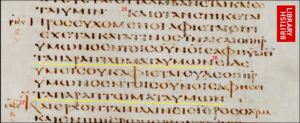
It is my opinion that the inclusion of this verse due to a parableptic error is a better explanation than the exclusion due to a later scribal harmonisation with Matthew 6:15.
If you liked this study please subscribe here
You can buy my books on Amazon there is a link here
Join our Patreon membership here or you can buy me a coffee through paypal
0 Comments