Are there really Unicorns in the Bible?…..100% Yes!!!!
Buy my books here
It is often stated when attacking the Bible, how can anyone take seriously a book that includes Unicorns? It’s a reasonable question, nobody has ever proven that unicorns exist or have ever existed. Not one fossil of one single bone of a unicorn has ever been found. Unicorns are mythical creatures and not part of reality. A book that includes them as if they were real cannot be taken seriously. And I would agree. Yet I fully 100% believe in the Bible. So how do I reconcile these two seemingly irreconcilable things? It’s pretty simple. When people today think of the word unicorn they automatically imagine the horse like creature with a single horn protruding from its head. This creature is almost certainly mythical. As we have already established no proof of its existence has ever been found. Any book that includes this creature as if it were real should not be given any credit. However this is not the unicorn that is mentioned in the Bible.
The word Unicorn is mentioned 9 times in the KJV version in verses such as: Deuteronomy 33:17
Deuteronomy 33:17 His glory is like the firstling of his bullock, and his horns are like the horns of unicorns: with them he shall push the people together to the ends of the earth: and they are the ten thousands of Ephraim, and they are the thousands of Manasseh. KJV
Other versions such as the NIV and ESV use the word wild Ox instead
Deuteronomy 33:17 In majesty he is like a firstborn bull; his horns are the horns of a wild ox. With them he will gore the nations, even those at the ends of the earth. Such are the ten thousands of Ephraim; such are the thousands of Manasseh.” NIV
Deuteronomy 33:17 A firstborn bull—he has majesty, and his horns are the horns of a wild ox; with them he shall gore the peoples, all of them, to the ends of the earth; they are the ten thousands of Ephraim, and they are the thousands of Manasseh.”
So the argument the Bible mentions Unicorns actually only works if the KJV is taken as the correct translation. If a person uses the NIV or ESV they can simply say that unicorns are not mentioned in the Bible but are mentioned in a Bible translation. The correct translation is wild ox and therefore the argument the Bible includes unicorns fails. But what about those who like myself do believe that the KJV is the correct translation and that Unicorn and not wild ox is in fact the correct word to use.
All uses of the word unicorn appear in the OT and are translated from the Hebrew word
רְאֵם Reem. The KJV translates this as unicorn/s in all 9 uses of the word.
So why is Unicorn and not wild ox the correct translation.
Firstly, Ox has its own Hebrew word שׁוֹר shor which is not what is being used and is translated as OX by by both the NIV and the ESV
Exodus 23:12 “Six days do your work, but on the seventh day do not work, so that your ox and your donkey may rest, and so that the slave born in your household and the foreigner living among you may be refreshed. NIV
Exodus 23:12 “Six days you shall do your work, but on the seventh day you shall rest; that your ox and your donkey may have rest, and the son of your servant woman, and the alien, may be refreshed. ESV
Secondly it cannot be a wild ox, the wild ox is simply an ox that is wild
In a passage in Isaiah we are told that the “reem” translated as wild ox in the NIV and Unicorn in the KJV cannot be tamed.
Job 39:9 “Will the wild ox consent to serve you? Will it stay by your manger at night? 10 Can you hold it to the furrow with a harness? Will it till the valleys behind you? 10 Can you hold it to the furrow with a harness? Will it till the valleys behind you? 11 Will you rely on it for its great strength? Will you leave your heavy work to it? 12 Can you trust it to haul in your grain and bring it to your threshing floor?NIV
Job 39:9 Will the unicorn be willing to serve thee, or abide by thy crib? 10 Canst thou bind the unicorn with his band in the furrow? or will he harrow the valleys after thee? 11 Wilt thou trust him, because his strength is great? or wilt thou leave thy labour to him? 12 Wilt thou believe him, that he will bring home thy seed, and gather it intothy barn?KJV
However, a wild ox (shor) CAN be tamed. Therefore, the use of wild ox does not work.
But we have already established that unicorns are not real so how can unicorn still be the correct word to use.
In the original 1611 edition of the KJV bible the translators used two slashes // known as a siglum. These were used throughout the Bible. In Isaiah 34:7 before the word Unicorn they used these slashes //unicorn. In the margin they again use the siglum with the words //”or Rhinocerots”
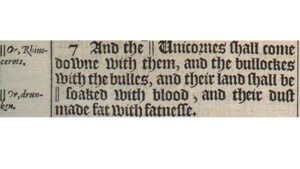
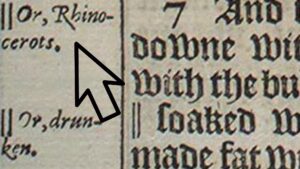
This was the word for Rhinoceros in 1611. The KJV translators clearly linked the word Unicorn with the Rhinoceros.
Oxford English dictionary states the origin of the word Unicorn
Middle English: via Old French from Latin unicornis, from uni- ‘single’ + cornu ‘horn’, translating Greek monokerōs.
Both these words mean one horned. The word unicorn simply means single horned.
If we have a look at Job 39:9 in the Greek septuagint we will see that the word reem is translated as Monokeros
Job 39:9 βουλήσεται δέ σοι μονόκερως δουλεῦσαι ἢ κοιμηθῆναι ἐπὶ φάτνης σου septuagint
And in Isaiah 34:7 in the Latin vulgate reem is translated as unicornes
Isaiah 34:7 et descendent unicornes cum eis et tauri cum potentibus inebriabitur terra eorum sanguine et humus eorum adipe pinguium Vulgate
When Jerome translated the Hebrew into latin he translated the Hebrew word Reem as Unicornis 4 times And Rinocerotis 5 times as we see in the translation of Job 39:9
Job 39:9 numquid volet rinoceros servire tibi aut morabitur ad praesepe tuum
Jerome who had spent years learning Hebrew among the Jews equated Rinoceros and unicornes as interchangeable, in other words meaning the same thing. A one horned Rhinoceros.
The Indian and Javan Rhinos have just one horn.
And today the scientific name for a one horned Rhinoceros is Rhinoceros unicornis (Greater One-horned Rhino, Great Indian Rhinoceros, Indian Rhinoceros)
(Diceros bicornis is the scientific name for a 2 horned Rhinoceros)
So in the latin vulgate we have Rinoceros and unicornis both being used where the KJV uses Unicorn. And the scientific name of a Rhinoceros being Rhinoceros unicornis
If you look at webster’s dictionary today under Unicorn we are given the following definition.
unicorn
1: a mythical usually white animal generally depicted with the body and head of a horse with long flowing mane and tail and a single often spiraled horn in the middle of the forehead
2: an animal mentioned in the Bible that is usually considered an aurochs, a one-horned rhinoceros, or an antelope
Although definition 1 states the now traditional understanding of the word it also has a 2nd definition and clearly states the animal in the Bible considered to be a one horned Rhinoceros
If we have a look at the same dictionary but from the very first edition back in 1828 we can see that the first definition is that of a Rhinoceros.
unicorn
U’NICORN, n. [L. unicornis; unus, one, and cornu, horn.]
1. an animal with one horn; the monoceros. this name is often applied to the rhinoceros.
2. The sea unicorn is a fish of the whale kind, called narwal, remarkable for a horn growing out at his nose.
3. A fowl.
fossil unicorn, or fossil unicorn’s horn, a substance used in medicine, a terrene crustaceous spar.
Definition number one says it all……there simply was no definition that referred to a mythical creature, a horse or a horse like animal
And if we look at the word Rhinoceros in the same dictionary we see that included in the definition is unicorn.
rhinoceros
RHINOC’EROS, n. [L. rhinoceros; Gr. nose-horn.]
A genus of quadrupeds of two species, one of which, the unicorn, as a single horn growing almost erect from the nose. This animal when full grown, is said to be 12 feet in length. There is another species with two horns, the bicornis. They are natives of Asia and Africa.
It is simply dishonest to take a modern definition of a word and apply it back to a usage of that word when the definition of that word was different. If we did that to the film the Gay Parisian and apply the modern definition of the word gay back into the meaning in the film this would absolutely change the meaning of the film which would simply be incorrect. This is not how we should understand the meaning of a word used before the change of definition.
BUT even today, while the main definition may have changed a unicorn, according to dictionary definitions, can still can mean a Rhinoceros. When the Bible mentions Unicorn it is not referring to the mythical horse like creature or a wild Ox rather very clearly the creature in question is a one horned Rhinoceros which was otherwise known as a Unicorn.
The earliest recorded reference to thy mythical “unicorn” comes to us from the writings of Ctesias in his work Indika, on India, around 400BC. This writing survives in the writings of Photius in the 9th century AD. The mention of the unicorn is found in fragment 25.
There are in India certain wild asses which are as large as horses and even larger. Their bodies are white, their heads dark red, and their eyes dark blue. They have a horn in the middle of the forehead that is one cubit [about a foot and a half] in length; the base of this horn is pure white…the upper part is sharp and of a vivid crimson, and the middle portion is black. Those who drink from these horns, made into drinking vessels, are not subject, they say, either to convulsions or to the falling sickness. Indeed they are immune even to poisons if, either before or after swallowing such, they drink wine, water, or anything else from these beakers.
As we have seen Ctesias makes mention of the healing powers of the horn. There are many myths that also make mention of the healing powers of horns.
There is a Kongo tradition about an animal called an Abada. This creature is about the size of a donkey with the tail of a boar with 2 horns. The horns of the Abada are said to have healing qualities.
Abada (unicorn) – Wikipedia
There are other creatures believed to have power in its horn, such as in the South American legend of the camahueto.
Ctesias had never been to India and was retelling the information he had heard from others. It is almost certainly an elaborated reference to the Indian Rhino.
He continues:
This animal is exceedingly swift and powerful, so that no creature, neither horse nor any other, can overtake it…There is no other way to capture them in the hunt than this: when they conduct their young to pasture, if they are surrounded by many horsemen, they refuse to flee, thus forsaking their offspring. They fight with thrusts of horn; they kick, bite, and strike with wounding force both horses and hunters; but they perish under the blows of arrows and javelins, for they cannot be taken alive. The flesh of this animal is so bitter that it is not edible; it is hunted for its horn and its ankle-bone.
Others such as Aristotle (referring to it as the “Indian ass”) and Julius Cesar make mention of this animal but it is Pliny the Elder who first calls it “monocerotem” in his work the Natural History
Latin
In India et boves solidis ungulis, unicornes, et feram nomine axin hinnulei pelle pluribus candidioribusque maculis, sacrorum Liberi patris — (Orsaei Indi simias candentes toto corpore venantur) —, asperrimam autem feram monocerotem, reliquo corpore equo similem, capite cervo, pedibus elephanto, cauda apro, mugitu gravi, uno cornu nigro media fronte cubitorum duum eminente. Hanc feram vivam negant capi.
English translation
There are in India oxen also with solid hoofs and a single horn; and a wild beast called the axis, which has a skin like that of a fawn, but with numerous spots on it, and whiter; this animal is looked upon as sacred to Bacchus. The Orsæan Indians hunt down a kind of ape, which has the body white all over; as well as a very fierce animal called the monoceros, which has the head of the stag, the feet of the elephant, and the tail of the boar, while the rest of the body is like that of the horse; it makes a deep lowing noise, and has a single black horn, which projects from the middle of its forehead, two cubits in length. This animal, it is said, cannot be taken alive.
Pliny the Elder Natural History 8:31 (J. Bostock, H.T. Riley, 1855)
It is Roman Historian Aelian, writing in the 2nd Century that brings us the spiralled Horn as he says the unicorn is reddish in colour and has a black horn that spirals up to a sharp point.
Justin Martyr makes reference to a unicorn when referring to the cross of crucifixion.
“Further, God pointed out m another way the
strength of the mystery of the cross when He said by
Moses in the blessing wherewith He blessed Joseph: Of
the blessing of the Lord is his land, of the seasons of
heaven and its dews, and of the abyss of streams from
below-and fruits in season from the course of the sun;
and of the conjunctions of months, and of the top of
ancient mountains, and of the top of hills, and of perennial
streams, and of fruits of a land of plenty. And let the
things accepted of Him who appeared in the bush come
on the head of Joseph and on his pate. Glorified among
his brethren as first-born; as of a bull is his glory; his
horns are the horns of an unicorn; with them shall he
push nations together even at the very end of the earth. 3
2. For no one could say or prove that the horns of a
unicorn are of any other matter or form than of the
figure which represents a cross. For the one piece of
wood stands upright, from which the upper part is raised
up into a horn, when the other piece of wood is fitted on,
and the ends seem like horns joined to that one horn.
And the piece fixed in the middle’ itself on which they that are crucified are upborne also projects like a horn, and
itself looks like a horn when fashioned together and fixed
in with the other horns“
Justin Martyr Dialogue with Trypho XCI
Likewise Tertullian also refers to the unicorn in this way:
Joseph likewise was a type of Christ, not indeed on this ground (that I may not delay my course ), that he suffered persecution for the cause of God from his brethren, as Christ did from His brethren after the flesh, the Jews; but when he is blessed by his father in these words: His glory is that of a bullock; his horns are the horns of a unicorn; with them shall he push the nations to the very ends of the earth,
Deuteronomy 33:17 — he was not, of course, designated as a mere unicorn with its one horn, or a minotaur with two; but Christ was indicated in him — a bullock in respect of both His characteristics: to some as severe as a Judge, to others gentle as a Saviour, whose horns were the extremities of His cross. For of the antenna, which is a part of a cross, the ends are called horns; while the midway stake of the whole frame is the unicorn. By this virtue, then, of His cross, and in this manner horned,
He is both now pushing all nations through faith, bearing them away from earth to heaven; and will then push them through judgment, casting them down from heaven to earth.
Against Marcion book 3 chapter 18
Basil the great also does this.
On the whole, since it is possible to find the word ‘horn’ used by Scripture in many places instead of ‘glory’, as the saying ‘He will exalt the horn of his people’ (Ps 148:14) and ‘His horn shall be exalted in glory’ (Ps 112:9), or also, since the ‘horn’ is frequently used instead of ‘power’, as the saying ‘My protector and the horn of my salvation’, Christ is the power of God; therefore, he is called the Unicorn on the ground that he has one horn, that is, one common power with the Father.
Homilies on the Psalms13.5 (commenting on Psalm 92:10):
There is also mention of the unicorn in a 2nd century “Christian” work called Physiologus. The Unicorn is referenced numerous times. I shall just give an example:
“The unicorn has one horn because the Savior said, “I and the Father are one” [John 10:30]. “For he has raised up a horn of salvation for us in the house of his servant David” [Lk. 1:69]. Coming down from heaven, he came into the womb of the Virgin Mary. “He was loved like the son of the unicorns” [cf. Ps. 22:21] as David said in the psalm.
Over time the myth of the “unicorn” has grown. It is during Medieval times that the image that we recognise to day as the “unicorn”, horse like creature, that became prominent. What probably started off as a fanciful reference to a Rhino has become embellished and turned into the creature that is so commonly known as the unicorn today.
Marco Polo claimed to have seen a unicorn.
Their hair is like that of a buffalo, and their feet like those of an elephant. In the middle of the forehead they have a very large black horn…. Their head is like that of a wild boar, and is always carried bent to the ground. They delight in living in mire and in mud. It is a hideous beast to look at, and in no way like what we think and say in our countries, namely a beast that lets itself be taken in the lap of a virgin. Indeed, I assure you that it is quite the opposite of what we say it is.
If you liked this study please subscribe here
You can buy my books on Amazon there is a link here
Help me keep this site free for all. Join our Patreon membership here
0 Comments