The truth about the Greek Septuagint (part 1)
“Jesus quoted from “the” Greek Septuagint………..”
I’m sure at some point just about every Christian has either made this claim themselves or has heard this claim being made by someone else. I know I most certainly have. On so many an occasion that it would be near on impossible for me to count …..on my fingers and toes anyway.
It is said so matter of fact, Jesus quoted “the” Greek Septuagint.
“By the first century, the LXX was the Bible of Greek-speaking Jews and so was the most frequently used version of the Old Testament in the early Church. For this reason, it was natural for the authors of the New Testament to lift quotes from it while writing in Greek to the Church.
But, while the New Testament authors quoted the LXX frequently, it does not necessarily follow that Christ did. We know for certain that Jesus quoted the Hebrew Old Testament at times, since he read from the scrolls in the synagogue. But Jesus could have only quoted from the Hebrew, and the New Testament authors later used the Greek translation to record the fact.
Either way, it doesn’t matter, because the Greek New Testament is inspired, and the Holy Spirit chose to have the sacred authors repeatedly cite the LXX. It doesn’t really matter if Jesus was quoting Scripture in Hebrew or Aramaic if the Holy Spirit chooses to use the Septuagint when translating his words into Greek. The importance of the Septuagint is demonstrated no matter which of these is the case.
But, since you ask, here is an example where the Greek gospels present Jesus as quoting the Septuagint: In Mark 7:6–7, Jesus quotes the LXX of Isaiah 29:13 when he says, “Well did Isaiah prophesy of you hypocrites, as it is written, ‘This people honors me with their lips, but their heart is far from me; in vain do they worship me, teaching as doctrines the precepts of men.’”
https://www.catholic.com/qa/in-which-passages-does-jesus-quote-the-septuagint-and-where-does-the-new-testament-allude-to-the
We will look at this specific quotation a little later in this study.
“Jesus and the Apostles studied, memorized, used, quoted, and read most often from the Bible of their day, the Septuagint. “
https://www.christianity.com/jesus/birth-of-jesus/genealogy-and-jewish-heritage/what-bible-did-jesus-use.html
“Of the approximately 300 Old Testament quotes in the New Testament, approximately 2/3 of them came from the Septuagint (the Greek translation of the Old Testament) which included the deuterocanonical books that the Protestants later removed.”
https://www.scripturecatholic.com/septuagint-quotes-new-testament/
Notice the assertion regarding the deuterocananical books, this also has an important part of to play. We shall also get to this later on in the study.
Then we get the good old “if it was good enough for Jesus and the New Testament writers then it is good enough for me” statements.
Many people actually believe the Septuagint to be an inspired version:
But how true are these claims?
In this writing I am going to look at the history of “the” Septuagint, examine the “facts” regarding its origin and authenticity and see just how true the commonly accepted statement “Jesus quoted from “the” Greek Septuagint………..” actually is.
It is my belief that not only did Jesus NOT quote “the” Septuagint text but I do not believe that such a thing as a “Septuagint” an “official” Greek translation of the Hebrew text even existed until at least AFTER Jesus himself had died and resurrected and ascended into heaven, and certainly not in existence when he was alive and preaching in the synagogues. Now this claim is NOT to be confused with the claim that there were no BC translations of the Hebrew of some sort. That is not what is being argued here at all. There may well have been and actually more accurately stated, there most certainly was some kind of Greek version of something regarding a translation of the Hebrew, we have manuscript evidence for such a thing. Very limited fragmentary manuscript evidence, but manuscript evidence non the less. However, it is almost certain that this translation or even more probable these translations, as there are likely more than one, were nothing more than individual attempts to translate a book or two, or maybe even the complete Torah into Greek. There is even a possibility that the Hellenistic Jews in Alexandria created a translation of their own which may well have become what is known as “the” Septuagint in ancient circles. But certainly NOT what is commonly understood as “the” Septuagint today. Not by a long shot. The Septuagint of today was not the Septuagint that existed before and around the time of Christ, had such a thing actually existed.
Now, I already know some of the arguments that will be used against me. One such being that I’m biased, my KJV only goggles have blinded me from the truth (I am not KJV only by the way). I need “the” Septuagint to be false so I can grasp hold of my precious KJV even tighter (it is the only English translation that I use as authoritative). I am a Bible worshipper ect….(I have already experienced these many many times). Anyone that has read my writings, however, will know I am far from biased. I personally do not care if I go against the traditional beliefs, or if something goes against what I believe, or at least what I believed, I am not scared to change my belief on something if I am shown wrong or my own study goes against my own personal belief. I have changed my belief on subjects based on personal study a number of times.
While I personally did not believe that Jesus would have quoted “the” Septuagint, I 100% believed that “the” Septuagint was an actual thing, an official pre Christ translation of the Hebrew Bible into Greek translated by the Jews themselves using their manuscripts, I mean, doesn’t everyone believe that? That was until I studied what that “thing” actually was, and as such do not need “the” Septuagint to be fake, to not be an actual thing (pre Christ anyway), because my KJV preference does not stem from the lack of or existence of “the” Septuagint in order for me to have a KJV preference. It’s a strawman argument at best. You do not need to be KJV only in order to reject the existence of a BC “the” Septuagint, as the rejection, or acceptance of such should be based on the evidence of a BC Septuagint and not a need to hold onto any certain belief. Before I started my study into “the” Septuagint I was not aware just how little evidence and how poorly supported the existence of “the” Septuagint actually was. How much assumption has been made in order for “it” to be. It just seems to be accepted as a fact. So with that out the way we can continue.
Questions
The questions must be asked
Did Jesus really quote “the” Greek Septuagint? Did Jesus really quote a Greek translation of the Hebrew texts? A Greek translation of the Hebrew texts that contain the apocrypha? A Greek translation of the Hebrew texts that contain the apocrypha that was “apparently” translated for Hellenistic Jews in Egypt (did you hear that part as well?) there are so many different stories it is hard to keep up , while he himself taught Jews in Israel? Not only did he, but also WHY would he use this translation?
And of course, what is “the” Greek Septuagint anyway?
First things first
The first thing that we need to do is explain exactly what “the” Septuagint actually is, even though I’m sure most people will say “I already know what it is”. Yes I am making lots of assumptions of what people will say, although this may not be as assumptive as some may think, these are actual statements that I have heard.
If you type “What is the Greek Septuagint” into google you will probably get thousands of results. One of the first I got was from Britannica.com that states
“Septuagint, abbreviation LXX, the earliest extant Greek translation of the Old Testament from the original Hebrew. The Septuagint was presumably made for the Jewish community in Egypt when Greek was the common language throughout the region.”
Britannica.com
Notice the word “presumably” here….Also note the reason for the translation.
Also there is the obvious Wikipedia entry
“The Septuagint or LXX (from the Latin: septuāgintā literally “seventy”; sometimes called the Greek Old Testament) is the earliest extant Greek translation of the Old Testament from the original Hebrew.[1] It is estimated that the first five books of the Old Testament, known as the Torah or Pentateuch, were translated in the mid-3rd century BCE and the remaining texts were translated in the 2nd century BCE.[2] Under Christian auspices, the Septuagint includes the Hebrew Bible as well as the deuterocanonical books of the Christian Old Testament. Considered the primary Greek translation of the Old Testament, it is quoted a number of times in the New Testament,[3][4] particularly in Pauline epistles,[5] by the Apostolic Fathers, and later by the Greek Church Fathers.
The full title in Ancient Greek: Ἡ τῶν Ἑβδομήκοντα μετάφρασις, literally “The Translation of the Seventy”, derives from the traditional story recorded in the Letter of Aristeas that the Septuagint was translated at the request of Ptolemy II by 70 or 72 Jewish scholars (6 from each of the 12 tribes of Israel) who independently translated identical versions of the entire Hebrew canon.[6][7][8] Subsequently, the Greek translation was in circulation among the Alexandrian Jews who were fluent in Greek, the common language in Egypt at the time, but not in Hebrew.[9][10] Separated from the Hebrew canon in Rabbinic Judaism, translations of the Torah into Greek by early Jewish rabbis have survived as rare fragments only.
The Septuagint should not be confused with other Greek versions of the Old Testament,[7] most of which did not survive except as fragments (some parts of these being known from Origen‘s Hexapla, a comparison of six translations in adjacent columns, now almost wholly lost). Of these, the most important are those by Aquila, Symmachus, and Theodotion.
Modern critical editions of the Septuagint are based on the Codices Vaticanus, Sinaiticus, and Alexandrinus.”
https://en.wikipedia.org/wiki/Septuagint
Can’t help but notice the word “estimated” here as well……hmmm
Let’s have a look at one last source….Septuagint.net (sounds like a good source to me)
Septuagint (sometimes abbreviated LXX) is the name given to the Greek translation of the Jewish Scriptures. The Septuagint has its origin in Alexandria, Egypt and was translated between 300-200 BC. Widely used among Hellenistic Jews, this Greek translation was produced because many Jews spread throughout the empire were beginning to lose their Hebrew language. The process of translating the Hebrew to Greek also gave many non-Jews a glimpse into Judaism. According to an ancient document called the Letter of Aristeas, it is believed that 70 to 72 Jewish scholars were commissioned during the reign of Ptolemy Philadelphus to carry out the task of translation. The term “Septuagint” means seventy in Latin, and the text is so named to the credit of these 70 scholars.
https://www.septuagint.net/
Notice the claim “this Greek translation was produced because many Jews spread throughout the empire were beginning to lose their Hebrew language”.
I’m sure that many have heard this claim as well, again I know I have. Remember it as this will come into play during this study.
So there we have it, basically “the” Greek Septuagint is the “authorised” BC Greek translation of the Hebrew Bible or at least the Torah anyway, translated by the Jews using THEIR scriptures in or around the year 285 BC. It should not be mistaken for any other Greek translation. Not all Greek translations are “the” Septuagint. We know of many different translations that have occurred over time. Aquila, Symmachus and Theodotion all translated the Hebrew into Greek. These 3 were included in the Hexapla of Origen. NONE of these 3 translations are Septuagint translations. “The” Septuagint is a specific translation. Translated by the 72(70) translators in Egypt using THEIR own manuscripts…or through divine inspiration (as some legends have it) . Any other Greek translation of the Hebrew simply cannot be “the” Septuagint and is, therefore, just a translation. Despite this simple fact, what has happened, throughout time, is that many people today apply the term “the” Septuagint to any Greek translation of the Hebrew Bible. This is a mistake that causes confusion.
Now You may have noticed that I put “the” of “the” Septuagint in brackets. This is because there is actually NO SUCH THING as THE Greek Septuagint. Yes I really did just say that. Contrary to what is believed by many, which included myself there is no such thing as THE Septuagint. When a person says “the” Greek Septuagint it’s a fair guess that that person has not personally studied the subject or at least not in any great depth. Just as I myself used to refer to THE Greek Septuagint, rather ignorantly I shall add, through a lack of proper study. Simply taking what is commonly “known” and accepted as if it were truth. I should have known better.
Lancelot Brenton stated in his introduction to the Septuagint
“We need not wonder that but little is known with accuracy on this subject; for, with regard to the ancient versions of the Scriptures in general, we possess no information whatever as to the time or place of their execution, or by whom they were made: we simply find such versions in use at particular times, and thus we gather the fact that they must have been previously executed.”
Brenton’s introduction to the Septuagint.
In their book Invitation to the Septuagint, Jobes and Silva explain that there really is no such thing as the Septuagint, this isn’t simply my own statement that I have made up.
Strictly speaking, there is really no such thing as the Septuagint. This may seem like an odd statement in a book entitled Invitation to the Septuagint, but unless the reader appreciates the fluidity and ambiguity of the term, he or she will quickly become confused by the literature.!
One might think that the Septuagint is the Greek version of the Bible in the same way that the Vulgate, for example, is the Latin version. The difference between them, however, is much greater than simply the language used. The Vulgate was largely the work of one man (Jerome) at one time (the end of the fourth century) in one place (Bethlehem).? As a result, the Latin Vulgate is characterized by unity throughout. Not so with the Septuagint, which was produced by many people unknown to us, over two or three centuries, and almost certainly in more than one location. Consequently, the Greek Old Testament does not have the unity that the term the Septuagint might imply.
Jobes and Silva, invitation to the Septuagint page 30
The book is certainly one that I would recommend to anyone wishing to delve deeper into the origination of the Septuagint.
Lets here just quote a few more statements from the book. The information is quite important to understand in order to piece together the Septuagint puzzle.
In fact, there was no one uniform Greek version of the entire Hebrew Bible—just individual scrolls that had been copied from other scrolls through the ages. For instance, a medieval Greek codex might contain the text of Genesis copied from a manuscript produced in the first century of our era and containing the translation originally made in the third century B.c.E. in Alexandria, while the text of Esther bound in the same codex may have been copied from a manuscript produced in the fourth century of our era and containing a translation made in the first century B.c.E. in Jerusalem.
Jobes and Silva, invitation to the Septuagint page 31
However, when the Greek version of a biblical book survives in more than one form, it is not always possible to know with certainty which is the older. Nor is it possible to know for sure if the oldest surviving form was in fact the first Greek translation made of that book
Jobes and Silva, invitation to the Septuagint page 33
First of all unlike as it is commonly referred to today, it was not the text itself that was originally referred to as “the” Septuagint. “The” Septuagint originally referred to the “apparent” translators of the Greek translation of the Hebrew scriptures and not the actual translation itself. Septuagint from the Latin septuāgintā meaning 70. It is also known by its Roman numerals name the LXX again meaning 70. This number is rather important which will also be shown in this study.
It isn’t until the early to mid 17th century that we get Septuagint referring to the text itself and for a time during the 17th century the translators become known as the Septuagints, a plural of Septuagint that was by this time starting to be used for the text.
John Owen refers to the LXX using a plural noun referring to the LXX as the translators rather than the text.
Todays Septuagint
What passes as the modern Greek Septuagint(s) (plural)as there are more than one Greek Septuagint in existence today, the texts of which are most certainly not the same text as what would have existed back in 285 BC had such a document even existed, are actually a compilation of primarily the codices Vaticanus (vast majority) and Sinaiticus and to a lesser extent Alexandrinus, all of which are considered “Septuagint texts and all of which disagree with each other in literally thousands of places. Codex Sinaiticus and Vaticanus are both from 4th century AD and Alexandrinus is an early 5th century AD manuscript around 250-350 years after the New Testament had already been written and some 600-700 years AFTER the “supposed” original translation. Importantly, the Septuagint includes the Apocrypha books. The relevance of which will depend on whether or not you accept the Apocrypha as authoritative scripture. Whichever side you fall on that argument, the fact that the Apocrypha is included should not be ignored.
Given these typical uses of the term Septuagint, one might understandably, though mistakenly, infer that the Greek translation found in a given ancient manuscript or modern edition is a homogeneous text produced in its entirety at one point in time. In fact, no such homogeneity exists in any collection of the Greek books of the Old Testament. Each edition—whether an ancient, hand-copied manuscript such as
Vaticanus or a modern, printed book such as the Rahlfs edition—is an amalgam, with each section of the Bible having a long and separate textual history.
The books of the Hebrew Bible were originally translated independently into Greek by different translators over several centuries.
Jobes and Silva, invitation to the Septuagint page 30-31
A couple of examples of Septuagints available today are
Sir Lancelot c.l Brenton 1851
Rahlfs Hanhart Septuaginta 1935 updated 2006
These would probably be considered the two foremost Septuagints today.
Again it must be stated the texts of these Greek “Septuagints” would not be the same texts as what would have existed before or at the time of Christ had it existed. So when a person says Jesus quoted “the” Septuagint it needs to be asked as to what “Septuagint” are they referring to.
The reader is cautioned, therefore, that there is really no such thing as the Septuagint. One must pay particular care to the context in which the term is used, even by the same writer—and even in the present book! Unfortunately, some writers use the term carelessly and equivocally, and the inevitable confusion that results from such ambiguity has led Septuagint scholars to call for standard terminology. This may be easier said than done, however, for the ambiguities of the term go back to antiquity.
We have no evidence that any Greek version of the Hebrew Bible, or even of the Pentateuch, was called the “Septuagint” prior to the second century of this era. The word came into English from Latin Septuaginta (“seventy”), a shortened form of the title Interpretatio septuaginta virorum: “The Translation of the Seventy Men.” This title arose from the Greek word for “the seventy” (hoi hebdomékonta), which had been used by second-century Christian writers to refer to the entire Greek Old Testament, even though only the first five books were traditionally said to have been produced by seventy (either a round figure or an abbreviation for seventy-two)
Jobes and Silva, Introduction to the Septuagint page 32
The oldest extensive manuscripts of the Septuagint that are extant are dated in the fourth century, at least a century after Origen, so we cannot always be certain that our Septuagint text corresponds to that of his day either in its pre-Origenic or post-Origenic form. We do not, and Origen did not, have extant for any book that anyone would consider the original form of that translation. All manuscripts display a considerable amount of textual development – certainly unintentional changes, such as the well-known panoply of errors, but also intentional changes, such as clarifications, revisions, doublets, and harmonizations.”
Dr. Eugene Ulrich John A. O’Brien Professor of Hebrew Scriptures at the University of Notre Dame.
Dr. Ulrich is the chief editor of the biblical scrolls of the dead sea scrolls from Qumran.
The Pentateuch seems to have been the only part of the Greek Old Testament of which a standard text was established by Jewish authorities. The Jews might have gone on at a later time to authorize a standard text of the rest of the Septuagint, but for reasons which will be mentioned below, lost interest in the Septuagint altogether. With but few exceptions, every manuscript of the Septuagint which has come down to our day was copied and preserved in Christian, not Jewish, circles.
F. F Bruce The books and the parchments page 150
( One of the major conflicts between Jews and early Christians was the interpretation of Isaiah 7:14 . The Greek translation of Isaiah 7:14 was a key point in Justin Martyr’s debates with the Jews.6 He relied exclusively on the Greek version, which translates the ambiguous Hebrew word עַלמָה, “marriageable girl, young woman”7 with παρθενος, “virgin.”8 The Jewish community reacted decisively against the persistence of Martyr and other apologists who used the cherished Jewish translation. According to Müller, “When the Christian church from the middle of the second century openly began to argue, on the basis of the wording of the Greek translation, against the wording of the Hebrew text, Judaism dissociated itself from the old Greek translation, probably in connection with the synod of Jamnia.”9
In order to replace the once-revered LXX,10 other literal Greek translations were produced by Aquila (128 AD), Symmachus (end of 2nd c. AD) and Theodotion (end of 2nd c. AD), the latter the result of a revisionist tradition begun in the first century BCE. According to some, Aquila, a Jewish proselyte, may have intended to create a Greek translation so literal that it could only be understood by those familiar with Hebrew,11 which would have excluded most members of the Christian demographic by that time.
The Influence of the LXX (logos.com)
Paul Kahle (a famous OT scholar) who has done extensive work in the Septuagint does not believe that there was one original old Greek version and that consequently the manuscripts of the Septuagint (so-called) cannot be traced back to one archetype. The theory, proposed and developed largely by him, is that the LXX had its origin in numerous oral, and subsequently written translations for use in the services after the reading of the Hebrew original. Later
an official standardized version of the Law was made, but did not entirely replace the older versions, while for the rest of the books there never was a standard Jewish translation, but only a variety of versions (Gooding).
Jack moorman Forever settled page 13
Lets just take one quotation as an example, the one already cited earlier in this study.
Mark 7:6 is a verse where Jesus quotes Isaiah 29:13
Mark 7:6 He answered and said unto them, Well hath Esaias prophesied of you hypocrites, as it is written, This people honoureth me with their lips, but their heart is far from me. KJV
Isaiah 29:13 Wherefore the Lord said, Forasmuch as this people draw near me with their mouth, and with their lips do honour me, but have removed their heart far from me, and their fear toward me is taught by the precept of men: KJV
The Textus receptus Greek of Mark reads
ο δε αποκριθεις ειπεν αυτοις οτι καλως προεφητευσεν ησαιας περι υμων των υποκριτων ως γεγραπται ουτος ο λαος τοις χειλεσιν με τιμα η δε καρδια αυτων πορρω απεχει απ εμου (Theodor Beza 1598)
ὁ δὲ εἶπεν αὐτοῖς Καλῶς ἐπροφήτευσεν Ἠσαίας περὶ ὑμῶν τῶν ὑποκριτῶν, ὡς γέγραπται ὅτι Οὗτος ὁ λαὸς τοῖς χείλεσίν με τιμᾷ, ἡ δὲ καρδία αὐτῶν πόρρω ἀπέχει ἀπ’ ἐμοῦ·
(Nestle-Aland 27 and UBS4)
Lets have a look at “the” Greek Septuagints rendering of Isaiah 29:13
Isaiah 29:13 Καὶ εἶπεν κύριος ᾿Εγγίζει μοι ὁ λαὸς οὗτος τοῖς χείλεσιν αὐτῶν τιμῶσίν με, ἡ δὲ καρδία αὐτῶν πόρρω ἀπέχει ἀπ᾽ ἐμοῦ, μάτην δὲ σέβονταί με διδάσκοντες ἐντάλματα ἀνθρώπων καὶ διδασκαλίας.
Rahlfs 2nd revised edition
However, Rahlfs text is from 1935 updated in 2006. It is a conglomerate of the manuscripts previously mentioned.
NONE of the manuscripts match this reading in Rahlfs Greek text.
Sinaiticus reads as such.
Isaiah 29:13
ροβ και ειπεν κϲ · εγγει ζει μου ο λαοϲ ου τοϲ · τοιϲ χιλεϲιν αυτων τιμουϲιν με · η δε καρδιαʼ αυ των πορω απεχι απ εμου · ματην δε ϲεβονται με · διδαϲκονταιϲ εν ταλματα ανθρω πων και διδαϲκα
The text that is called “the” Greek Septuagint today that supposedly follows the Greek of the NT is NOT “the” Septuagint. It is not a text that existed at the time of Jesus even if a Greek text did. The text as found in Rahlfs Septuaginta didn’t exist as such until 1935…AD when Rahlf compiled it. It is an amalgamation of Greek manuscript readings that all differ from one another. To state that Jesus quoted “the” Septuagint because the Greek text of the NT matches more with “the” text of the Greek Septuagint is either through a lack of proper study, disingenuousness or deceit. What the Greek of the NT matches more is a created text from 1935.
As I already stated there is actually very little…..very very little indeed, evidence regarding the existence of an “official” BC Greek Septuagint. Now I’m certainly not saying that there were no translations whatsoever, we do have some evidence that there were at least attempts to translate the Hebrew into Greek but there is very little evidence for this specific “official” translation. It is THIS translation that we are dealing with because it is THIS translation that is believed to have been quoted by the NT writers.
Evidence
The earliest attestation of “the” Greek Septuagint is the letter of Aristeas. This just happens to be THE sole “primary” source of evidence that we have available. There are about two dozen copies of the letter of Aristeas that survive today, the earliest of these dates to the eleventh century.
Most scholars date the actual letter as having been written somewhere between 100-150 BC, at least 100 but maybe even as much as 185 years AFTER the “supposed translation took place. It is in the first person, the author claiming to be Aristeas, the man sent to the Jews to procure the translators. Aristeas would appear to be a rather old man while writing the letter. Most scholars reject the authenticity of this letter. It has to be stated that there is NO corroborating evidence that verifies the claims made in this letter that exist in the known world. The claims made by the author of the letter stand alone. The letter itself being the evidence for the claims. We do have further secondary sources such as Josephus, Philo and Justin Martyr to name a few (there are 17 sources named in the appendix of Henry St. John Thackeray’s 1917 book “The Letter of Aristeas” as supporting evidence for the septuagint.
( I highly recommend checking out the research of David w Daniels of Chick Publications on these 17 sources. )
And of course there is Origen’s Hexapla which we will deal with later in part 2.
There are various different versions of the story of the origination of the Greek text, let’s see how much of the version that YOU know fits with the evidence and WHERE each particular part of the story comes from.
Before we get into the letter itself it must be noted that most scholars reject the authenticity of the letter as stated by Bruce Metzger:
Most scholars who have analyzed the letter have concluded that the author cannot have been the man he represented himself to be but was a Jew who wrote a fictitious account in order to enhance the importance of the Hebrew Scriptures by suggesting that a pagan king had recognized their significance and therefore arranged for their translation into Greek
Metzger, B., The Bible in Translation (Baker Academic, 2001), p. 15.
Here I actually think it is quite important to make note of this rather important fact and demonstrate that the authenticity of this letter is almost universally rejected. The reason for this is because it is the information that is contained in this letter that forms most of what is stated as having factually happened when describing the events of the creation of the Septuagint translation.
“Modern scholars commonly regard the “Letter of Aristeas” as a work typical of Jewish apologetics, aiming at self-defense and propaganda, and directed to the Greeks. Here are some instances illustrating this general view. In 1903 Friedlander wrote that the glorification of Judaism in the letter was no more than self-defense, though “the book does not mention the antagonists of Judaism by name, nor does it admit that its intention is to refute direct attacks.” Stein sees in the letter “a special kind of defense, which practices diplomatic tactics,” and Tramontano also speaks of “an apologetic and propagandist tendency.” Vincent characterizes it as “a small unapologetic novel written for the Egyptians” (i.e. the Greeks in Egypt). Pheiffer says: “This fanciful story of the origin of the Septuagint is merely a pretext for defending Judaism against its heathen denigrators, for extolling its nobility and reasonableness, and first striving to convert Greek speaking Gentiles to it.” Schürer classes the letter with a special kind of literature, “Jewish propaganda in Pagan disguise,” whose works are “directed to the pagan reader, in order to make propaganda for Judaism among the Gentiles.” Andrews, too, believes that the role of a Greek was assumed by Aristeas in order “to strengthen the force of the argument and commend it to non-Jewish readers. Even Gutman, who rightly recognizes that the Letter sprang ‘from an inner need of the educated Jew,’ sees in it ‘a strong means for making Jewish propaganda in the Greek world.’ ”[
V. Tcherikover, “The Ideology of the Letter of Aristeas” Harvard Theological Review 51.2 (April 1958), pp. 59-85
The author of this letter declares himself (§ 16) a heathen; as such, in §§ 128, 129, he asks Eleazar concerning the purport of the Jewish dietary laws; and in § 306 consults the translators about the meaning of the ceremony of washing the hands before prayer (see Schürer, ii. 444, note 57). But it is universally recognized that in point of fact his panegyrizing tendency toward Judaism throughout shows him to be a Jew (Kautzsch, “Die Apokryphen,” i. 16); it is also certain that he can not have lived in the time of Philadelphus. However important and reliable his general information may be concerning Egyptian affairs, government, and court-ceremonial in the times of the Ptolemies (Wilcken, in “Philologus,” iii. 111), his historical statements about the time of Philadelphus are unreliable.
ARISTEAS, LETTER OF – JewishEncyclopedia.com
Examination of the parallelism with the verbal usages of the Septuagint cited in the index to Wendland’s edition of Aristeas’ letter will show by the multitude of the resemblances that the letter was written at a period in which the translation of the whole Bible (not only that of the Law) had already exerted wide influence.
ARISTEAS, LETTER OF – JewishEncyclopedia.com
Of special importance, however, is a passage in the prologue to Jesus Sirach, wherein the latter’s grandson excuses the imperfections of his translation by stating that the Greek translation of the Law, the Prophets, and the other books varies considerably from the original Hebrew. If the Greek translation had still enjoyed, in the year 130 (when the translation of Sirach was probably made), that esteem which Aristeas (according to Schürer, seventy years earlier) presupposes, such condemnatory criticism could not have been offered to Egyptian Jews. All of this is testimony in favor of the later Maccabean age; and the possession of Samaria and parts of Idumea by the Jewish state (§ 107) proves the era to have been at least the time of John Hyrcanus. One can, therefore, readily understand how it is that Alexander Polyhistor was unacquainted with the work, if written in the first century
ARISTEAS, LETTER OF – JewishEncyclopedia.com
Leonhard Rost writes:
“The author claims to be a Greek—that is, non-Jewish—official in the court of King Ptolemy II Philadelphus (285-246), who was one of the leaders of the mission to the high priest Eleazar and is now reporting what happened to his brother Philocrates. This statement is a fiction. The letter shows clearly that the author was an Alexandrian Jew living considerably later (§§ 28, 182) than the events described.
(Judaism Outside the Hebrew Canon, p. 102)
These discrepancies are cited by H. T. Andrews. Bickermann, besides citing some earlier observations, adds the demonstration that various idioms in the Letter do not occur until the middle of the second century and later. Examples are the phrase ‘if it seems good’ (§ 32), the title ‘chief bodyguard(s)’ in the plural, and the formula ‘greetings and salutations.’ It is therefore best to follow M. Hadas and date the Letter around the year 130 B.C. Wendland assumes that it was composed between 97 and 93 B.C. Willrich and Graetz suggest the reign of Caligula, but this dating is too late, since Aristeas presumes that the island of Pharos is inhabited, whereas Caesar had made it uninhabitable in 63 B.C.” Leonhard Rost (Judaism Outside the Hebrew Canon, p. 102)
So the letter that details the how and why of the creation of the Septuagint has been rejected by much of scholarship as authentic…yet the information contained is still regarding as factual….the creation of the LXX having taken place that is, even if the story of how it came to be is not.
Many of the secondary sources, such as Tertullian, Josephus, Eusebius and Epiphanius all refer to Aristeas.
Let’s start then with the letter of Aristeas seeing that the information contained within this letter is claimed to be from the person who was sent to Israel to procure the services of the translators. I shall look at the claims made and then analyze them along with the evidence from other sources. (full letter will be available at the end of this writing).
There are a lot of historically inaccurate claims made in the letter itself.
In this letter the author “Aristeas” claims that HE was a Greek court official during the time of king Ptolemy Philadelphus’ reign.
There is NO historical evidence available that supports this claim. Very simply put there are no records of any Aristeas holding this or in fact any position during the reign of king Ptolemy Philadelphus. Therefore this is an unverified claim. It is nothing more than an unsubstantiated claim.
Aristeas then states the king of Egypt wanting to have all the books of the world in his library is told about the books of the Jewish law by Demetrius who has been appointed by the king to acquire all the books of the world for the kings library. The King asks why it shouldn’t be so that the books be attained. Demetrius explains that they are in the Hebrew tongue and would require translating.
There are a few claims here. The letter claims it was for the kings library that the translation be made. NOT as the Septuagint.net (for example) made claim, for the Hellenistic Greek speaking Jews who were living in Egypt at the time because they spoke Greek and had forgotten their mother tongue. These are 2 very different reasons for the translation.
It most certainly must be noted that Egypt had only been part of the Greek empire for 50 or so years by the time this “supposed” translation took place. Egypt was conquered by Alexander the great in 332 BC. More so, although we know there were Jews living in Egypt before this time, it was only during the reign of Ptolemy Soter who succeeded Alexander that Jews were brought to Egypt as captives. It was hardly enough time for the Jews who were very protective of their language and still are, to have simply “forgotten” it in such a short period of time.
Hebrew was also still being spoken in Israel, despite what some do claim. That Hebrew was a language no longer spoken at the time of Jesus.
It is the general consensus of religious scholars and historians that Jesus and his disciples primarily spoke Aramaic, the traditional language of Judea in the first century AD. Their Aramaic was most likely a Galilean accent distinct from that of Jerusalem. Jesus spent most of his time in the communities of Nazareth and Capernaum in Galilee, which were Aramaic-speaking villages…….Historians, scientists, and social anthropologists largely agree that Aramaic was the prevalent language in Israel during Jesus’ time. Aramaic was very similar to Hebrew, but with many terms and expressions that were acquired from other languages and cultures, notably Babylonian.
What Language did Jesus Speak? Aramaic, Hebrew or Greek? (christianity.com)
In a discussion between Israeli leader Benjamin Netanyahu and Pope Francis, Benjamin Netanyahu said that Jesus spoke Hebrew, he was “corrected” by Pope Francis who stated that Jesus spoke Aramaic.
“Jesus was here, in this land. He spoke Hebrew,” Netanyahu said, discussing the strong connection between Judaism and Christianity.
Pope Francis looked up and slightly pointed his finger. “Aramaic,” he corrected.
Pope Francis Corrects Benjamin Netanyahu on Jesus Speaking Hebrew | TIME
HEBREW (tongue). One of the closely related group of languages, known as Semitic, which includes among others Arabic, *Aramaic, and *Syriac. It was the classical language of Israel, in which the OT, except for certain chapters in the Books of *Ezra and *Daniel, was written. So long as it continued in common use only the consonants were transcribed. It ceased to be a spoken language about the 4th century B.c.,
The Oxford dictionary of the Christian Church 1st Edition 1958 page 614
The dead sea scrolls have shown this to be false. The Qumran library contains over 700 non Biblical manuscripts, of which 550 are in Hebrew.
All the commentaries on the scriptures are in Hebrew.
“For years it had been thought that the Bible Christ used was the Greek Septuagint (also known as the LXX). The common thought was that the Jews at the time of Christ had all but lost their use of Hebrew since the international language of that day was Greek. However, with the discovery of the Dead Sea Scrolls (which will be discussed in greater detail in the following chapter), it has been established that the Jews did not lose their use of Hebrew. In fact, most of their writings (both sacred and otherwise) were written in Hebrew.”
Dr Thomas Holland Crowned with Glory
Ben Sira or Joshua ben Sirach wrote a work called the Book of Sirach (or Ecclesiasticus) around 180-175bc in Hebrew.
It is no longer understood, nor can it be reasonably argued, that Hebrew was an unspoken language in the 1st Century. Historical and biblical evidence demonstrates otherwise.
Subsequently the Oxford dictionary of the Christian Church amended their entry regarding the Hebrew language
Hebrew continued to be used as a spoken and written language after the classical period, and is found in texts from *Qumran and in the *Mishnah; it survived as a written language to the present day, when it has also been revived as the official language of the state of Israel. In the NT period, spoken Hebrew had largely (but not entirely) been replaced by * Aramaic.
The Oxford dictionary of the Christian Church 3rd Edition 1997 page 741
In the New Testament, in the book of Acts, we find a passage where Paul is spoken to by Jesus on the road to Damascus. we see that it states Jesus spoke in the “Hebrew tongue”
Acts 26:14 And when we were all fallen to the earth, I heard a voice speaking unto me, and saying in the Hebrew tongue, Saul, Saul, why persecutest thou me? it is hard for thee to kick against the pricks. KJV
However, some modern versions of the Bible change this to “Aramaic tongue” or “Aramaic”
Acts 26:14 We all fell to the ground, and I heard a voice saying to me in Aramaic, ‘Saul, Saul, why do you persecute me? It is hard for you to kick against the goads.’ NIV
Acts 26:14 When we had all fallen to the ground, I heard a voice saying to me in Aramaic, ‘Saul, Saul, why are you persecuting me? You are hurting yourself by kicking against the goads.’ NET
This is changed based on the belief that Jesus would have spoken Aramaic rather than Hebrew.
Paul also states that he spoke Hebrew (to the people)
Acts 21:40 And when he had given him licence, Paul stood on the stairs, and beckoned with the hand unto the people. And when there was made a great silence, he spake unto them in the Hebrew tongue, saying,
The people recognise that Paul spoke to them in Hebrew
Acts 22:2 (And when they heard that he spake in the Hebrew tongue to them, they kept the more silence: and he saith,)
The Greek word in these verses is Ἑβραΐδι Hebraidi which means Hebrew not Aramaic.
Jesus also referred to the Jot and the Tittle.
Matthew 5:18 For verily I say unto you, Till heaven and earth pass, one jot or one tittle shall in no wise pass from the law, till all be fulfilled.
The Jot and the tittle are Hebrew letters. Jesus was referring to the written Hebrew language which would only have made sense if the law that Jesus referred to was written in Hebrew. Greek does not have a Jot or Tittle.
We also have Jewish coins from the area that date to the time of Jesus. The coins have Hebrew writing on them not Aramaic. Only one coin found has any Aramaic (one side of the coin)
The claim that Jesus spoke Aramaic and not Hebrew is based on the belief that Hebrew was not a spoken language at the time of Jesus. This has been proven false. There is no longer any reason to assume Jesus did not speak Hebrew and so would by necessity have used the Greek version.
I would recommend this presentation by Steven Notley.
Steven Notley, “Between the Chairs” New Testament Evidence for the Hebrew Jesus Spoke 10/25/2014 (youtube.com)
If the Jews in Jerusalem and Israel were still reading, writing and speaking Greek we must ask as to why they would have needed the Greek translation? The use of the Greek translation is only required on the basis that the Jews were not speaking Hebrew. With the evidence that Jews were speaking and reading Hebrew, the necessity for the Greek is no longer an argument for the usage of the Septuagint.
I will make note here, and I guess it is just personal opinion, but I find the idea that not one person in the New Testament mentions this change from Hebrew to Greek utterly preposterous. Such a huge thing as changing the “authoritative language” of the Hebrew people, their sacred law and writings from Hebrew to Greek and nobody even mentions it is simply impossible. Had this happened then it would have been noted in the New Testament, to claim otherwise is simply a ridiculous notion.
We also have a problem with the claim regarding Demetrius of Phalerum (ca. 345-283). Demetrius served in the court of Ptolemy Soter the Father of King Ptolemy Philadelphus and NOT of the son who actually banished Demetrius as Demetrius had voted against him and instead voted for the King’s brother to succeed the father Ptolemy Soter. Demetrius died in 283 bc just 2 years into the reign of Ptolemy Philadelphus.
Brenton comments that the Septuagint is in the Alexandrian dialect not the Jewish.
“This Alexandrian dialect is the idiom in which the Septuagint version was made.”
Brenton’s introduction to the Septuagint
He further states the words and expressions would make it of Alexandrian in origin.
“In examining the version itself, it bears manifest proof that it was not executed by Jews of Palestine, but by those of Egypt: — there are words and expressions which plainly denote its Alexandrian origin: this alone would be a sufficient demonstration that the narrative of Aristeas is a mere fiction. It may also be doubted whether in the year 285 B.C. there were Jews in Palestine who had sufficient intercourse with the Greeks to have executed a translation into that language; for it must be borne in mind how recently they had become the subjects of Greek monarchs, and how differently they were situated from the Alexandrians as to the influx of Greek settlers.”
Brenton’s introduction to the Septuagint.
2. THE QUALITY OF THE TRANSLATION
The Greek of the LXX is not straight forward Koine Greek. At its most idiomatic, it abounds with Hebraisms; at its worst it is little more than Hebrew in disguise. But with these reservations the Pentateuch can be classified as fairly idiomatic and consistent, though there are traces of its being the work of more than one translator. Outside the Pentateuch some books, it seems, were divided between two translators working simultaneously, while others were
translated piecemeal at different times by different men using widely different methods and vocabulary. Consequently the style varies from fairly good Koine Greek, as in part of Joshua, to indifferent Greek, as in Chronicles, Psalms, the Minor Prophets, Jeremiah, Ezekiel, and parts of Kings, to lateral and sometimes unintelligible translation as in Judges, Ruth, Song of Solomon, Lamentations, and other parts of Kings.
Jack Moorman forever settled page 11
But what about the other details of the story? The language of the translation bears the marks of the Greek spoken in Egypt, and it seems improbable that it would have been produced by a large group of Palestinian scholars. It is much more reasonable to believe that a handful of Greek-speaking Alexandrian Jews were responsible for it
Jobes and Silas, Invitation to the Septuagint page 35
When we look at the secondary claims we get even more problems. Philo wrote that King Ptolemy Philadelphus had such a passionate desire for the laws of Moses that he sent ambassadors to the High Priest of Judea who Philo also describes as being the king of Judah. Philo also claimed that the translators sat in secret and that they produced interpretations that were the same using the same words and phrases as if they had been prompted by an invisible force. He further added that they exactly defined every Hebrew word with the corresponding Greek . He said that they were called prophets.
This goes against the letter of Aristeas which says the translators worked together to come to the agreement over the wording. Philo in his version while changing the story from a cumulative collaboration to separate translations also appealed to divine inspiration upon all the translators. Now as I earlier stated that It wasn’t impossible or implausible that the Jews would have gone against God and translated the texts even though it was forbidden for 66 of them (who were not of the tribe of Levi to have done so) but how likely was it that God would have then supernaturally inspired them to come up with the exact same translation while they were disobeying him? I shall leave that to you to decide. We also have the added claim here that the translators were prophets.
Justin Martyr also called them prophets. Justin, however, further claimed that Ptolemy sent to Herod who was king of the Jews….which obviously contradicts both Philo and the letter of Aristeas as Philo stated that the High priest was also King but the letter of Aristeas said that the high priest was Eleazer.
There were, then, among the Jews certain men who were prophets of God, through whom the prophetic Spirit published beforehand things that were to come to pass, ere ever they happened.
And when Ptolemy king of Egypt formed a library, and endeavoured to collect the writings of all men, he heard also of these prophets, and sent to Herod, who was at that time king of the Jews,
Justin Martyr first apology chapter 31
Historical records show there was no King Herod of the Jews at the time of the “supposed” translation of the Septuagint. Martyr also claimed that it was Herod, the king and NOT the high priest who responded back. If Aristeas was personally sent to the high priest and not the king and the high priest was Eleazar then Justyn Martyr and Philo were BOTH in error with their facts. Which simply makes their testimony unreliable at best. Historical records also show that Eleazer did not become high priest until 260 bc, so if the letter of Aristeas is correct then the translation could not have started until after this time.
Irenaeus in the 2nd century claimed in his writings that it was Ptolemy the 1st who arranged for the translation moving the story BACK in time to Ptolemy Philadelphus’ father. He just happens to be the only person source that does this. Again facts somewhere are incorrect and so the witness becomes unreliable.
Clement of Alexandria also in the 2nd century claimed that Ptolemy asked for the law and the prophets to be interpreted, he was the first person to make claim to such a fact. Justin Martyr had claimed that just the Prophecies had been translated. Clement combines Justin and the other sources.
It is said that theScripturesboth of the law and of theprophetswere translated from the dialect of the Hebrews into the Greek language in the reign of Ptolemy the son of Lagos, or, according to others, of Ptolemy surnamed Philadelphus;
Clement of Alexandria Stromata book 1 chapter 22
As we can see, Clement was also aware of different stories of when the LXX was translated
Eusebius of Caesarea who wrote in the 4th century claimed that it was God that wanted the prophecies of the saviour to be accurately translated and put in public libraries before the saviour came to earth. He said that God put it in the mind of King Ptolemy to accomplish this and that the translation was dispensed by divine providence. Again an appeal to the divine inspiration of the Greek texts.
All of these accounts vastly differ from one another and do not accurately match the story as told by Aristeas. As they differ so much in their recording of the story we have to ask how reliable their records are.
Lancelot Brenton stated regarding the additions to the story.
“The embellishments and fictitious additions which this account soon received might be scarcely worthy of notice in this place, were it not that they are intimately connected with the authority which this version was once supposed to possess, and with the name by which it is commonly known.”
Brenton’s Introduction to the Septuagint
The letter of Aristeas is very clear that it was ONLY the books of the law, the Torah or Pentateuch in Greek that was translated.
Now it is claimed by some that the rest of the books were translated at a later date (well if they were not translated at the time the Torah was translated but they had been translated by the time Jesus was preaching as Jesus quoted from them then there is no option but to believe they were translated, they simply MUST have been translated sometime in between as there would be no other explanation as to how Jesus could have quoted them. This understanding however is despite there not being ONE single piece of evidence referencing this separate translation ANYWHERE stating that this later date translation had occurred. The by WHO and WHEN the translation of the remainder of the books was done, has NOT one single piece of evidence to support it. It has only the necessity that it simply had to have been done in order to support the belief that it actually was. This is not in any way supporting evidence that it indeed was.
Lancelot Brenton stated on this matter
“If the expression of Aristobulus does not designate the whole of the books of the Old Testament as translated in the time of Ptolemy Philadelphus, the question arises, When were the other books besides the Pentateuch turned into Greek? To this no definite answer could be given: “
Brenton’s Introduction to the Septuagint
Let’s examine more claims. Aristeas also claims that the King sent a letter to the High priest in Jerusalem, requesting 6 elders out of every tribe, noble men well learned in the law.
So it is claimed that 72 Jewish elders 6 from each tribe were requested (6 x 12 tribes = 72) .
The high priest, Eleazar, who as I stated became high priest in 260 bc responds that he will send as requested 6 elders from each tribe.
So the total elders sent according to the letter of Aristeas is 72 and not 70, Septuagint and LXX both refer to 70. Clement of Alexandria stated that there were 70 translators. This was also stated by St John Chrysostom, however, he also stated that this was done a mere 100 years or so before the coming of Christ some 150 or so years after the “supposed” translation had taken place.
Justyn Martyr also claimed there were 70 translators in his writings.
Epiphanius of Salamis claimed that the 72 translators were in 36 cells, 2 in each cell and all the cells were locked by day. He claimed that each pair was given 1 book at a time, the complete hebrew Bible plus the apocrypha to translate. So in the end there were 36 copies of every book. They all slept separately so they could not talk to one another. Yet he claims at the end when they were checked every single one was exactly the same. Not one word was different. This has taken the story to completely new levels and again this appeals to a supernatural intervention. God inspiring the Greek translation.
This goes against the letter of Aristeas. Remember it is this letter that claims to be from the man who was sent to obtain the translators, “first hand”, “eye witness” evidence.
Aristeas had stated in his letter that the men were taken to the island of Pharos where they stayed in a house together. They compared their results and made them agree. Whatever they agreed upon was written down. They met together daily and the work was completed in 72 days. It was proclaimed an excellent and sacred translation and that NO alteration should be made to it.
It is mainly because of these claims to inspiration that some people have proclaimed that the Greek text is actually superior to the Hebrew.
The letter said that the Greek agreed with the Hebrew and was checked and all agreed. There was no mention at all of the Greek being superior to the Hebrew.
This for anyone that understands scripture is a totally ridiculous claim. To even imagine that God gave an inferior text, God’s word to his chosen people through Moses and the rest of the prophets written in Hebrew was inferior to his word in the Greek is beyond imagination and should be dismissed out of hand by anyone that believes in the word of God and that God’s word is true.
Jerome who said there were 70 translators stated he did not know who the lying author was who called them prophets, constructed the 70 cells at Alexandria in which they were separated yet all wrote the same words (70 cells as asserted by Philo and not 36 as claimed by Epiphanius. Jerome continued Aristeas and later after him Josephus have said nothing of the sort but that they were assembled in a single hall and conferred together not that they prophesied, for it is one thing to be a prophet and another to be an interpreter. He also stated that both Aristeas and Josephus assert that only the 5 books of Moses were translated by the 70.
And I do not know who was the first author to build up with his lying the seventy cells of Alexandria, in which they separately composed the same thing for Aristæus, bodyguard of the same Ptolemy, and many years later Josephus, report nothing of this kind: but write that they were assembled in one palace, not to prophesy, but to confer and debate
For it is one thing to be a prophet, and another to be a translator:
Jerome preface to the Pentateuch
The lying author would seem to be Philo or at least he is the first author that we have recorded as having said it. Either Philo made this up or he got it from another source that we do not have access to today.
What is interesting is that Jerome compares the information that he knows against the letter of Aristeas. This indicates that he believed that the letter of Aristeas was the authoritative source for the information regarding the translation.
Josephus directly bases his account upon the letter of Aristeas Tertullian and Eusebius also reference Aristeas directly.
If the letter of Aristeas is then not authentic the information regarding the translation should at least be brought into doubt.
The Babylonian Talmud also states that it was ONLY the Torah that was permitted to be translated into the Greek. It also states that there were 72 translators.
Our sages only allowed [the Torah to be written also in] Greek, as it is taught: Rabbi Yehuda said, “Even though the Rabbis permitted Greek, they only permitted it for the Torah [ie: not for tephillin or mezuzot] and this is because of what happened with King Ptolemy, as it is taught: It once happened that King Ptolemy gathered seventy-two elders and brought them into seventy-two chambers and did not reveal to them why he had brought them there. He came in to each one of them and said, “Write for me the Torah of Moses, your Master”. The Holy One, Blessed is He, placed counsel in each of their hearts and they came to an identical conclusion.” (Babylonian Talmud Megilah 9a)
According to the Masekhet Soferim there are a number of different stories regarding the translation one of which has just 5 translators and it was considered a very dark day for Israel when this translation was allowed to happen. It also states that it is not permissable for the Torah to be written in anything but the Hebrew.
It is not permissable [to write the Torah] in old Hebrew, in Aramaic, in Medean or in Greek. No language nor script shall be read from unless it be written in Hebrew [literally, Assyrian]. It happened once that five elders wrote the Greek bible for King Ptolemy, and that day was as hard for Israel as the day on which the [golden] calf was made. For it is impossible for the Torah to be translated exactly. According to another story, King Ptolemy gathered together seventy-two elders and placed them into seventy-two houses, without revealing to them why he had summoned them. Then he went to each and every one of them and told them to write for him the Torah of Moses your Teacher; the Omnipresent put wisdom into the heart of each one of them, so that they became all of one mind and wrote him the Torah itself, making thirteen changes.
– Masekhet Soferim 1:6-7;
The Jerusalem Talmud however states that the Torah cannot be correctly translated into any language Except the Greek
RABBAN SHIMON BEN GAMLIEL TAUGHT, “EVEN WITH BOOKS;THEY ONLY PERMITTED THEM TO BE [ALSO] WRITTEN IN GREEK.” THEY CHECKED AND THEY FOUND THAT IT IS IMPOSSIBLE FOR THE TORAH TO BE TRANSLATED EXACTLY [INTO ANY LANGUAGE], EXCEPT GREEK. (Jerusalem Talmud Megilah 71C)
Josephus in his writings said NOTHING new from the letter of Aristeas. In fact he simply paraphrased the letter over 100 times. He simply changed “I” as in I Aristeas to “he”. The evidence of Josephus is nothing more than the assertion of the letter itself. It does not authenticate the letter. It offers no further evidence to attest to the letter. His work simply attests to the fact by his time the letter of Aristeas was known and being used.
Now the 70 from 72 could simply be a “rounding down” of the number to refer to the translators, however there is no particular reason or explanation given as to why this would have been done. It would seem that those that state 70 believed that the number of translators was 70 as they make no reference to 72 or that 70 is the rounding down of the 72.
Some have postulated that the number became 70 in order to give more credibility to the Greek translation as being divinely inspired, the number 70 a possible reference to the 70 elders of Israel
By the second century, we have evidence of an alternate Jewish tradition, found in rabbinic material, that gives the number of translators who went to Alexandria as seventy, not seventy-two.’? This detail is probably intended to justify the claim that the Greek version, like the Hebrew, was divinely inspired. Seventy elders of Israel accompanied Moses to Mount Sinai and saw God (Exod. 24:1-2, 9-11); moreover, seventy elders received a share of the Spirit that was in Moses (Num. 11:10-25). By numbering the translators of the Torah as seventy, the tradition portrays them as assistants to Moses working centuries later to administer the law.
To further complicate things, the seventy (two) translators only produced the Pentateuch in Greek, as far as we know, while the rest of the Hebrew Bible was edited and revised anonymously over at least the next 300
The Origin of the LXX (logos.com)
This is actually by necessity. The only way that the NT writers could have quoted the Greek Septuagint is if it existed…..why did they deem it authoritative over the Hebrew if the 70 didn’t do those translations. Jesus and the disciples must have believed this translation took place, including the other books of the Old Testament, like Isaiah.
If the “quotes from the NT writers have been inserted back into the Greek then there is no necessity for Jesus or the New Testament writers to have quoted or used the Greek Septuagint.
Claiming that the translation was made from the Jerusalem scrolls under circumstances that paralleled the giving of the law on Sinai, the author seeks to give the Greek version of the Scriptures used in Alexandria authority and veneration, such as the Hebrew texts in Jerusalem enjoyed.
Jobes and Silvas, Invitation to the Septuagint page 34
As we see that Logos.com has the other books of the Old Testament being translated anonymously over the next 300 years or so. Even if the Torah had been translated as per the traditon, and even inspired this would not in any way give the same authority to the other books of the Old Testament nor would it mean that those books were inspired.
It seems unlikely on general grounds that it all transpired just as the Letter claims. It is possible that the Letter was written in part to defend the validity of the Torah in Greek in face of claims made for the sole sufficiency of the Hebrew version. In later Christian retellings of the story about the translation found in the Letter, the tale expanded so that eventually the entire Hebrew Bible was involved (so Justin Martyr, Dialogue with Trypho 68:6-7); indeed, all the translators worked on the entire project independently, and when they compared their results at the end, wonder of wonders, every one of them was exactly alike (Irenaeus, Against Heresies 3.21.2).” James C. VanderKam (An Introduction to Early Judaism, pp. 84-85)
Most scholars today think the letter is pseudepigraphal, that is, ascribed to Aristeas but actually written by someone else. It seems to have been written with the goal of proving that the Septuagint is the best version of the Hebrew Bible, superior even to the Hebrew original.
Septuagint: Key Insights on the Greek Bible (or LXX) (bartehrman.com)
The letter of Aristeas seems to include details that are designed to give it an air of authority.
The table described by Aristeas is basically the same as the table of the tabernacle in Exodus.
So they fashioned the table “two cubits in length” and “a cubit and a half in height,” making the work
“of pure gold” and perfectly solid ; I mean, the gold
was not overlaid upon other material, but the whole was
one massive plate of beaten metal.’ And they made
“a border of an hand-breadth round about,” with “rails
that revolved” and bore a design of ropes in relief
Exodus 25: 23 Thou shalt also make a table of shittim wood: two cubits shall be the length thereof, and a cubit the breadth thereof, and a cubit and a half the height thereof. 24 And thou shalt overlay it with pure gold, and make thereto a crown of gold round about. 25 And thou shalt make unto it a border of an hand breadth round about, and thou shalt make a golden crown to the border thereof round about.
We do not know who did the translations, what manuscripts they used, how proficient at Hebrew or Greek they were or how proficient a Job they did. It assumes that the Greek is superior to the Hebrew of Today so when they disagree the Greek is the preferred reading…..sometimes……its very inconsistent.
By the 2nd
The 72 names are also listed in the letter of Aristeas , and further attests that it was 72 in all, although many of the names are from a completely different time period and some are Greek names certainly not Jewish ones. There seems to be a complete mish mash in the list.
Brenton stated that the level of translation seemed to differ between the works, with the Torah being the best translated and the book of Isaiah the worst. Clearly if they had been inspired by God to do such a translation there would be no worst.
“The variety of the translators is proved by the unequal character of the version: some books show that the translators were by no means competent to the task, while others, on the contrary, exhibit on the whole a careful translation. The Pentateuch is considered to be the part the best executed, while the book of Isaiah appears to be the worst.
Brenton also says that the translators input their own traditional thoughts into the scriptures and thus influencing the translation.
In estimating the general character of the version, it must be remembered that the translators were Jews, full of traditional thoughts of their own as to the meaning of Scripture; and thus nothing short of a miracle could have prevented them from infusing into their version the thoughts which were current in their own minds. They could only translate passages as they themselves understood them. This is evidently the case when their work is examined.
Brenton also attributed the deviations to the incompetency of some of the translators.
It would be, however, too much to say that they translated with dishonest intention; for it cannot be doubted that they wished to express their Scriptures truly in Greek, and that their deviations from accuracy may be simply attributed to the incompetency of some of the interpreters, and the tone of mental and spiritual feeling which was common to them all.”
Brenton’s introduction to the Septuagint.
12 Tribes
We must note that the sending of these elders by the Jewish high priest would have been a direct violation of the very law that the translators would have been translating. By Jewish law ONLY the tribe of the Levites were the keepers of God’s word and only they were given authority to copy the sacred texts. The other 11 tribes had no authorisation from God to do such a thing. Now while it is highly unlikely that the elders of the other 11 tribes would embark on such a task, it isn’t totally implausible that they would have done so. The Jews were well renowned for disobeying God. It also must be noted that the Northern and Southern tribes of the kingdoms had been separated for hundreds of years prior to this supposed translation. The Northern tribes of Israel had been lost. It is very likely that some people from these tribes dwelt amongst the Southern tribes, but the Northern and Southern tribes did not have dealings with each other.
We also are told in the letter that money and gifts were bestowed upon the Jews and this may have had some influence on their decision and the agreeing to the translation, but we are not told this, it is only an assumption that it may have had an influence. Just as it is assumption that the Jews would have gone against the law they were to translate and translated the texts that they were so protective of. “The” Septuagint also contains the Apocrypha. Books that the Jews did not and do not hold as authoritative or part of scripture. Some of which had not even been written by this time. Again its highly unlikely they would have translated these books that they themselves didn’t hold to or even know about as they were not yet written. And remember the letter very clearly says ONLY the law was translated.
For many years it was believed that Hebrew had been a lost language at the time of Jesus. However with the discovery of the Dead Sea Scrolls we now have evidence that the language was alive and well and most certainly still being used when Jesus would have been preaching. There is absolutely no evidence that the Jews and Jesus did not speak Hebrew although many people most likely would have spoken Greek as well.
The Dead sea scrolls do not prove an LXX
The limited readings found in the Dead sea scrolls do not align with the readings of either the Hebrew or the Greek Septuagint.
There is NOTHING at all in the DSS to prove a Pre-Christian Septuagint. The alleged 12 minor prophets in Greek were not found in Qumram but some 12 miles away and they were found with pottery and coins that date well into the Christian era. Charles Pfeiffer says in his book that the coins prove the scroll was written after 200 A.D. (Charles F. Pfeiffer – The Dead Sea Scrolls and the Bible, Baker Book House 1969.)
If the story is in fact fictitious as the evidence would indicate then the Greek text that is known as the LXX today is not in fact the LXX as the LXX is names after the supposed translators. There is no LXX if the 70/72 translators did not translate the Hebrew text as the story states because that what the LXX is. If the LXX was not translated by the 70/72 translators, if there was no authority to translate these text as per the story, if it was not inspired by God (and we have to ask WHY it would be) as per the fables attached to the story, if it was not translated using the Jews own manuscripts then the LXX simply becomes just a Greek translation of the Hebrew texts done by who knows, translated who knows when using who knows what manuscripts. If it was translated by Hellenistic Jews in Alexandria who had began to lose their Hebrew roots and the text is imperfect as it most certainly is then there really is NO reason whatsoever then to assume that it is superior to the Hebrew or the reading of it should be placed up and above the readings of the Hebrew especially when the text differs from the Hebrew. It is far more likely that it is the Greek that is the incorrect reading.
For Jesus to have used “the” Septuagint this would have meant that “the” Septuagint had it existed, would have had to have found its way back from Egypt into Israel at some point, then into the Synagogues and the Jewish people who spoke Hebrew would have had to have accepted it and used it over their own scriptures in their own language. ALL of which is purely assumptive based on the fact this HAD to have happened. Yet another appeal to necessity as evidence. There is no support for such an assumption beyond the necessity of the assumption.
Jesus said that not one jot or tittle shall pass from the law until all be fulfilled.
Matthew 5:18 For verily I say unto you, Till heaven and earth pass, one jot or one tittle shall in no wise pass from the law, till all be fulfilled.
Had Jesus been using the Greek texts then it would have been impossible for him to have said these words as the jot and tittle are part of written Hebrew (a jot is a letter and a tittle is a small mark to distinguish between Hebrew letters) and have NOTHING whatsoever to do with Greek and would not and do not exist in the Greek. The only way what Jesus said would have been understood is if Jesus would have been reading from the Hebrew and the Jews would have known the Hebrew. This simply would not have made any sense in Greek and would have been pointless.
Jesus did not use “the” Septuagint because “the” Septuagint didn’t exist for Jesus to have even been able to use let alone choose to quote “the” Septuagint then it had to have existed, which it didn’t. Although there may or may not have been a book or even the Torah translated into Greek during his time on earth. It is FAR FAR FAR more likely seeing the dated codices and manuscripts that we have available to us today that the words of Jesus and the writings of Paul in the New Testament have been retrospectively inserted back into the Old Testament to make the words of Jesus and Paul fit more “accurately” with the Old Testament by people who did not understand why there were differences between the quotes of Jesus from the Old Testament that didn’t perfectly match the Old Testament writings. Rather than Jesus quoted “the” Septuagint, “the” Septuagint, or rather the Greek translation of the Old Testament was changed to match that of the words of Jesus.
“Quotations” however do not always match perfectly and in fact neither do they have to.
In Genesis God told Abraham that Sarah was going to have a son.
Sarah laughed at this
Genesis 18:12 Therefore Sarah laughed within herself, saying, After I am waxed old shall I have pleasure, my lord being old also?
However when God “quoted” Sarah to Abraham in the VERY NEXT VERSE he does not in fact quote her word for word. Rather God simply “quotes” the meaning of what Sarah had said.
Genesis 18:13 And the LORD said unto Abraham, Wherefore did Sarah laugh, saying, Shall I of a surety bear a child, which am old?
Another perfect example of a paraphrased quotation is found in 1 Samuel chapter 15
1 Samuel 15:2Thus saith the LORD of hosts, I remember that which Amalek did to Israel, how he laid wait for him in the way, when he came up from Egypt. 3 Now go and smite Amalek, and utterly destroy all that they have, and spare them not; but slay both man and woman, infant and suckling, ox and sheep, camel and ass.
However, when this is quoted in the same chapter the quote is not word for word.
1 Samuel 15:18 And the LORD sent thee on a journey, and said, Go and utterly destroy the sinners the Amalekites, and fight against them until they be consumed.
The quote even includes what the Lord said.
The simple fact is that biblical quotations do not have to align perfectly in order to be quotes. It is evident that quotations simply need to reflect the general meaning of that which is being “quoted”.
There are very clear examples of where “the” Septuagint has in fact inserted the “quotation” because the translator(s) of “the” Septuagint did not understand this concept and have thought it necessary to change the original wording of a verse because they could not harmonise the text otherwise.
I think one of the most obvious example of this is with Psalm 14 and its “quotation” of in Romans 3. It is also a perfect example of a quote that encompasses multiple verses to form a quote.
In Romans 3 Paul states as it is written and then references 9 statements
Romans 3:
10 As it is written, There is none righteous, no, not one:
11 There is none that understandeth, there is none that seeketh after God.
12They are all gone out of the way, they are together become unprofitable; there is none that doeth good, no, not one.
13Their throat is an open sepulchre; with their tongues they have used deceit; the poison of asps is under their lips:
14Whose mouth is full of cursing and bitterness:
15Their feet are swift to shed blood:
16 Destruction and misery are in their ways:
17 And the way of peace have they not known:
18 There is no fear of God before their eyes.
These 9 statements are found throughout the Psalms and the Book of Isaiah. There is not one place in the entire OT where these 9 statements are written together.
Verse 13- Psalm 5:9 and Psalm 140:3
verse 14- Psalm 10:7
Verse 15- Isaiah 59:7
Verse 16- Isaiah 59:7
Verse 17- Isaiah 59:8
Verse 18- Psalm 36:1
So with the first 3 being from the first 3 verses of Psalm 14 and Psalm 53, it is perfectly evident that the translator of “the” Septuagint was unaware that the rest of the verses were contained elsewhere as they simply ADD the other 6 statements from the passage in Romans to verse 3 of Psalm 14.
Psalm 14:3 They are all gone aside, they are all together become filthy: there is none that doeth good, no, not one. KJV
Psalm 14:3 They are all gone out of the way, they are together become good for nothing, there is none that does good, no not one. (Their throat is an open sepulchre; with their tongues they have used deceit; the poison of asps is under their lips: whose mouth is full of cursing and bitterness; their feet are swift to shed blood: destruction and misery are in their ways; and the way of peace they have not known: there is no fear of God before their eyes). Brenton septuagint (emphasis mine)
Unawares that the other 6 statements were found elsewhere, the translator(s) of “the” Septuagint have simply forced into scripture the “missing” quotations. They had no space to add extra verses so had to simply add them to verse 3 making verse 3 a rather long verse.
This is a perfect example of where the already written NT Greek is simply inserted back into the OT to align them, fails and the attempt to harmonise the scriptures inadvertently exposing the insertion.
These extra words are found in both Vaticanus and Sinaiticus. Interestingly at this point of the text of Sinaiticus, someone has Put a “C” at the beginning of each line and a reversed C “ↄ” at the end of the line. 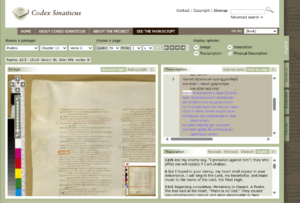
The words as they appear in Sinaticus have been placed in purple font on the Codex Sinaticus website.
Codex Sinaiticus – See The Manuscript | Psalms |
Alexandrinus does not contain the words.
The Hebrew texts of Psalm 14 verse 3 do not contain these extra quotations. Neither does any Jewish translation. Origen’s Hexapla makes note that the words were not in the Hebrew.
What is clearly evident is that the “quotations” found in Romans of Psalm 14 verses 1,2 and 3 do not perfectly match, they are paraphrase quotations, however when we look at the extra 6 quotations found at the end of verse 3 suddenly they match the quotation of in Romans …..WORD FOR WORD. To anyone who objectively looks at these quotes it is rather obvious that they have simply been forced where they do not belong.
I fear it is of no coincidence that the Douay- Rheims also adds these verses (it is a Catholic Bible after all)
Psalm 14:3 They are all gone aside, they are become unprofitable together: there is none that doth good, no not one. Their throat is an open sepulchre: with their tongues they acted deceitfully; the poison of asps is under their lips. Their mouth is full of cursing and bitterness; their feet are swift to shed blood. Destruction and unhappiness in their ways: and the way of peace they have not known: there is no fear of God before their eyes. D-R
Jerome, who once believed that the Greek of the Hexepla was the inspired text but later concluded that it was indeed the Hebrew, supports the notion that the Septuagint has added or removed from the Hebrew.
“It would be tedious now to enumerate, what great additions and omissions the Septuagint has made, and all the passages which in church-copies are marked with daggers and asterisks [symbols indicating words present in the Greek but absent in the Hebrew, and vice versa”
Jerome’s Letter LVII
It is telling therefore that he did not include these 6 verses at the end of Psalm 14:3 in his Latin vulgate.
What is telling is that despite the claim of oldest and best manuscripts by modern scholarship regarding VAticanus and Sinaiticus, which has led to the many modern scholars rejecting the longer ending of Mark, based almost entirely on these two manuscripts, modern versions reject the reading of Vaticanus and Sinaticus here. Clearly understanding that this is not the correct reading of the verse.
Psalm 14:3 All have turned away, all have become corrupt; there is no one who does good, not even one. NIV
Psalm 14:3 They have all turned aside; together they have become corrupt; there is none who does good, not even one. ESV
Psalm 14:3 Everyone rejects God; they are all morally corrupt. None of them does what is right, not even one! NET
The inconsistency from modern scholars is evident. So much for Paul quoting the inspired and authoritative LXX.
Another perfect example of this is where the LXX translators mixed up an event with another and so changed the text to better make the event fit, because the text didn’t fit, because they were unknowingly referencing the wrong event, that they had thought was in reference in Hebrews.
The “quote” comes in Hebrews 11:21
Hebrews 21:11 By faith Jacob, when he was a dying, blessed both the sons of Joseph; and worshipped, leaning upon the top of his staff. KJV
The is a supposed quote of Genesis 47:31 And he said, Swear unto me. And he swore unto him. And Israel bowed himself upon the head of the bed. KJV
However, we can see they do not match. Hebrews has Jacob leaning upon his STAFF. The KJV in Genesis says BED, however, the Septuagint in Genesis 47:31 says STAFF just like it does in Hebrews.
Genesis 47:31 And he said, Swear to me; and he swore to him. And Israel did reverence, leaning on the top of his staff. Septuagint. Brentons Septuagint
Thus, it is assumed that the writer of Hebrews was quoting the Greek Septuagint of Genesis 47:31 and not the Hebrew.
Some modern versions have followed this reading of the Septuagint.
Genesis 47:31 “Swear to me,” he said. Then Joseph swore to him, and Israel worshiped as he leaned on the top of his staff.NIV
Genesis 47:31 Then he said, “Take an oath to me,” and he took an oath to him. Then Israel bowed over the top of his staff.NHEB
But this is a fundamental mistake that shows the verse was retrospectively changed in “the” Septuagint. They changed bed to staff because they incorrectly believed that Hebrews 11:21 was referring to Genesis 47:31 and so they made Genesis 47:31 fit their believed quotation of it. Context shows the scribes error which has passed down to us today.
Hebrews is NOT, not cannot be referring to Genesis 47:31 at all. Bed is the correct translation in this verse.
The Greek in Hebrews reads ῥάβδου rhabdou Which means a staff or rod.
The Hebrew word for bed and staff are EXACTLY the same when they are written in consonants only, both are written מטה
It is ONLY when the vowel pointings are put in can you know the difference in the written form.
Mittah (bed) מִטָּה – matteh (staff) מַטֶה
When reading consonants only, it is the context that determines which word is being referred to.
Whoever translated the Greek of Genesis 47:31 has not understood the context and has incorrectly rendered the word staff instead of bed.
Notice that in the verse in Hebrews there are more than two people present. Jacob, Joseph, and Josephs two sons and Jacob blessed the two sons
Hebrews 21:11 By faith Jacob, when he was a dying, blessed both the sons of Joseph; and worshipped, leaning upon the top of his staff. KJV
In Genesis 47 it is only Jacob and Joseph present and there is NO blessing of any sons.
Genesis 47:29 And the time drew nigh that Israel must die: and he called his son Joseph, and said unto him, If now I have found grace in thy sight, put, I pray thee, thy hand under my thigh, and deal kindly and truly with me; bury me not, I pray thee, in Egypt: 30 But I will lie with my fathers, and thou shalt carry me out of Egypt, and bury me in their buryingplace. And he said, I will do as thou hast said. 31 And he said, Swear unto me. And he sware unto him. And Israel bowed himself upon the bed’s head.
Hebrews cannot be referring to Genesis 47:31.
It isn’t until Genesis 48 that Jacob (Israel) blesses the sons of Joseph.
Genesis 48:8 And Israel beheld Joseph’s sons, and said, Who are these? 9 And Joseph said unto his father, They are my sons, whom God hath given me in this place. And he said, Bring them, I pray thee, unto me, and I will bless them.
The simple fact is that the translator(s) of the Septuagint or maybe just a scribe who noticed a supposed disagreement, were not competent enough to realise these were two separate events. They mistakenly assumed that Hebrews 11:21 must be in reference to Genesis 47:31 because of the reference to Jacob (Israel) dying.
BUT Jacob did not die in Genesis 47 in fact he also tells Joseph that he must die in chapter 48
Genesis 48:21 And Israel said unto Joseph, Behold, I die: but God shall be with you, and bring you again unto the land of your fathers.
It isn’t actually until chapter 49 that Jacob in fact dies.
Genesis 49:33 And when Jacob had made an end of commanding his sons, he gathered up his feet into the bed, and yielded up the ghost, and was gathered unto his people.
It is obvious that Genesis 47:31 has been amended in the Greek of the Septuagint to align with Hebrews which could only have been done after Hebrews had already been written. With evidence that whoever translated the Greek not only purposely inserted the NT back into the OT, with some rather disastrous results, how can we trust any of the supposed quotes.
Most modern versions do NOT follow the reading of the “oldest and best” manuscripts of the Septuagint in this verse but rather read just as the KJV does “bed”. If the oldest and best manuscripts and the Septuagint are superior to the Hebrew text, then why have most modern versions not followed the oldest and best manuscripts in this verse?
Modern version do not always follow the LXX, sometimes as seen they reject the LXX reading and follow the Hebrew. Yet they often disagree where to follow the LXX and where to follow the Hebrew meaning that modern versions disagree amongst themselves. Sometimes they will agree with the KJv and sometimes disagree, while other versions may agree with the KJV and disagree with it totally opposite to another version. What does the Bible say? Well I guess it depends on what version you read. Many Christians today literally take a pick and mix approach to scripture, jumping from one version to another to get the reading they best prefer. I personally have listened to sermons where the preacher has used the reading of 2, 3 or even 4 different versions…sometimes even using a KJV. Takes all sorts doesn’t it 🙂 > It is rare to hear the KJV quoted when someone is not KJV only.
It is often said that Jesus quoted “the” Septuagint because the quotes better match “the” Septuagint.
As we have already seen this point is irrelevant. Quotes are not always, and neither do they need to be word for word. There are MANY places where a quote in the NT does not match word for word “the” Septuagint either. If they argument is that a quote must be an exact quote then this also disqualifies “the” Septuagint. As quotes are not word for word, they simply match “better”. When we understand that quotes are more references than exact quotations or paraphrase quotes then as we have seen already there really is not issue with the quotes in the NT from the Hebrew texts.
AS IT IS WRITTEN
In 1 Corinthians we find a verse where it is stated as it is WRITTEN, indicating what is then quoted is a quotation of where it is written elsewhere in the Bible.
1 Corinthians 2:9 But as it is written, Eye hath not seen, nor ear heard, neither have entered into the heart of man, the things which God hath prepared for them that love him.
This is a “quotation” of Isaiah 64:4
Isaiah 64:4 For since the beginning of the world men have not heard, nor perceived by the ear, neither hath the eye seen, O God, beside thee, what he hath prepared for him that waiteth for him.
However, as is evident, what is actually written in the Hebrew of Isaiah does not match the quotation in 1 Corinthians. So what about the Septuagint, does the quotation match the Septuagint reading of Isaiah 64:4. The answer is no.
Isaiah 64:4 From of old we have not heard, neither have our eyes seen a God beside thee, and thy works which thou wilt perform to them that wait for mercy.
This shows that quotations in the New Testament of the Old Testament, even when it says it is written, do not have to be word for word. Even the Septuagint does not match the quotation . Paul was not quoting either the Hebrew or the Septuagint verbatim, neither does he have to.
Let’s have a look at one of these quotes by Jesus.
In the gospel of Luke we see Jesus in the synagogue, he is given the Book of Isaiah and he turns to the place where it is written.
Luke 4:17 And there was delivered unto him the book of the prophet Esaias. And when he had opened the book, he found the place where it was written,
He then reads what is written.
Luke 4:18 The Spirit of the Lord is upon me, because he hath anointed me to preach the gospel to the poor; he hath sent me to heal the brokenhearted, to preach deliverance to the captives, and recovering of sight to the blind, to set at liberty them that are bruised, 19 To preach the acceptable year of the Lord.
However when we find this quotation in the Book of Isaiah we see that it is different than what Jesus had just read.
Isaiah 61:1The Spirit of the Lord GOD is upon me; because the LORD hath anointed me to preach good tidings unto the meek; he hath sent me to bind up the brokenhearted, to proclaim liberty to the captives, and the opening of the prison to them that are bound; 2To proclaim the acceptable year of the LORD, and the day of vengeance of our God; to comfort all that mourn;
There are clear differences between what Jesus “read” and what was in fact written.
But why would they be different?
One way to clear this up is to proclaim that Jesus was reading not from the Hebrew texts but the Septuagint. However, when we look at the Septuagint text of Isaiah we will see that the quote of Jesus and the passage in Isaiah do not match either.
Isaiah 61:1 The Spirit of the Lord is upon me, because he has anointed me; he has sent me to preach glad tidings to the poor, to heal the broken in heart, to proclaim liberty to the captives, and recovery of sight to the blind 2 to declare the acceptable year of the Lord, and the day of recompence; to comfort all that mourn;
So to claim that Jesus MUST have quoted the Septuagint because the Hebrew doesn’t match what Jesus said simply backfires in dramatic fashion. What Jesus said does NOT match “the” Septuagint either.
Luke stated that Jesus found the place where it was written. He did not say that Jesus quoted the scriptures word for word.
Acts 15- 16/18 Amos 9-12
Acts 15:16. “After this I will return, and will build again the tabernacle of David, which is fallen down; and I will build again the ruins thereof, and I will set it up: 17 That the residue of men might seek after the Lord, and all the Gentiles, upon whom my name is called, saith the Lord, who doeth all these things. 18 Known unto God are all his works from the beginning of the world.”
Amos 9:11 In that day will I raise up the tabernacle of David that is fallen, and close up the breaches thereof; and I will raise up his ruins, and I will build it as in the days of old: 12 That they may possess the remnant of Edom, and of all the heathen, which are called by my name, saith the Lord that doeth this.
It is believed by many scholars that James was actually quoting the Septuagint and not the Hebrew.
However, yet again the quote in the Septuagint is not exactly the same. If a quote must be exact then this again disproves the Septuagint.
The Septuagint
Amos 9:11 In that day I will raise up the tabernacle of David that is fallen, and will set up the parts thereof that have been broken down, and will build it up as in the ancient days. 12 that the remnant of men, and all the Gentiles upon whom my name is called, may earnestly seek me, saith the Lord who does all these things.
We have to remember that quotations are not always and do not have to be word for word.
Part of the confusion here is that James is not simply quoting from Amos 9-11 and 12
In the previous verse in Acts 15 James states the words of the PROPHETS, plural, as it is written.
Acts 15:15 And to this agree the words of the prophets; as it is written,
James was not quoting one passage in Amos. Rather he was quoting prophets.
I will return – This is not found in Amos but in Jeremiah
Jeremiah 12-15 And it shall come to pass, after that I have plucked them out I will return, and have compassion on them, and will bring them again, every man to his heritage, and every man to his land.
Now if we go to the passage in Jeremiah we will see that this has the same meaning as found in Acts 15.
Jeremiah 12:14Thus saith the LORD against all mine evil neighbours, that touch the inheritance which I have caused my people Israel to inherit; Behold, I will pluck them out of their land, and pluck out the house of Judah from among them. 15 And it shall come to pass, after that I have plucked them out I will return, and have compassion on them, and will bring them again, every man to his heritage, and every man to his land. 16 And it shall come to pass, if they will diligently learn the ways of my people, to swear by my name, The LORD liveth; as they taught my people to swear by Baal; then shall they be built in the midst of my people. 17 But if they will not obey, I will utterly pluck up and destroy that nation, saith the LORD.
God is very clearly talking about bringing in the gentiles and the nations seeking God.
The Translator(s) of the Septuagint simply failed to understand why the text of Acts 15 did not seem to align with that of Amos and so retrospectively changed the translation to better fit.
Do the Greek manuscripts found amongst the DSS prove the existence of a BC Septuagint?
The simple answer to this is no. There were in fact very very few Greek manuscripts that were found at Qumran.
There are only two that can even remotely support a BC Septuagint. They are 7QpapLXXExod (7Q1) which contains just a tiny piece of Exodus namely verses 28-4/7 and is dated from the Hasmonean dynasty 140-116 BC and 7QpapEpJer (7Q2) which contains a minute portion of the Letter of Jeremiah, just verses 43-44 and again this is from the Hasmonean dynasty.
There are also fragmentals
4Q119 (Rahlfs number 801 (Leviticus 26:2-16) Found in cave 4 at Qumran Dated between the 1st Century BC and the 1st Century AD.
4Q120 (leviticus 1:11 and 2:3 and 6:5) Rahlfs number 802 Dated to between the 1st Century BC and the 1st Century AD, found in cave 4 at Qumran.
https://www.deadseascrolls.org.il/explore-the-archive/manuscript/4Q120-1?locale=en_US
4Q121 (Numbers 3:39 and 4:16) Ralphs number 803 dated to 30 BC and 68 AD found in Cave 4 at Qumran
https://www.deadseascrolls.org.il/explore-the-archive/manuscript/4Q121-1?locale=en_US
The other manuscripts have are yet unspecified. They are 7Q3 (Herodian) , 7Q4 (Hasmonean) 7Q5 (Herodian), 7Q6-18 (Hellenistic-Roman; Herodian), 7Q19 (Herodian)
The letter of Jeremiah is NOT included as part of the Hebrew Bible, however it is included in the Catholic Bible as part of the book of Baruch and also the orthodox church as a book in its own right.
The very small fragment of Exodus would serve to support the BC Septuagint ONLY if such a translation existed. It is not a piece of the original LXX and so at best can only be a copy. It is just as likely that the piece is part of an individual’s attempt at a translation. As it is a part of the Torah, the Pentateuch it can only support the claim that the Torah was translated into Greek and not the whole Tanakh.
What about the Greek manuscripts of the 12 minor prophets ? Why didn’t I mention these or include them in the Greek manuscripts found?
Many people like to point to the scroll of 12 prophets (manuscript 8HevXIIgr) found amongst the DSS and say well this proves the LXX translation. The problem with this claim is that it’s not in fact strictly correct.
They were not actually found amongst the manuscripts in the caves at Qumran. They were found 12 miles away at Nahal Hever. They were also found amongst coins and pottery that date well beyond the time of Christ, the time of the second Jewish Revolt (Simon Ben Kosibah to be more precise which is dated to around 132/135 AD The dates of these manuscripts are likely to be at LEAST from this date and more probably a little later. They are then at least 40 years younger than the NT.
The quotes of these manuscripts do NOT match the LXX. They do not match the quotes found in Vaticanus, Sinaiticus or Alexandrinus.
In Part 2 we will look at some of these quotes from Jesus and Paul and show the reasons why they don’t perfectly match the Old Testament writings yet are in fact correct and why changing the Old Testament writings to match the New Testament actually means that the quotes of Jesus and Paul become inaccurate and incorrect.
Furthermore, it needs to be asked, if Jesus was quoting the Greek rather than the Hebrew and the Greek had been inspired of God and had overtaken the Hebrew why was this NEVER mentioned in the New Testament by ANYONE?Nobody attested to this feat that had been miraculously carried out some 250+ years earlier. Nobody stated anything of the sort. Jesus never mentions this translation which must be said would have been a miraculous event. Nobody mentions that the Jews who were so protective of their language and scriptures had been changed from Hebrew into Greek under God’s guidance. This simply is not a biblical teaching. The fact is, that this event, the inspired translation of the Hebrew into Greek is never stated, not even alluded to anywhere in the whole New Testament. The silence of such should be, to those who are listening, absolutely deafening.
Also this event, this historic event where the Hebrews translated their sacred texts into Greek cannot be found…..in ANY BC ancient Jewish writings. There are a few little mentions in some AD writings however nobody at the time of this translation or for the next 300 plus years says a single thing about it. The Jewish and Biblical silence over the translation, a translation of such importance and magnitude is also deafening.
Furthermore, not one person mentions the translators, or ANYONE for that matter, having translated anything other than the Torah until Justin Martyr in the 2nd Century AD. This is after the New Testament had already been written.
It has to also be asked as to WHY God would authorise such a translation into Greek in Egypt?
God told Israel many times not to go back to Egypt.
Where is the biblical attestation of such an event where God took the authoritative Hebrew and superseded it with Greek? …..NOWHERE that’s where!
The evidence for an “authorised” Greek Septuagint just doesn’t hold up under scrutiny. There are far too many inconsistencies, variations, appeals to divine inspiration, contradictions, assumptions, must have beens, historical inaccuracies, blatant elaborations and more than likely flat out lies in the supporting sources. NOT even ONE of the secondary sources offers ANY further source than the letter of Aristeas as evidence. Apart from the letter of Aristeas all these other writers simply reiterate and expand on the information in the letter. The letter of Aristeas IS the sole source of evidence and it isn’t even regarded as authentic. There simply just is not enough evidence to be able to assert the translation happened when and as is claimed.
read part 2 here http://www.followintruth.com/the-truth-about-the-septuagint-part-2
If you liked this study please subscribe here
You can buy my books on Amazon there is a link here
Help me keep this site free for all. Join our Patreon membership here
here
Below are some of the writings of those that reference the Septuagint for a more full detailed look at what they actually recorded.
Accounts of the Septuagint’s Creation
| Source | Number of Translators | Books Translated | Method (cells vs. together) | Additional Details |
|---|---|---|---|---|
| Philo of Alexandria (Life of Moses 2.31–43; esp. 651–652 ed. Cohn-Wendland) | Not specified precisely, but “the most respectable of the Hebrews” skilled in both Hebrew and Greek. (Clearly evokes 70/72, but Philo focuses on their character). | Only the Law (Torah) | They worked together on Pharos Island, praying for divine help. They “prophesied” the same words, producing identical translations word-for-word. | Stresses inspiration: they were “hierophants and prophets.” Annual festival on Pharos commemorated the event. Emphasizes the translation’s divine harmony, not mechanics. |
| Justin Martyr (First Apology 31) | Not numbered. Mentions only that men were commissioned to translate. | Refers to the books of the Prophets (broader than Torah). | Method not described. | Focuses on how these writings foretold Christ. Says Herod (!) sent the Hebrew texts to Ptolemy (a chronological confusion). Books remain in Egypt and with Jews, but Jews fail to understand them. |
| Clement of Alexandria (Stromata 1.22) | Seventy elders | Law and Prophets | Each elder translated each book separately; then translations were compared, found in agreement. | Attributes inspiration: “Greek prophecy.” Mentions Demetrius Phalereus’ role. Connects Plato & Pythagoras’ philosophy to Moses’ Law. Quotes Aristobulus & Numenius to show Greek philosophy borrowed from Moses. |
| Irenaeus (Against Heresies 3.21.2–3) | Seventy elders | All the books (Torah + Prophets implied) | Separated by Ptolemy, each produced identical translations independently; when compared, they matched word-for-word. | Emphasizes divine inspiration, proving Scriptures are trustworthy. Connects to Esdras’ restoration of Scripture after exile. Uses LXX to defend Christian faith against heretics. |
| Tertullian (Apology 18) | Seventy-two interpreters (matches Aristeas) | Writings of the Jews (implies the Law primarily). | Not separated, but commissioned together. | Names Demetrius Phalereus; cites Aristeas. Claims Hebrew originals were still visible in Ptolemaic library at Serapis’ temple. Notes Jews still read them publicly every Sabbath. |
| Eusebius (Praep. Evang. 8.1–5, citing Aristeas) | 72 translators (6 from each tribe, as per Aristeas) | Explicitly the Law (Torah) | Worked in common, producing one unified text; assembly later confirmed it must never be altered. | Gives the fullest account: Ptolemy freed Jewish slaves, lavish gifts sent to Jerusalem, Eleazar the High Priest cooperated. Mentions curses for altering the translation. Recounts miraculous judgments on Greek authors (Theopompus, Theodectes) who tried to use Mosaic texts improperly. |
Septuagint Origin Accounts — Measured Against the Letter of Aristeas
| Source | Aristeas baseline (for reference) | Where this source disagrees with Aristeas | Notes / overlaps |
|---|---|---|---|
| Letter of Aristeas | 72 translators (6 from each tribe); Torah only; translators work separately then compare/approve a unified text; royal patronage of Ptolemy II Philadelphus and Demetrius of Phalerum; Eleazar (High Priest) sends them; work associated with Alexandria/Pharos; 72 days; public reading/curse against alterations; deposited in the Library. | — | Baseline. |
| Philo of Alexandria (Life of Moses 2.31–43) | — | Number: not stated (implicitly not fixed at 72). Method: stresses they translated together and—by divine prompting—produced identical wording (“every one of them employed the self-same nouns and verbs”), i.e., a stronger miraculous uniformity than Aristeas’ “compare and approve.” | Scope: effectively Torah (aligns). Place: Pharos (aligns). Royal patronage: Ptolemy II (aligns). Adds annual Pharos festival (extra detail). |
| Justin Martyr (First Apology 31) | — | Sender: says Herod sent the Hebrew books—chronologically wrong (Aristeas has Eleazar under Ptolemy II, long before Herod). Scope: highlights the Prophets, not just the Law—broader than Aristeas’ Torah-only. Number/method: not given (thus diverges from Aristeas’ specifics). | Focus is apologetic: LXX used to show prophecies about Christ. |
| Clement of Alexandria (Stromata 1.22) | — | Number: 70 elders (not 72). Scope: Law and Prophets (broader than Aristeas’ Torah-only). Method: says each translated each prophetic book separately, then all were compared and found to agree—close in spirit but procedurally different from Aristeas’ description. | Affirms Demetrius’ role and royal library (overlap). Adds claim Greek philosophers borrowed from Moses (extra). |
| Irenaeus (Against Heresies 3.21.2–3) | — | Number: “Seventy” (not 72). Scope: implies all the books (or at least more than the Torah)—broader than Aristeas. Method: claims translators were separated (like in “cells”) and yet produced identical word-for-word translations independently—more miraculous than Aristeas’ “separate then compare.” | Uses the story to argue divine inspiration and to anchor Christian use of the LXX before Christ. |
| Tertullian (Apology 18) | — | Scope: speaks of the “writings peculiar to the Jews” (likely the Law, but could be read more broadly)—less precise than Aristeas. Method: does not mention separation/verification; emphasizes public accessibility—procedural gap vs. Aristeas. | Number: 72 (agrees). Demetrius, library, royal patronage (overlap). Adds claim of Hebrew originals visible at Serapis temple (extra). |
| Eusebius (Praeparatio Evangelica 8; citing Aristeas) | — | Substantively agrees with Aristeas; no material disagreement. | Repeats Aristeas’ details (72 men; Torah; Eleazar; Demetrius; library; curse). Adds paraphrase and framing for Christian apolo |
-
Number of translators: Aristeas = 72. Later writers vary: 70 (Clement, Irenaeus) vs. 72 (Tertullian; Eusebius following Aristeas). Philo doesn’t specify.
-
Books translated: Aristeas = Torah only. Several later accounts expand the scope—Prophets (Clement, Justin), or even “all the books” (Irenaeus).
-
Method: Aristeas = translators work separately, then compare to produce a single approved text. Philo and Irenaeus heighten the miracle: either together in perfect unison (Philo) or separately yet word-for-word identical (Irenaeus). Clement gives a hybrid (each book done separately, then compared). Tertullian is silent on method.
-
Setting & patrons: All broadly align with Alexandria and Ptolemy II; Demetrius and the Library feature in Aristeas, Clement, Tertullian, Eusebius. Justin’s “Herod” detail contradicts Aristeas’ chronology.
Philo of Alexandria
and among the Ptolemies, Philadelphus was the most illustrious; for all the rest put together scarcely did as many glorious and praiseworthy actions as this one king did by himself, being, as it were, the leader of the herd, and in a manner the head of all the kings.
VI. (31) He, then, being a sovereign of this character, and having conceived a great admiration for and love of the legislation of Moses, conceived the idea of having our laws translated into the Greek language; and immediately he sent out ambassadors to the high-priest and king of Judea, for they were the same person. (32) And having explained his wishes, and having requested him to pick him out a number of men, of perfect fitness for the task, who should translate the law, the high-priest, as was natural, being greatly pleased, and thinking that the king had only felt the inclination to undertake a work of such a character from having been influenced by the providence of God, considered, and with great care selected the most respectable of the Hebrews whom he had about him, who in addition to their knowledge of their national scriptures, had also been well instructed in Grecian literature, and cheerfully sent them. (33) And when they arrived at the king?s court they were hospitably received by the king; and while they feasted, they in return feasted their entertainer with witty and virtuous conversation; for he made experiment of the wisdom of each individual among them, putting to them a succession of new and extraordinary questions; and they, since the time did not allow of their being prolix in their answers, replied with great propriety and fidelity as if they were delivering apophthegms which they had already prepared. (34) So when they had won his approval, they immediately began to fulfil the objects for which that honourable embassy had been sent; and considering among themselves how important the affair was, to translate laws which had been divinely given by direct inspiration, since they were not able either to take away anything, or to add anything, or to alter anything, but were bound to preserve the original form and character of the whole composition, they looked out for the most completely purified place of all the spots on the outside of the city. For the places within the walls, as being filled with all kinds of animals, were held in suspicion by them by reason of the diseases and deaths of some, and the accursed actions of those who were in health. (35) The island of Pharos lies in front of Alexandria, the neck of which runs out like a sort of tongue towards the city, being surrounded with water of no great depth, but chiefly with shoals and shallow water, so that the great noise and roaring from the beating of the waves is kept at a considerable distance, and so mitigated. (36) They judged this place to be the most suitable of all the spots in the neighbourhood for them to enjoy quiet and tranquillity in, so that they might associate with the laws alone in their minds; and there they remained, and having taken the sacred scriptures, they lifted up them and their hands also to heaven, entreating of God that they might not fail in their object. And he assented to their prayers, that the greater part, or indeed the universal race of mankind might be benefited, by using these philosophical and entirely beautiful commandments for the correction of their lives. VII. (37) Therefore, being settled in a secret place, and nothing even being present with them except the elements of nature, the earth, the water, the air, and the heaven, concerning the creation of which they were going in the first place to explain the sacred account; for the account of the creation of the world is the beginning of the law; they, like men inspired, prophesied, not one saying one thing and another another, but every one of them employed the self-same nouns and verbs, as if some unseen prompter had suggested all their language to them. (38) And yet who is there who does not know that every language, and the Greek language above all others, is rich in a variety of words, and that it is possible to vary a sentence and to paraphrase the same idea, so as to set it forth in a great variety of manners, adapting many different forms of expression to it at different times. But this, they say, did not happen at all in the case of this translation of the law, but that, in every case, exactly corresponding Greek words were employed to translate literally the appropriate Chaldaic words, being adapted with exceeding propriety to the matters which were to be explained; (39) for just as I suppose the things which are proved in geometry and logic do not admit any variety of explanation, but the proposition which was set forth from the beginning remains unaltered, in like manner I conceive did these men find words precisely and literally corresponding to the things, which words were alone, or in the greatest possible degree, destined to explain with clearness and force the matters which it was desired to reveal. (40) And there is a very evident proof of this; for 1f Chaldaeans were to learn the Greek language, and if Greeks were to learn Chaldaean, and if each were to meet with those scriptures in both languages, namely, the Chaldaic and the translated version, they would admire and reverence them both as sisters, or rather as one and the same both in their facts and in their language; considering these translators not mere interpreters but hierophants and prophets to whom it had been granted it their honest and guileless minds to go along with the most pure spirit of Moses. (41) On which account, even to this very day, there is every year a solemn assembly held and a festival celebrated in the island of Pharos, to which not only the Jews but a great number of persons of other nations sail across, reverencing the place in which the first light of interpretation shone forth, and thanking God for that ancient piece of beneficence which was always young and fresh. (42) And after the prayers and the giving of thanks some of them pitched their tents on the shore, and some of them lay down without any tents in the open air on the sand of the shore, and feasted with their relations and friends, thinking the shore at that time a more beautiful abode than the furniture of the king”s palace. (43) In this way those admirable, and incomparable, and most desirable laws were made known to all people, whether private individuals or kings, and this too at a period when the nation had not been prosperous for a long time. And it is generally the case that a cloud is thrown over the affairs of those who are not flourishing, so that but little is known of them;
Philo of Alexandria on the life of Moses (complete works of pages 651-652)
Justin Martyr
There were, then, among the Jews certain men who were prophets of God, through whom the prophetic Spirit published beforehand things that were to come to pass, ere ever they happened. And their prophecies, as they were spoken and when they were uttered, the kings who happened to be reigning among the Jews at the several times carefully preserved in their possession, when they had been arranged in books by the prophets themselves in their own Hebrew language. And when Ptolemy king of Egypt formed a library, and endeavoured to collect the writings of all men, he heard also of these prophets, and sent to Herod, who was at that time king of the Jews, requesting that the books of the prophets be sent to him. And Herod the king did indeed send them, written, as they were, in the foresaid Hebrew language. And when their contents were found to be unintelligible to the Egyptians, he again sent and requested that men be commissioned to translate them into the Greek language. And when this was done, the books remained with the Egyptians, where they are until now. They are also in the possession of all Jews throughout the world; but they, though they read, do not understand what is said, but count us foes and enemies; and, like yourselves, they kill and punish us whenever they have the power, as you can well believe. For in the Jewish war which lately raged, Barchochebas, the leader of the revolt of the Jews, gave orders that Christians alone should be led to cruel punishments, unless they would deny Jesus Christ and utter blasphemy. In these books, then, of the prophets we found Jesus our Christ foretold as coming, born of a virgin, growing up to man’s estate, and healing every disease and every sickness, and raising the dead, and being hated, and unrecognised, and crucified, and dying, and rising again, and ascending into heaven, and being, and being called, the Son of God. We find it also predicted that certain persons should be sent by Him into every nation to publish these things, and that rather among the Gentiles [than among the Jews] men should believe in Him. And He was predicted before He appeared, first 5000 years before, and again 3000, then 2000, then 1000, and yet again 800; for in the succession of generations prophets after prophets arose.
Justin Martyr first apology chapter 31
Clement of Alexandria
So much for the details respecting dates, as stated variously by many, and as set down by us.
It is said that the Scriptures both of the law and of the prophets were translated from the dialect of the Hebrews into the Greek language in the reign of Ptolemy the son of Lagos, or, according to others, of Ptolemy surnamed Philadelphus; Demetrius Phalereus bringing to this task the greatest earnestness, and employing painstaking accuracy on the materials for the translation. For the Macedonians being still in possession of Asia, and the king being ambitious of adorning the library he had at Alexandria with all writings, desired the people of Jerusalem to translate the prophecies they possessed into the Greek dialect. And they being the subjects of the Macedonians, selected from those of highest character among them seventy elders, versed in the Scriptures, and skilled in the Greek dialect, and sent them to him with the divine books. And each having severally translated each prophetic book, and all the translations being compared together, they agreed both in meaning and expression. For it was the counsel of God carried out for the benefit of Grecian ears. It was not alien to the inspiration of God, who gave the prophecy, also to produce the translation, and make it as it were Greek prophecy. Since the Scriptures having perished in the captivity of Nebuchadnezzar, Esdras the Levite, the priest, in the time of Artaxerxes king of the Persians, having become inspired in the exercise of prophecy restored again the whole of the ancient Scriptures. And Aristobulus, in his first book addressed to Philometor, writes in these words: And Plato followed the laws given to us, and had manifestly studied all that is said in them.
And before Demetrius there had been translated by another, previous to the dominion of Alexander and of the Persians, the account of the departure of our countrymen the Hebrews from Egypt, and the fame of all that happened to them, and their taking possession of the land, and the account of the whole code of laws; so that it is perfectly clear that the above-mentioned philosopher derived a great deal from this source, for he was very learned, as also Pythagoras, who transferred many things from our books to his own system of doctrines. And Numenius, the Pythagorean philosopher, expressly writes: For what is Plato, but Moses speaking in Attic Greek?
This Moses was a theologian and prophet, and as some say, an interpreter of sacred laws. His family, his deeds, and life, are related by the Scriptures themselves, which are worthy of all credit; but have nevertheless to be stated by us also as well as we can.
Clement of Alexandria Stromata book 1 chapter 22
Irenaeus
2. For before the Romans possessed their kingdom, while as yet the Macedonians held Asia, Ptolemy the son of Lagus, being anxious to adorn the library which he had founded in Alexandria, with a collection of the writings of all men, which were [works] of merit, made request to the people of Jerusalem, that they should have their Scriptures translated into the Greek language. And they — for at that time they were still subject to the Macedonians — sent to Ptolemy seventy of their elders, who were thoroughly skilled in the Scriptures and in both the languages, to carry out what he had desired. But he, wishing to test them individually, and fearing lest they might perchance, by taking counsel together, conceal the truth in the Scriptures, by their interpretation, separated them from each other, and commanded them all to write the same translation. He did this with respect to all the books. But when they came together in the same place before Ptolemy, and each of them compared his own interpretation with that of every other, God was indeed glorified, and the Scriptures were acknowledged as truly divine. For all of them read out the common translation [which they had prepared] in the very same words and the very same names, from beginning to end, so that even the Gentiles present perceived that the Scriptures had been interpreted by the inspiration of God. And there was nothing astonishing in God having done this — He who, when, during the captivity of the people under Nebuchadnezzar, the Scriptures had been corrupted, and when, after seventy years, the Jews had returned to their own land, then, in the times of Artaxerxes king of the Persians, inspired Esdras the priest, of the tribe of Levi, to recast all the words of the former prophets, and to re-establish with the people the Mosaic legislation.
3. Since, therefore, the Scriptures have been interpreted with such fidelity, and by the grace of God, and since from these God has prepared and formed again our faith towards His Son, and has preserved to us the unadulterated Scriptures in Egypt, where the house of Jacob flourished, fleeing from the famine in Canaan; where also our Lord was preserved when He fled from the persecution set on foot by Herod; and [since] this interpretation of these Scriptures was made prior to our Lord’s descent [to earth], and came into being before the Christians appeared — for our Lord was born about the forty-first year of the reign of Augustus; but Ptolemy was much earlier, under whom the Scriptures were interpreted — [since these things are so, I say,] truly these men are proved to be impudent and presumptuous, who would now show a desire to make different translations, when we refute them out of these Scriptures, and shut them up to a belief in the advent of the Son of God. But our faith is steadfast, unfeigned, and the only true one, having clear proof from these Scriptures, which were interpreted in the way I have related; and the preaching of the Church is without interpolation. For the apostles, since they are of more ancient date than all these [heretics], agree with this aforesaid translation; and the translation harmonizes with the tradition of the apostles. For Peter, and John, and Matthew, and Paul, and the rest successively, as well as their followers, did set forth all prophetical [announcements], just as the interpretation of the elders contains them.
IRenaeus AGainst Heresies book 3 chapter 21
Tertullian
Ptolemy, surnamed Philadelphus, the most learned of his race, a man of vast acquaintance with all literature, emulating, I imagine, the book enthusiasm of Pisistratus, among other remains of the past which either their antiquity or something of peculiar interest made famous, at the suggestion of Demetrius Phalereus, who was renowned above all grammarians of his time, and to whom he had committed the management of these things, applied to the Jews for their writings — I mean the writings peculiar to them and in their tongue, which they alone possessed, for from themselves, as a people dear to God for their fathers’ sake, their prophets had ever sprung, and to them they had ever spoken. Now in ancient times the people we call Jews bare the name of Hebrews, and so both their writings and their speech were Hebrew. But that the understanding of their books might not be wanting, this also the Jews supplied to Ptolemy; for they gave him seventy-two interpreters — men whom the philosopher Menedemus, the well-known asserter of a Providence, regarded with respect as sharing in his views. The same account is given by Aristæus. So the king left these works unlocked to all, in the Greek language. To this day, at the temple of Serapis, the libraries of Ptolemy are to be seen, with the identical Hebrew originals in them. The Jews, too, read them publicly. Under a tribute-liberty, they are in the habit of going to hear them every Sabbath. Whoever gives ear will find God in them; whoever takes pains to understand, will be compelled to believe.
The apology chapter 18
Eusebius
PREFACE
IN the preceding Book, I have traced the lives of the Hebrews of old time before the appearance of Moses, men beloved of God who proved that title true by crowning themselves with the rewards of every virtue. Their pious doctrines also and instructions I described, and moreover their perfectly true and religious beliefs concerning God, which we have confessed that we Christians had come to love and to desire. And now, following the order of succession, I will pass on to the civil polity in the time of Moses, which after that first stage in religion presents a second, namely that which, is provided with legal ordinances quite peculiar to the Jewish nation.
For we shall prove at the proper opportunity that the institutions of Moses were suited to Jews alone, and not to the other nations of the world, nor were possible to be observed by all men, I mean by those who dwelt at a distance from the land of Judaea, whether Greeks or barbarians.
But now I am going to set forth this mode of life, I mean the life in the time of Moses, not in words of my own, but as before only in the words of the very authors who have been approved among the Jews for their hereditary learning: for I think it is proper for me to present the testimonies on which my proofs rest, in the same way as I began, through the authors properly belonging to each subject.
As therefore I called up Phoenicians, and Egyptians, and Greeks as witnesses of the matters well known among themselves in their own country, so it seems to me that the present occasion properly claims these Jewish witnesses, and not that I should myself be supposed to be giving a superficial sketch of matters foreign to me.
But before coming to this point, I think it necessary to set plainly before my readers, how the oracles of the Jews passed to the Greeks, and what was the method settled for the interpretation of the sacred writings entrusted to them; showing also the number and character of the interpreters, and the great zeal of the king, whereby those oracles came to be translated into the Greek language; for the explanation of these matters also will not be unadvisable in regard to my proof of the Preparation for the Gospel.
For when the light of the salutary preaching of our Saviour was all but ready to shine forth unto all men in the Roman empire, more than ordinary reason required that the prophecies concerning Him, and the mode of life of the pious Hebrews of old, and the lessons of their religious teaching, hidden from long ages in their native tongue, should now at length come forth to all the nations, to whom the knowledge of God was about to be introduced; and then God Himself, the author of these blessings, anticipating the future by His foreknowledge as God, arranged that the predictions concerning Him who was to appear before long as the Saviour of all mankind, and to establish Himself as the teacher of the religion of the One Supreme God to all the nations under the sun, should be revealed to them all, and be brought into the light by being accurately translated, and set up in public libraries. So God put it into the mind of King Ptolemy to accomplish this, in preparation, as it seems, for that participation in them by all the nations which was so soon to take place.
For we should not otherwise have got from the Jews those oracles which they would have hidden away for their jealousy of us; but these in consequence of the divinely ordered interpretation were vouchsafed to us in a translation by the men who were approved among them for intelligence and hereditary culture.
These things are described by Aristeas, a man who besides being learned was moreover engaged in the transactions of the time of the second Ptolemy, surnamed Philadelphus, in whose reign the translation of the Jewish Scriptures, made through the zeal of the king, was awarded a place in the libraries of Alexandria. But it is time to listen to the author himself relating the matter word for word in the following manner:
CHAPTER II
[ARISTEAS] ‘WHEN Demetrius Phalereus was appointed over the king’s library, he acquired large sums of money with the view of collecting all the books in the world, and by making purchases and transcriptions brought the king’s purpose to completion, as far as in him lay.
‘So being asked in our presence how many myriads there are of books, he answered—-“Over twenty myriads, O king: and I shall endeavour to have the rest made up to fifty myriads in a short time. It has also been notified to me that the customs of the Jews are worthy of transcription and of a place in thy library.”
‘”What is there then,” said the king, “to hinder you from doing this? For all that you can require has been assigned to you.” And Demetrius replied—-“An interpretation also is required; for in Judaea they use characters peculiar to themselves, just as the Egyptians use their own position of the letters, inasmuch as they have also a language of their own. And they are supposed to employ Syriac, but that is not so, for it is a different kind of language.”
‘And when the king understood everything, he ordered a letter to be written to the High Priest of the Jews, in order that the aforesaid matters might be completed.’
And further on he adds:
‘And when this was accomplished, the king commanded Demetrius to report on the description of the Jewish books. For all matters were arranged by these kings in ordinances and with great accuracy, and nothing thrown off at random. For this reason also I have given a place to the report and to the copies of the letters, and to the number of the offerings sent, and the manufacture of each, because every one of them was distinguished by the grandeur of the parts and artistic skill. A copy of the report is as follows:’
CHAPTER III
‘”To THE GREAT KING FROM DEMETRIUS.
‘”IN accordance with thy command, O king, that the books which were wanting to the completion of the library might be collected, and that the parts which had been damaged might be properly restored, I have very carefully given my attention to these matters, and now present my report to thee.
‘”There are wanting the books of the Law of the Jews, together with some few others. For they are expressed in Hebrew characters and language, and are rather carelessly written, and not as they are in the original, according to the report of those who know best, since they have not had the benefit of the king’s providence.
‘”But it is right that thou shouldest possess these also thoroughly corrected, because this legislation, being divine, is very full of wisdom and sincerity. For which reason both prose-writers and poets and the multitude of historians have avoided the mention of the aforesaid books, and of the men who ordered their life according to them, because, as Hecataeus of Abdera says, the mode of thought therein is of a pure and venerable character.
‘”If therefore it seems good, O king, there shall be a letter written to the High Priest in Jerusalem, to send elderly men who have lived the most honourable lives, and are experienced in matters of their own Law, six from each tribe, in order that we may test the agreement by a large number, and after receiving the exact interpretation, may give it a distinguished place, in a manner worthy both of the circumstances and of thy purpose. Good fortune be ever thine.”
‘And when this report had been presented, the king commanded a letter to be written to Eleazar on this subject, informing him also of the release of the captives which had taken place. He also gave for the manufacture of bowls and cups, and a table, and flagons, fifty talents weight of gold, and seventy talents weight of silver, and a large quantity of precious stones.
‘And he commanded the treasurers to give to the artists the choice of whatever they should prefer, and of current coin as much as a hundred talents for sacrifices and other things. Concerning the workmanship, we will give you information, as soon as we have gone through the copies of the letters. The king’s letter was in the following form:’
CHAPTER IV
‘”KING PTOLEMY TO THE HIGH PRIEST ELEAZAR, GREETING AND HEALTH.
‘”WHEREAS it happens that many Jews who were carried away from Jerusalem by the Persians in the time of their power, have been settled in our country, and many more have come with my father into Egypt as prisoners of war, of whom he enrolled many in the military class on higher pay, and likewise, when he judged the chief of them to be faithful, built fortresses and entrusted them to their charge, in order that through them the native Egyptians might be intimidated: and whereas we having succeeded to the kingdom deal very kindly with all men, and more especially with your fellow countrymen, for we have released more than ten myriads of them from captivity, by paying their masters the due price in money, and amending whatever wrong was done through the attacks of the mobs, having taken a pious resolution to do this and to dedicate a thank-offering to the Most High God, who has preserved our kingdom in peace and in the highest glory in all the world: we have also enrolled in the army those of the most vigorous age, and appointed those whom we judged capable to be about our person and worthy of trust about the court.
‘”And whereas we wish to show favour to thee also and to all the Jews throughout the world, and to those who shall come after, we have purposed that your Law should be translated in the Greek language out of what you call the Hebrew language, in order that these books also may be kept in our library with the rest of the royal books.
‘”Thou wilt, therefore, be acting well and in a manner deserving our favour, in choosing out men of honourable lives, advanced in years, who are skilled in the Law and able to interpret it, out of each tribe six, that so agreement may be obtained from the large number, because the inquiry concerns matters of great importance. For we think that if this is accomplished, we shall gain great glory from it.
‘”Now concerning this business we have sent Andreas one of the chiefs of our bodyguard and Aristeas, men in honour with us, to converse with thee, and to bring the first-fruits of our offerings to the temple, with a hundred talents of silver for sacrifices and other things. And do thou also write to us on whatsoever thou desirest: for thou wilt gratify us, and be doing what deserves our friendship; for whatever things thou mayest prefer shall be performed as quickly as possible. Farewell.”
‘In answer to this, Eleazar wrote back appropriately as follows:’
CHAPTER V
‘”ELEAZAR HIGH PRIEST TO KING PTOLEMY, TRUE FRIEND, GREETING.
‘”IF thou art in good health thyself, and Queen Arsinoe thy sister, and thy children, that would be well, and as we wish; we ourselves also are well. On the receipt of thy letter we greatly rejoiced at thy purpose and noble design; and having assembled the whole people we read it before them, that they might know the reverence thou hast toward our God.
‘”We exhibited also the cups which thou hast sent, twenty of gold, and thirty of silver, five bowls, and a table for dedication of offerings, and a hundred talents of silver for offering sacrifices, and for whatever repairs the temple may yet need; and these have been brought by Andreas, one of those honoured in thy presence, and Aristeas, noble and virtuous men, eminent in learning, and worthy in all respects of thy training and just esteem.
‘”They communicated thy commands to us, and have also received from us an answer befitting thy deeds. For in all things whatsoever are expedient for thee. even if they are contrary to our natural disposition, we shall obey: since this is a mark of friendship and affection. For in many ways thou hast conferred upon our citizens benefits great and never to be forgotten.
‘”Immediately, therefore, we offered sacrifices on behalf of thee, and thy sister and children, and friends; and all the people prayed that it may happen to thee always according to thy desire, and that God who ruleth over all may preserve thy kingdom in peace with honour.
‘”Also, in order that the transcription of the sacred Law may be made conveniently and with safety, I chose out, in the presence of all, men of honour and virtue, of mature years, from each tribe six, and these I have sent with the Law. Thou wilt do well then, 0 righteous sovereign, in giving directions, as soon as the transcription of the books is made, that the men may be sent back to us again in safety. Farewell.” ‘
Aristeas next interposes many statements concerning the proposed business, and after his account of the translation of the Scriptures adds in exact words:
‘And as soon as these volumes had been read, the priests and the elder men among the interpreters and rulers of the city, and the leaders of the people stood up and said: “Since the interpretation of the books has been well and reverently made and accurately in every point, it is right that they should continue as they are, and that no revision take place.” And when all had shouted in approval of this saying, they commanded that, as their custom is, any one who should make a revision by adding or by taking away or by changing anything at all in what had been written should be accursed: in which they did rightly, in order that it might be always preserved as an overflowing fountain.
‘When this also had been announced to the king, he was greatly rejoiced: for he thought that the purpose which he entertained had been safely accomplished. And all was read over before him, and he greatly admired the mind of the Lawgiver, and said to Demetrius: “How is it that, when so great deeds had been performed, none of the historians or poets ever attempted to make mention of them?” And he replied: “Because the legislation was sacred, and had come through God, and some of those who attempted it were smitten by God and ceased from the attempt.”
‘For he said that he had heard from Theopompus, that, when intending rather rashly to add to his history some of the passages which had been previously translated out of the Law, he had suffered from confusion of mind more than thirty days, but in the interval of relief he besought God that it might be made clear to him, what the reason of the occurrence was: and when he had been taught in a dream, that he had been over-curious in his desire to publish the divine oracles to common men, and had desisted, he was thus restored to his senses.
‘From Theodectes also, the tragic poet, I was informed that as he was going to convert one of the events recorded in the Book into a drama he was stricken with cataract in the eyes, and having got a suspicion that it had happened to him for this reason, he propitiated God, and after many days was restored.
‘And when the king had received, as I said before, the report from Demetrius concerning these books, he reverenced them, and commanded that great care should be taken of the books, and that they should be preserved in purity.’
Let this abridgement from the writing of the aforesaid author suffice: so now let us take a view of the polity established by the legislation of Moses from authors illustrious among that people. And I will give the first place to the remarks of Philo on the journeying of the Jews from Egypt, which they made under Moses as their leader, quoting from the first book of what he entitled Hypothetica, where, in making his defence of the Jews as against their accusers, he speaks as follows:
Eusebius Preparation for the Gospel book 8
If you liked this study please subscribe here
You can buy my books on Amazon there is a link here
Join our Patreon membership here or you can buy me a coffee through paypal