How can Jesus be the son of David from the tribe of Judah?
One of the main objections used against Jesus being the Messiah, often by those of the Jewish faith, is that if Jesus was “conceived” of God through the holy spirit, by Mary, who was a virgin and therefore did not indeed have a physical earthly human father then this rather than supporting the claim of his Messiahship, would actually disqualify him from being the prophesied Jewish Messiah.
The objection being that 1) the Messiah, who was to be king of Israel would be of the tribe of Judah seeing that it was declared by God that the sceptre would not depart from Judah.
Genesis 49:10 The sceptre shall not depart from Judah, nor a lawgiver from between his feet, until Shiloh come; and unto him shall the gathering of the people be.
The Messiah would thus need to be of the tribe of Judah.
2) That the Messiah would be specifically from the line of David. God made a promise to king David regarding the kingdom that it would be one of his seed that would be the one who would reign as king of Israel.
2 Samuel 7:12 And when thy days be fulfilled, and thou shalt sleep with thy fathers, I will set up thy seed after thee, which shall proceed out of thy bowels, and I will establish his kingdom.
It is argued that tribal affiliation is passed down through the father.
This claim is based on a number of Old Testament passages
Numbers 1:17 And Moses and Aaron took these men which are expressed by their names: 18 And they assembled all the congregation together on the first day of the second month, and they declared their pedigrees after their families, by the house of their fathers, according to the number of the names, from twenty years old and upward, by their polls. 19 As the LORD commanded Moses, so he numbered them in the wilderness of Sinai.20 And the children of Reuben, Israel’s eldest son, by their generations, after their families, by the house of their fathers, according to the number of the names, by their polls, every male from twenty years old and upward, all that were able to go forth to war;
So, with Jesus having no earthly father this would mean Jesus had no tribal affiliation to Judah, or any tribe for that matter, as Jewish tribal affiliation is passed down through the father, therefore as Jesus had no earthly father to pass down that tribal affiliation to Jesus, Jesus could not have been of the tribe of Judah and so could not be the promised Messiah.
If Jesus was not of the tribe of Judah, then he could not be king!
Jesus also could not be a son of David, having no earthly father he would have no physical lineage that would trace back to King David and therefore he could not be called the son of David. Again, it is the Jewish claim that to be a son of (a direct descendant) then this must be and can only be through the father. As Jesus did not have an earthly father this would exclude Jesus from being a son of David and thus this would again invalidate the claim that Jesus was the Jewish Messiah.
If Jesus was not of the line of David, then he could not be the one that God would establish the kingdom through!
In his book, 26 reasons why Jews don’t believe in Jesus, Asher Norman explicitly outlines this argument.
“The Messiah Ben David must be Jewish, from the Tribe of Judah. Under Jewish Law Tribal affiliation is through the birth father only. Since Jesus allegedly had no human father, he had no tribal affiliation. Therefore, Jesus was not from the tribe of Judah and is eliminated from messianic consideration.”
Asher Norman, 26 reasons why Jews don’t believe in Jesus page 61
These arguments themselves actually only work if we use the fact Jesus didn’t have an earthly father and was in fact supernaturally born of God. If Jesus was not born of a virgin, if the Bible taught that Joseph was his biological father as some Christians do believe, then this argument would automatically no longer be valid. I believe that Jesus was born of supernatural means and that Joseph was not the literal father of Jesus. Of course, the argument against a supernatural birth cannot simply be dismissed by Jews as not being possible as they believe God is capable of the supernatural. It therefore is not the supernaturalism of the birth that they would reject, it is the not having a biological father to pass down the line of Judah and David that is the objection. It is at least possible for a Jew to accept that Jesus was born of supernatural means by way of a virgin birth but still reject him as Messiah.
Obviously even if it could be proven that this disqualified Jesus as the Jewish Messiah it would, even in the argument against Messiahship, emulate Jesus as a super naturally conceived man of God and therefore at the very least would make him worthy of such recognition, something that the Jews do not do. But anyway, let’s get back to the objections themselves.
The objection against Jesus being the Messiah would seem to be a logical and biblical one.
But we will see that it fails when it is analysed.
Biblical confirmation regarding Jesus
The New Testament states that Jesus was BOTH from the Tribe of Judah
Hebrews 7:14 For it is evident that our Lord sprang out of Juda; of which tribe Moses spake nothing concerning priesthood.
And that he was called the son of David numerous times in the New Testament
Matthew 1:1 The book of the generation of Jesus Christ, the son of David, the son of Abraham.
Romans 1:3 Concerning his Son Jesus Christ our Lord, which was made of the seed of David according to the flesh;
The New Testament at least does make the case that Jesus, while born of a virgin, is in fact, of the tribe of Judah and a son of David.
So we must ask and provide and answer as to how can Jesus who the Bible says was born of a virgin conceived of through the holy spirit and therefore had no earthly father, indeed be from the tribe of Judah and also a son of David if tribal affiliation is passed down through the father?
Many people have “answered” or attempted to answer these objections. There are in fact many different answers that have been given. Some people have accepted these answers, and some have rejected them. In this writing I will offer my own “answer”. To some this may be just another failed attempt to try and justify the acceptance of Jesus as the Messiah. Hopefully though I will actually do what I have set out to do and use the SCRIPTURES themselves to prove that Jesus was both from the tribe of Judah and the line of David and therefore would support his claim to be the Jewish Messiah.
The objection ONLY works IF it is true that tribal affiliation can ONLY be passed down through a biological father. IF this can be shown false then the objection cannot stand. I believe the claim can be shown false and so would invalidate the objection.
Incorrect objection
The fault lies in the objection itself. It is the objection that is incorrect. It actually relies on an incorrect understanding that it is ONLY through the biological father that these attributes can be passed on.
Jesus showed on numerous occasions that the Jewish authorities had incorrect interpretation of their scriptures.
Matthew 22:29 Jesus answered and said unto them, Ye do err, not knowing the scriptures, nor the power of God.
Matthew actually included women in his genealogy, including Tamar, Rahab and Ruth.
Something that needs to be noted regarding the passing down of tribal affiliation through the father. While what we see in the book of Numbers is clearly the counting of the Israelites and them being reckoned by their father’s tribe, this in no way actually stipulates in law that a man’s tribal affiliation must be through his father. This is only how Israel was to be counted within the count of the warriors within Israel. Woman and children (those up to 20 years of age) are not counted as they are not part of the count of the warriors in Israel.
Numbers 1: 1And the LORD spake unto Moses in the wilderness of Sinai, in the tabernacle of the congregation, on the first day of the second month, in the second year after they were come out of the land of Egypt, saying, 2Take ye the sum of all the congregation of the children of Israel, after their families, by the house of their fathers, with the number of their names, every male by their polls; 3From twenty years old and upward, all that are able to go forth to war in Israel: thou and Aaron shall number them by their armies. 4And with you there shall be a man of every tribe; every one head of the house of his fathers.
This is not in any way stating that a man’s tribal affiliation must be through the father. It must also be noted the Levites were excluded from this count and we get no mention of them being numbered by the way of through their father’s house. So, on this basis, at least Levites would be excluded from the passing down of tribal affiliation through the father.
The passage in Numbers simply is in no way a command on how tribal affiliation must be passed, it only serves to show how the count was to be conducted and how it was to be recorded.
While it is clear that this has been the way that Jews do count tribal affiliation it is not through any law of the Old Testament that demands this.
But we shall take it that the Jewish understanding is true. Tribal affiliation is passed down through the father. The affirmation that tribal affiliation can ONLY be passed down through the biological father is still false.
Clear exceptions to the Jewish “rule”
1) Levirate marriage.
We do have biblical evidence of Levirate marriage, this is where a brother or kinsman if there is no brother, of a man that has died without children, was obligated to have a child with the man’s wife and that child to be counted as the seed of the dead brother.
Deuteronomy 25: 5 If brethren dwell together, and one of them die, and have no child, the wife of the dead shall not marry without unto a stranger: her husband’s brother shall go in unto her, and take her to him to wife, and perform the duty of an husband’s brother unto her. 6 And it shall be, that the firstborn which she beareth shall succeed in the name of his brother which is dead, that his name be not put out of Israel.
The first child of that levirate marriage was counted as the dead mans child.
Notice that it does not say the first MALE child born. Simply that the first born would succeed in the name of the dead brother.
We even find a leviraite marriage, between an Israelite man and a Moabite woman in the genealogy found in Matthew which actually comes in the genealogy of king David.
Matthew 1: 5 And Salmon begat Booz of Rachab; and Booz begat Obed of Ruth; and Obed begat Jesse;
Ruth was a Moabite.
Ruth 1:3 And Elimelech Naomi’s husband died; and she was left, and her two sons.4 And they took them wives of the women of Moab; the name of the one was Orpah, and the name of the other Ruth: and they dwelled there about ten years.
Ruth was married to an Israelite man. However, he died without having any children with her.
Ruth had a child with Boaz, a near kinsman, and the child was counted as that of Naomi to restore the lineage that had been cut of through the death of her 2 sons.
Ruth 4:13 So Boaz took Ruth, and she was his wife: and when he went in unto her, the LORD gave her conception, and she bare a son.14 And the women said unto Naomi, Blessed be the LORD, which hath not left thee this day without a kinsman, that his name may be famous in Israel.15 And he shall be unto thee a restorer of thy life, and a nourisher of thine old age: for thy daughter in law, which loveth thee, which is better to thee than seven sons, hath born him.16 And Naomi took the child, and laid it in her bosom, and became nurse unto it.17 And the women her neighbours gave it a name, saying, There is a son born to Naomi; and they called his name Obed: he is the father of Jesse, the father of David.
So child could be considered a child of a dead man, even though the man was not the physical father of the child.
This has been used by some Christians in their arguments against the Jewish objections. While I use this to demonstrate that lineage can be passed on through non biological fathers, I do not believe this is the answer to how Jesus is the son of David of the tribe of Judah.
The reason I don’t think this works is because Joseph was not dead. He was very much alive at the time. This clause in the law would not therefore apply to Joseph and Jesus. It was also not the brother of Joseph that impregnated Mary. However, as already stated, what it does do is serve as a demonstration that there were times that a child could be considered the offspring of a man that was not physically the father and counted within the lineage of that man.
2) “Adoption”
In the story of Caleb, who was one of the two spies that were sent by Joshua to survey the promised land. we find that Caleb was not an Israelite by birth. He was the biological son of Jephunneh who was a Kenezite.
Numbers 32:12 Save Caleb the son of Jephunneh the Kenezite, and Joshua the son of Nun: for they have wholly followed the LORD.
The Kenezites were one of the tribes that inhabited the land promised to Abraham at the time when God promised it to him.
Genesis 15:18 In the same day the LORD made a covenant with Abram, saying, Unto thy seed have I given this land, from the river of Egypt unto the great river, the river Euphrates:19 The Kenites, and the Kenizzites, and the Kadmonites, 20 And the Hittites, and the Perizzites, and the Rephaims, 21 And the Amorites, and the Canaanites, and the Girgashites, and the Jebusites.
The land that was promised to Abraham, at that time, belonged to other peoples. Other peoples already lived in the land God promised to Abraham, including the Kenizzites.
The word Kenezite appears just 4 times in scripture, 3 times directly in reference to Caleb and once in the verse in Genesis.
The Kenizzites are descendants of Kenaz
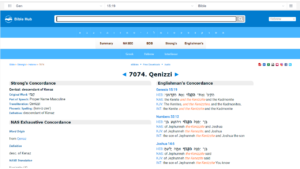
Kenaz was a descendant of Esau.

Genesis 36: 9 And these are the generations of Esau the father of the Edomites in mount Seir: 10 These are the names of Esau’s sons; Eliphaz the son of Adah the wife of Esau, Reuel the son of Bashemath the wife of Esau. 11 And the sons of Eliphaz were Teman, Omar, Zepho, and Gatam, and Kenaz. 12 And Timna was concubine to Eliphaz Esau’s son; and she bare to Eliphaz Amalek: these were the sons of Adah Esau’s wife. 13 And these are the sons of Reuel; Nahath, and Zerah, Shammah, and Mizzah: these were the sons of Bashemath Esau’s wife. 14 And these were the sons of Aholibamah, the daughter of Anah the daughter of Zibeon, Esau’s wife: and she bare to Esau Jeush, and Jaalam, and Korah.
Caleb was therefore, not an Israelite by birth. However, we see back in the book of Numbers when Caleb is sent to spy out the land, he is recorded as being of the tribe of Judah.
Numbers 13:6 Of the tribe of Judah, Caleb the son of Jephunneh.
So, while Caleb was not a physical Israelite from the tribe of Judah, he was counted as being such by God. This further shows that the argument that tribal affiliation MUST come through the father is not a valid objection. This is a biblical example of a man who was considered of the tribe of Judah while not even being a biologically born Israelite.
Caleb WAS counted as being an Israelite and given an inheritance amongst the tribe of Judah.
Joshua 15:13 And unto Caleb the son of Jephunneh he gave a part among the children of Judah, according to the commandment of the LORD to Joshua, even the city of Arba the father of Anak, which city is Hebron.
This is a fulfilment of a promise that God had given
Deuteronomy 1:35 Surely there shall not one of these men of this evil generation see that good land, which I sware to give unto your fathers, 36 Save Caleb the son of Jephunneh; he shall see it, and to him will I give the land that he hath trodden upon, and to his children, because he hath wholly followed the LORD.
We see an instruction of such in Ezekiel 47:21-23
Ezekiel 47: 21 So shall ye divide this land unto you according to the tribes of Israel. 22 And it shall come to pass, that ye shall divide it by lot for an inheritance unto you, and to the strangers that sojourn among you, which shall beget children among you: and they shall be unto you as born in the country among the children of Israel; they shall have inheritance with you among the tribes of Israel. 23 And it shall come to pass, that in what tribe the stranger sojourneth, there shall ye give him his inheritance, saith the Lord GOD.
Some do argue that The Kenizzites had actually joined Israel long before and so Caleb was an Israelite because lthough his father was a Kenezzite, the Kenezzites were Israelites. This may sound like it could answer how Caleb would be an actual Israelite, but when we investigate this what we will actually see is all this does is move back the “adoption” into the tribe of Judah to an earlier point. At some point in the past, either with Calebs father, grandfather, or a further relative, the one who gets integrated would have had a Kenezzite as a father and yet would still have also been classed as of the tribe of Judah. It is thus irrelevant as to when this happened, the fact is is that it happened at some point, still showing that non native Israelites could be considered of a tribe.
We can actually see many non Jews becoming Israelites in the book of Esther
Ester 8:17 And in every province, and in every city, whithersoever the king’s commandment and his decree came, the Jews had joy and gladness, a feast and a good day. And many of the people of the land became Jews; for the fear of the Jews fell upon them.
While this again does serve as a refutation of the claim that tribal affiliation can only be passed on through a biological father, again I don’t believe this is the answer to how Jesus is the son of David of the tribe of Judah.
And I shall explain why:
I’m going to start with the genealogy of Jesus as given in the books of Matthew and Luke. There are 2 completely different genealogies given for Jesus in these 2 accounts (often used to show a contradiction in the Bible by uninformed people). It is, however, generally accepted by most scholars that Matthew traces the genealogy of Jesus through Joseph (his supposed father) while Luke traces his genealogy through Mary. This I believe is actually correct and we will also look at the reasons why this is the case. However, this fact is often INCORRECTLY then used to try to prove that Jesus was from Judah and from the line of David through Joseph.
Genealogy Matthew
When we look at Joseph’s genealogy, we will notice that Joseph was BOTH of the tribe of Judah and also a descendant of David.
Matthew 1:2 Abraham begat Isaac; and Isaac begat Jacob; and Jacob begat Judas and his brethren; 3And Judas begat Phares and Zara of Thamar; and Phares begat Esrom; and Esrom begat Aram; 4And Aram begat Aminadab; and Aminadab begat Naasson; and Naasson begat Salmon; 5And Salmon begat Booz of Rachab; and Booz begat Obed of Ruth; and Obed begat Jesse; 6And Jesse begat David the king; and David the king begat Solomon of her that had been the wife of Urias; 7 And Solomon begat Roboam; and Roboam begat Abia; and Abia begat Asa; 8And Asa begat Josaphat; and Josaphat begat Joram; and Joram begat Ozias; 9And Ozias begat Joatham; and Joatham begat Achaz; and Achaz begat Ezekias; 10 And Ezekias begat Manasses; and Manasses begat Amon; and Amon begat Josias; 11And Josias begat Jechonias and his brethren, about the time they were carried away to Babylon:
12And after they were brought to Babylon, Jechonias begat Salathiel; and Salathiel begat Zorobabel; 13And Zorobabel begat Abiud; and Abiud begat Eliakim; and Eliakim begat Azor; 14 And Azor begat Sadoc; and Sadoc begat Achim; and Achim begat Eliud; 15And Eliud begat Eleazar; and Eleazar begat Matthan; and Matthan begat Jacob; 16And Jacob begat Joseph the husband of Mary, of whom was born Jesus, who is called Christ.
Now obviously those that believe in the virgin birth, like me, will assert that Joseph was not the biological father of Jesus. Notice that everyone is stated as having begat, except when it comes to that of Joseph of Jesus. Even in this genealogy Matthew has to use the fact that Joseph was the husband of Mary of whom (Greek ἧς hēs which is a feminine pronoun clearly the whom is a reference to Mary), was born Jesus in order to connect Joseph to Jesus, and therefore Joseph’s genealogy is not actually the literal genealogy of Jesus.
However, when trying to give an answer as to how Jesus could be of the tribe of Judah and the line of David it is the genealogy of Joseph as stated in Matthew that is often used. The claim being that Joseph was the adoptive father of Jesus and so Jesus would have inherited both his tribal affiliation to Judah and his being the son of David through his adoptive father Joseph.
Simple. Or is it? If it were that simple then surely all Jews would be embracing Jesus as the Messiah, we know that this is not the case. We can conclude that Joseph would have brought Jesus up as his son,
Matthew 13:55 Is not this the carpenter’s son? is not his mother called Mary? and his brethren, James, and Joses, and Simon, and Judas?.
Joseph is certainly referred to as the parent of Jesus, this still would not have made Jesus part of the physical bloodline of Joseph. I rather think physical bloodline is what is being referred to in the term son of David.
Furthermore, on closer inspection of Joseph’s genealogy we see that Joseph’s lineage from David included Jechonias.
The line of king Jechonias was cursed by God due to his wickedness which is told of in Jeremiah 22 and God stated that NO one from his seed would sit on the throne of David
Jeremiah 22:30 Thus saith the LORD, Write ye this man childless, a man that shall not prosper in his days: for no man of his seed shall prosper, sitting upon the throne of David, and ruling any more in Judah.
Therefore, had Joseph been able to pass down his tribal affiliation to Jesus and Jesus would have been from the tribe of Judah through adoption he would not have been able to sit upon the throne as he would also have been of the lineage that included Jechonias which in itself would have disqualified Jesus as the Messiah.
Irenaeus wrote about this curse and how Jesus would not be able to be King.
9. But besides, if indeed He had been the son of Joseph, He could not, according to Jeremiah, be either king or heir. For Joseph is shown to be the son of Joachim and Jechoniah, as also Matthew sets forth in his pedigree. Matthew 1:12-16 But Jechoniah, and all his posterity, were disinherited from the kingdom; Jeremiah thus declaring, As I live, says the Lord, if Jechoniah the son of Joachim king of Judah had been made the signet of my right hand, I would pluck him thence, and deliver him into the hand of those seeking your life.
Jeremiah 22:24-25 And again: Jechoniah is dishonoured as a useless vessel, for he has been cast into a land which he knew not. Earth, hear the word of the Lord: Write this man a disinherited person; for none of his seed, sitting on the throne of David, shall prosper, or be a prince in Judah.
Jeremiah 22:28 And again, God speaks of Joachim his father: Therefore thus says the Lord concerning Joachim his father, king of Judea, There shall be from him none sitting upon the throne of David: and his dead body shall be cast out in the heat of day, and in the frost of night. And I will look upon him, and upon his sons, and will bring upon them, and upon the inhabitants of Jerusalem, upon the land of Judah, all the evils that I have pronounced against them.
Jeremiah 36:30-31 Those, therefore, who say that He was begotten of Joseph, and that they have hope in Him, do cause themselves to be disinherited from the kingdom, failing under the curse and rebuke directed against Jechoniah and his seed. Because for this reason have these things been spoken concerning Jechoniah, the [Holy] Spirit foreknowing the doctrines of the evil teachers; that they may learn that from his seed — that is, from Joseph — He was not to be born but that, according to the promise of God, from David’s belly the King eternal is raised up, who sums up all things in Himself, and has gathered into Himself the ancient formation [of man].
Irenaeus against heresies book 3 chapter 21
There are some, for reasons of trying to sidestep the virgin birth “problem” who claim that Joseph IS the biological father of Jesus. They claim that the curse had actually been removed and so there was no problem with Jesus being the literal begotten son of Joseph even though Joseph had a lineage that included Jechonias because the curse that stopped his descendants from sitting on the throne of David was no longer in effect.
Haggai 2:23 is most often used in support of this claim
Haggai 2:23 In that day, saith the LORD of hosts, will I take thee, O Zerubbabel, my servant, the son of Shealtiel, saith the LORD, and will make thee as a signet: for I have chosen thee, saith the LORD of hosts.
Zerubbabel was a descendent of Jechonias. It is claimed that the language used here, where it is stated Zerubbabel would be made a signet is the same language used in the curse of Jechonias where it is stated that if he were a signet he would be removed.
Jeremiah 22:24 As I live, saith the LORD, though Coniah the son of Jehoiakim king of Judah were the signet upon my right hand, yet would I pluck thee thence;
And so, this is a clear indication that the curse of Jechonias had been reversed through Zerubbabel.
This however is simply not the case.
The simplest rebuttal to this is that Zerubbabel was never king of Judah. Neither were any of his descendants. If the curse had been reversed, then Zerubbabel would have also been made king.
It must also be noted that this is NOT talking about the day of Zerubbabel. This is talking about “in that day” In that day is a reference to the day of the Messiah.
(This will be further expanded upon soon).
There is much Rabbinic tradition used also to support this view by some.
The website JewsforJesus.org for example uses Rabbinic tradition, I shall state just 3, although they do cite more.
Pesikta de-Rab Kahana (5th c.)
I accepted the repentance of Jeconiah: shall I not accept your repentance? A cruel decree had been imposed upon Jeconiah: Scripture says, This man Coniah is a despised, shattered image (‘sb) (Jer. 22:28), for Jeconiah, according to R. Abba bar Kahana, was like a man’s skull (‘sm) which once shattered is utterly useless, or according to R. Helbo, like a wrapper of reed matting that dates are packed in, which, once emptied, is utterly useless. And Scripture goes on to say of Jeconiah: He is a vessel that none reaches for with delight (ibid.), a vessel, said R. Hama bar R. Hanina, such as a urinal; or a vessel, said R. Samuel bar Nahman, such as is used for drawing off blood. [These comments on Jeconiah derive from] R. Meir’s statement: The Holy One swore that He would raise up no king out of Jeconiah king of Judah. Thus Scripture: As I live, saith the Lord, though Coniah the son of Jehoiakim . . . were the signet on a hand, yet by My right, I would pluck thee hence (Jer. 22:24), words by which God was saying, explained R. Hanina bar R. Isaac, “Beginning with thee, Jeconiah, I pluck out the kingship of the house of David.” It is to be noted, however, that the Hebrew for “pluck thee” is not as one would expect ‘tkk, but the fuller and less usual ‘tknk, which may also be rendered “mend thee”–that is, mend thee by thy repentance. Thus in the very place, [the kingship], whence Jeconiah was plucked, amends would be made to him: [his line would be renewed].
R. Ze’era said: I heard the voice of R. Samuel bar Isaac expounding from the teacher’s chair a specific point concerning Jeconiah, but I just cannot remember what it was. R. Aha Arika asked: Did it perhaps have some connection with this particular verse — Thus saith the Lord: Write ye this man childless, a man [who] will not prosper in his days (Jer. 22:30)? “Yes, that’s it!” said R. Ze’era. Thereupon R. Aha Arika went on to give R. Samuel bar Isaac’s interpretation of the verse: In his days Jeconiah, so long as he is childless, will not prosper, but when he has a son, then he will prosper by his son’s prosperity.
R Aha bar Abun bar Benjamin, citing R. Abba bar R. Papi, said: Great is the power of repentance, which led God to set aside an oath even as it led Him to set aside a decree. Whence the proof that a man’s repentance led Him to set aside the oath He made in the verse As I live, saith the Lord, though Coniah the son of Jehoiakim were the signet on a hand, yet by My right, I would pluck thee hence (Jer. 22:24)? The proof is in the verse where Scripture says [of one of Jeconiah’s descendants] In that day, saith the Lord of hosts, will I take thee, O Zerubbabel . . . the son of Shealtiel . . . and will make thee as a signet (Haggai 2:23). And the proof that a man’s repentance led God to set aside a decree He issued in the verse Thus saith the Lord: Write ye this man childless, etc. (Jer. 22:30)? The proof is in the verse where Scripture says, The sons of Jeconiah — the same is Asir — Shealtiel his son, etc. (1 Chron. 3:17). R. Tanhum bar Jeremiah said: Jeconiah was called Asir, “one imprisoned,” because he had been in prison (‘asurim); and his sons called “Shealtiel” because he was like a sapling, newly set out (hustelah), through whom David’s line would be continued.
R. Tanhuma said: Jeconiah was called Asir, “imprisoned,” because God imprisoned Himself by His oath in regard to him; and Jeconiah’s son was called Shealtiel, “God consulted,” because God consulted the heavenly court, and they released Him from His oath.
–Yale Judaica edition translated by William G. Braude and Israel J. Kapstein (Philadelphia: Jewish Publication Society of America, 1975), pp. 376-77. Bracketed portions are Braude and Kapstein’s explanations.
Leviticus Rabbah XIX:6 (5th-6th c.)
The Holy One, blessed be He, then said: ‘In Jerusalem you did not observe the precept relating to issues, but now you are fulfilling it,’ as it is said,As for thee also, because of the blood of thy covenant I send forth thy prisoners out of the pit(Zech. IX, 11) [which means], You have remembered the blood at Sinai, and for this do‘I send forth thy prisoners’. R. Shabbethai said: He [Jeconiah] did not move thence before the Holy One, blessed be He, pardoned him all his sins. Referring to this occasion Scripture has said:Thou art all fair, my love, and there is no blemish in thee(S.S. IV, 7). A Heavenly Voice went forth and said to them:‘Return, ye backsliding children, I will heal your backslidings’(Jer. III, 22).
–Soncino Midrash Rabbah vol. 4, p. 249
Pesikta Rabbati, Piska 47 (6th-7th c.)
R. Joshua ben Levi, however, argued as follows: Repentance sets aside the entire decree, and prayer half the decree. You find that it was so with Jeconiah, king of Judah. For the Holy One, blessed be He, swore in His anger, As I live, saith the Lord, though Coniah the son of Jehoiakim kind of Judah were the signet on a hand, yet by My right — note, as R. Meir said, that it was by His right hand that God swore — I would pluck thee hence (Jer. 22:24). And what was decreed against Jeconiah? That he die childless. As is said Write ye this man childless (Jer. 22:30). But as soon as he avowed penitence, the Holy One, blessed be He, set aside the decree, as is shown by Scripture’s reference to The sons of Jeconiah — the same is Assir — Shealtiel his son, etc. (1 Chron. 3:17). And Scripture says further: In that day . . . will I take thee, O Zerubbabel . . . the son of Shealtiel . . . and will make thee as a signet (Haggai 2:23). Behold, then how penitence can set aside the entire decree!
–Yale Judaica edition translated by William G. Braude (New Haven: Yale University Press, 1968), vol. 2, p. 797
As you can see ALL of these sources come AFTER the birth, death and resurrection of Jesus.
NONE of these traditions come from before the time of Jesus.
But even more the promise to David was that one of his SEED would be given the kingdom. There really is no getting around the fact that even if Jesus was the adopted son of Joseph and was a son of David through this adoption, he would not have been nor could have been an actual physical seed of David and this would most certainly would negate his claim.
Rather than trying to show how Jesus was the son of David of the tribe of Judah through Joseph, Matthew who was writing to the Jews wrote his genealogy to specifically show that Joseph was NOT the father of Jesus neither did Jesus obtain his tribal affiliation or his right to the throne through Joseph.
Matthew states that each father begat the son. The word is egennēsen ἐγέννησεν and means to begat, to bring forth. This Greek word is a verb in the active tense. A word used to demonstrate an action.The action thus is in the active tense.
Lets take a closer look:
Matthew 1: 2 Abraham begat Isaac; and Isaac begat Jacob; and Jacob begat Judas and his brethren;
So we have Abraham who begets, egennēsen ἐγέννησεν, Isaac. Abraham is the subject who begets Isaac the object. The direct object is the person or thing that received the action or effect of the verb. Isaac is the recipient of the action of begetting by Abraham. Then we have the name Isaac repeated again and it is stated that he begat, egennēsen ἐγέννησεν, Jacob. Isaacs name is repeated so we know that it is Isaac that begat Jacob not Abraham. Without the repeat of the name it would read, Abraham begat Isaac begat Jacob, which would mean that Abraham begat both Isaac and Jacob. Now in verse 3 we will see that a woman is included.
Matthew 1:3 And Judas begat Phares and Zara of Thamar;
Here we see that Judas begat Phares and Zara. Yet again we have the subject, Judas, and the object(s) Phares and Zara. But we are also told that Phares and Zara are of Thamar. Thamar was their mother. So Phares and Zara were begat, egennēsen ἐγέννησεν by their father and they are of their mother.
We also see this 3 more times in this genealogy.
Matthew 1:5 And Salmon begat Booz of Rachab; and Booz begat Obed of Ruth; and Obed begat Jesse; 6 And Jesse begat David the king; and David the king begat Solomon of her that had been the wife of Urias;
So the children are begat by their father and of their mother. Remember the begat is in the active case in every usage of the translation begat. Of is the Greek ἐκ ek, meaning out of. So they are begat by their father and they are out of their mother.
When it comes to Joseph in verse 16 we are clearly told that he was begat (active) by Jacob.
Matthew 1:16 And Jacob begat Joseph the husband of Mary, of whom was born Jesus, who is called Christ.
What we do not see is that Joseph begat Jesus. Remember, we have one name repeated in every referent. In verse 15 we are given the information that Matthan begat Jacob and then Jacob is repeated again in verse 16 as we are told he begat Joseph.
Matthew 1:15 And Eliud begat Eleazar; and Eleazar begat Matthan; and Matthan begat Jacob 16 And Jacob begat Joseph the husband of Mary, of whom was born Jesus, who is called Christ.
Josephs name is not repeated, instead we get the connection between Joseph and Mary. Joseph is simply referred to as the husband of Mary. It is Mary then that is linked to Jesus.
“Of whom” Of again is the Greek ek, out of. The word “whom ” ἧς hes, is in the feminine form. The of whom is a reference to Mary, out of whom. Then we get “was born”. This is the same Greek word as used in the begat, however, this time it is in the passive tense, ἐγεννήθη egennēthē. While the root word is the same, the form and tense of the word is not.
So this is not a reference to someone who is begat but someone being born. Jesus is the one who is born and he is born “of whom”, which is Mary.
Verse 16 clearly has Jacob begat Joseph while Joseph is only stated as being the husband of Mary. He is not stated as having begat anyone. It then refers directly to Jesus, who is born of Mary.
The passive tense of gennaó, which is egennēthē ἐγεννήθη, is used 7 times in the Bible and is always rendered in the sense of the one born.
I shall just give one more example and list the other verses.
Matthew 26:24 The Son of man goeth as it is written of him: but woe unto that man by whom the Son of man is betrayed! it had been good for that man if he had not been born.
Mark 14:21, John 9:19, John 9:20, John 16:21, Acts 7:20,
Matthew is very clearly showing that the person begat is a literal descendant of the one “begetting” and not adopted. Joseph is the BEGOTTEN son of Jacob. Jacob was Joseph’s literal bloodline.
Jesus is the only one in this list for whom begat is not used of in relation to their father.
Matthew started his book by calling Jesus the son of David.
Matthew 1:1 The book of the generation of Jesus Christ, the son of David, the son of Abraham.
But then Matthew deliberately went on to show that this was not and could not have been through Joseph. WHY?
So that people could not incorrectly use this argument, God did not sneak Jesus onto the throne through the back door on a technicality. The fact is that Jesus obtained his tribal affiliation and his lineage to David through the only way he could, from his blood Grandfather Heli through his mother Mary.
It’s not a surprise then that straight after this genealogy list Matthew goes straight into the description of the virgin birth. In Matthew 1:18-25. After showing how Joseph could not be the father, nor was in any way connected to Jesus through a “begetting”, Matthew then demonstrates that this is because it was foretold that a virgin would give birth, which Matthew is showing is fulfilled in Jesus.
Genealogy Luke
When we look at the genealogy in Luke which is through Mary, we will see that Joseph is referred to as the SON of Heli. How do we know that this was Mary’s and not Josephs genealogy? We already know from Matthew that Jacob was the physical father of Joseph. Joseph is not referred to as the begotten son of Heli. In Jewish tradition women are not mentioned in genealogies only the man. Unlike Matthew, Luke follows strict Jewish tradition in his Genealogy. How then would it be possible to trace a woman’s lineage? You would use the name of her husband which is exactly what Luke does. When we look in the Greek, we see that there is the use of the definite article before each name, THE Heli, THE Matthat. All names have this definitive article EXCEPT one, that of Josephs. When this would have been read by Greek speakers, it would have been very clear that it was NOT “the” Joseph that was being referred to as the “son” of Heli but Mary. Luke keeping to the Jewish tradition used the name of her husband. Heli was the father-in-law of Joseph. This would have made Joseph a son of although not the physical son of Heli. Heli was the physical father of Mary as attested to by the Jewish Jerusalem Talmud (Chag. 77,4 )
Jesus was the (supposed) son of Joseph but not the son of. The Greek word translated as supposed is ἐνομίζετο, enomizeto meaning To think, suppose, assume, consider, or believe. It was thought that Joseph was the father of Jesus. Only Joseph and Mary were privy to the knowledge at the time that Jesus was not the biological son of Joseph. Jesus would almost certainly have known this as he grew older. Thus as Joseph brought up Jesus in his house with Mary it was assumed that Joseph was his father.
Taken from strongs
Usage: The verb “nomizó” is used in the New Testament to express a belief or assumption based on custom, tradition, or common opinion. It often conveys the idea of thinking or supposing something to be true, sometimes without full knowledge or certainty. This term can imply a reliance on societal norms or expectations when forming judgments or beliefs.
Luke 3:23 And Jesus himself began to be about thirty years of age, being (as was supposed) the son of Joseph, which was the son of Heli, 24 Which was the son of Matthat, which was the son of Levi, which was the son of Melchi, which was the son of Janna, which was the son of Joseph, 25 Which was the son of Mattathias, which was the son of Amos, which was the son of Naum, which was the son of Esli, which was the son of Nagge, 26 Which was the son of Maath, which was the son of Mattathias, which was the son of Semei, which was the son of Joseph, which was the son of Juda, 27 Which was the son of Joanna, which was the son of Rhesa, which was the son of Zorobabel, which was the son of Salathiel, which was the son of Neri, 28 Which was the son of Melchi, which was the son of Addi, which was the son of Cosam, which was the son of Elmodam, which was the son of Er, 29 Which was the son of Jose, which was the son of Eliezer, which was the son of Jorim, which was the son of Matthat, which was the son of Levi, 30 Which was the son of Simeon, which was the son of Juda, which was the son of Joseph, which was the son of Jonan, which was the son of Eliakim, 31 Which was the son of Melea, which was the son of Menan, which was the son of Mattatha, which was the son of Nathan, which was the son of David, 32 Which was the son of Jesse, which was the son of Obed, which was the son of Booz, which was the son of Salmon, which was the son of Naasson, 33 Which was the son of Aminadab, which was the son of Aram, which was the son of Esrom, which was the son of Phares, which was the son of Juda, 34 Which was the son of Jacob, which was the son of Isaac, which was the son of Abraham, which was the son of Thara, which was the son of Nachor, 35 Which was the son of Saruch, which was the son of Ragau, which was the son of Phalec, which was the son of Heber, which was the son of Sala, 36 Which was the son of Cainan, which was the son of Arphaxad, which was the son of Sem, which was the son of Noe, which was the son of Lamech, 37 Which was the son of Mathusala, which was the son of Enoch, which was the son of Jared, which was the son of Maleleel, which was the son of Cainan, 38 Which was the son of Enos, which was the son of Seth, which was the son of Adam, which was the son of God.
Here we see that Mary was both from the tribe of Judah and from the line of David.
And this is how I believe Jesus is both a son of David and from the Tribe of Judah. Through the only way that he could be, through his mother Mary. Mary was a physical descendant of King David. As Mary was the physical mother of Jesus, Jesus was a physical descendant of David. And also, his mother was of Judah as her father Heli was from Judah, Jesus was of Judah.
So, lets now look at the biblical evidence for this.
3) Maternal inheritance:
In a passage in the book of Numbers the daughters of Zelophehad came to Moses regarding their father who had died but had no son. They asked why his name should not continue seeing he had no son to carry on his name.
Numbers 27:1 Then came the daughters of Zelophehad, the son of Hepher, the son of Gilead, the son of Machir, the son of Manasseh, of the families of Manasseh the son of Joseph: and these are the names of his daughters; Mahlah, Noah, and Hoglah, and Milcah, and Tirzah. 2And they stood before Moses, and before Eleazar the priest, and before the princes and all the congregation, by the door of the tabernacle of the congregation, saying, 3 Our father died in the wilderness, and he was not in the company of them that gathered themselves together against the LORD in the company of Korah; but died in his own sin, and had no sons. 4 Why should the name of our father be done away from among his family, because he hath no son? Give unto us thereforea possession among the brethren of our father.
Moses took their cause to the LORD.
Numbers 27:5 And Moses brought their cause before the LORD.
The LORD then stated that they were correct and that the daughters could be counted and could continue on their father’s name. In fact God went into more detail regarding the passing on the name.
Numbers 27:6 And the LORD spake unto Moses, saying, 7The daughters of Zelophehad speak right: thou shalt surely give them a possession of an inheritance among their father’s brethren; and thou shalt cause the inheritance of their father to pass unto them. 8 And thou shalt speak unto the children of Israel, saying, If a man die, and have no son, then ye shall cause his inheritance to pass unto his daughter. 9 And if he have no daughter, then ye shall give his inheritance unto his brethren. 10And if he have no brethren, then ye shall give his inheritance unto his father’s brethren. 11 And if his father have no brethren, then ye shall give his inheritance unto his kinsman that is next to him of his family, and he shall possess it: and it shall be unto the children of Israel a statute of judgment, as the LORD commanded Moses.
Further on in the book of Numbers we see protection for woman who would pass on their family name and inheritance. Their inheritance was not to be lost if they married.
Numbers 36:1 And the chief fathers of the families of the children of Gilead, the son of Machir, the son of Manasseh, of the families of the sons of Joseph, came near, and spake before Moses, and before the princes, the chief fathers of the children of Israel: 2 And they said, The LORD commanded my lord to give the land for an inheritance by lot to the children of Israel: and my lord was commanded by the LORD to give the inheritance of Zelophehad our brother unto his daughters. 3 And if they be married to any of the sons of the other tribes of the children of Israel, then shall their inheritance be taken from the inheritance of our fathers, and shall be put to the inheritance of the tribe whereunto they are received: so shall it be taken from the lot of our inheritance. 4 And when the jubile of the children of Israel shall be, then shall their inheritance be put unto the inheritance of the tribe whereunto they are received: so shall their inheritance be taken away from the inheritance of the tribe of our fathers.
Genealogy and tribal affiliation passed on through a woman.
We get an example of genealogy and tribal affiliation being passed through a daughter in 1 Chronicles chapter 2 where Sheshan had no sons but his genealogy is continued through his daughter Ahli (verse 31)
1 Chronicles 2:34 Now Sheshan had no sons, but daughters. And Sheshan had a servant, an Egyptian, whose name was Jarha. 35 And Sheshan gave his daughter to Jarha his servant to wife; and she bare him Attai.36And Attai begat Nathan, and Nathan begat Zabad.
Jarha, the father of the children of Sheshan, was an Egyptian and therefore had no tribal affiliation and so the tribal affiliation was not passed down through the father but through Sheshan herself.
When we look at verse 31 where we are told the name of Sheshan’s Daughter the word translated as children is the Hebrew word ū-ḇə-nê וּבְנֵ֥י which means SON
1 Chronicles 2:31 And the sons of Appaim; Ishi. And the sons of Ishi; Sheshan. And the children of Sheshan; Ahlai
This is the EXACT same word translated as sons for the others mentioned. Ahlai was considered a “son” when it came to the lineage of Sheshan, and the children of Ahlai were also included in his lineage and counted as within the kingly line of Judah despite the father not being an Israelite and so having no tribal affiliation nor any bloodline back to David.
An objection to this is that the word translated as children, ū-ḇə-nê, is always used for children and does not mean that they are being referred to as sons. This is partly true, but actually demonstrates that the female children are in fact being called sons. We know that there is a Hebrew word for daughters it is the Hebrew בַּתbath(Daughter) or the plural בָנ֗וֹת ḇā-nō-wṯ,. This is what the daughters are called in verse 34. However, The daughters are not being referred to by this term in 1 Chronicles 2:31. They are referred to by the male ū-ḇə-nê. While this word is translated as children in some versions in some verses, it is always in reference to either male children (sons) or where male and female children could be the referent. It is never used of just female children.
The first time it is translated as children (in the KJV) is Genesis 3:16. In context this is clearly a reference to any offspring of Eve, male or female.
Genesis 3:16 Unto the woman he said, I will greatly multiply thy sorrow and thy conception; in sorrow thou shalt bring forth children; and thy desire shall be to thy husband, and he shall rule over thee.
It is also found in verses like Genesis 10:21, where it is clearly talking about male sons (plural, which can also be called children)
Genesis 10:21 Unto Shem also, the father of all the children of Eber, the brother of Japheth the elder, even to him were children born.
The word is not ever translated as children where only female children are in reference.
When we continue the context, we see that the line continues.
1 Chronicles 2: 37 And Zabad begat Ephlal, and Ephlal begat Obed, 38 And Obed begat Jehu, and Jehu begat Azariah, 39 And Azariah begat Helez, and Helez begat Eleasah, 40 And Eleasah begat Sisamai, and Sisamai begat Shallum, 41 And Shallum begat Jekamiah, and Jekamiah begat Elishama.
Furthermore, each father is recorded as having begat their son.
Begat is the Hebrew יָלַד Yalad.
This is the same word used of Shashan and Attai, except in this case it is in the feminine form, whereas all the others are in the masculine form.
One objection that has been offered is that Sheshan’s lineage is not of Israel.
However, we know that Sheshan’s lineage is that of Judah by way of just looking at the names in the Genealogy listed.
1 Chronicles 2: 25And the sons of Jerahmeel the firstborn of Hezron were, Ram the firstborn, and Bunah, and Oren, and Ozem, and Ahijah. 26Jerahmeel had also another wife, whose name was Atarah; she was the mother of Onam. 27And the sons of Ram the firstborn of Jerahmeel were, Maaz, and Jamin, and Eker. 28And the sons of Onam were, Shammai, and Jada. And the sons of Shammai; Nadab, and Abishur. 29And the name of the wife of Abishur was Abihail, and she bare him Ahban, and Molid. 30And the sons of Nadab; Seled, and Appaim: but Seled died without children. 31And the sons of Appaim; Ishi. And the sons of Ishi; Sheshan. And the children of Sheshan; Ahlai. 32And the sons of Jada the brother of Shammai; Jether, and Jonathan: and Jether died without children. 33And the sons of Jonathan; Peleth, and Zaza. These were the sons of Jerahmeel. 34Now Sheshan had no sons, but daughters. And Sheshan had a servant, an Egyptian, whose name was Jarha. 35And Sheshan gave his daughter to Jarha his servant to wife; and she bare him Attai. 36And Attai begat Nathan, and Nathan begat Zabad, 37And Zabad begat Ephlal, and Ephlal begat Obed, 38And Obed begat Jehu, and Jehu begat Azariah, 39And Azariah begat Helez, and Helez begat Eleasah, 40And Eleasah begat Sisamai, and Sisamai begat Shallum, 41And Shallum begat Jekamiah, and Jekamiah begat Elishama.
So here we have a genealogy list that includes Sheshan, his daughter Ahlai, and the children of Ahlai and then their children and onwards.
In verse 25 we are given the name Jerahmeel who we are told is the first born of Hezron
We see this recorded in verse 9 also
2 Chronicles 2:9 The sons also of Hezron, that were born unto him; Jerahmeel, and Ram, and Chelubai.
In verse 5 we are told that Hezron is the son of Pharez.
2 Chronicles 2:5 The sons of Pharez; Hezron, and Hamul
And in verses 3 and 4 we get the sons of Judah. In verse 4 it states that of Tamar bare Judah Pharez.
2 Chronicles 2: 3The sons of Judah; Er, and Onan, and Shelah: which three were born unto him of the daughter of Shua the Canaanitess. And Er, the firstborn of Judah, was evil in the sight of the LORD; and he slew him. 4And Tamar his daughter in law bare him Pharez and Zerah. All the sons of Judah were five.
Pharez is the son of Judah and the son of Pharez is Hezron who had a son called Jerahmeel who is in the genealogy of Sheshan. Sheshan then is a direct descendant of Judah.
But what about the genealogy after Ahlai, are they considered Israelites? The answer to this is yes. Not only are they of the tribe of Israel but they are also of the royal seed.
At the end of this particular genealogy we find the name Elishama
1 Chronicles 2:41 And Shallum begat Jekamiah, and Jekamiah begat Elishama.
Elishama is recorded as being of the royal seed in Jeremiah 41:1 and 2 Kings 25:25 )
Jeremiah 41:1 Now it came to pass in the seventh month,thatIshmael the son of Nethaniah the son of Elishama, of the seed royal, and the princes of the king, even ten men with him, came unto Gedaliah the son of Ahikam to Mizpah; and there they did eat bread together in Mizpah.
2 Kings 25:25 But it came to pass in the seventh month, that Ishmael the son of Nethaniah, the son of Elishama, of the seed royal, came, and ten men with him, and smote Gedaliah, that he died, and the Jews and the Chaldees that were with him at Mizpah.
So not only do we have a lineage and tribal affiliation going through a woman, it is of the royal seed. Just like through Mary.
We also find the record of Amasa, who was born to Abigail the sister of King David. Amasa had a father who was an Ishmaelite
1 Chronicles 2:15 Ozem the sixth, David the seventh: 16 Whose sisterswereZeruiah, and Abigail. And the sons of Zeruiah; Abishai, and Joab, and Asahel, three.17And Abigail bare Amasa: and the father of AmasawasJether the Ishmeelite.
This Amasa later became the captain of the host of Judah
2 Samuel 17: 24 Then David came to Mahanaim. And Absalom passed over Jordan, he and all the men of Israel with him. 25 And Absalom made Amasa captain of the host instead of Joab: which Amasa was a man’s son, whose name was Ithra an Israelite, that went in to Abigail the daughter of Nahash, sister to Zeruiah Joab’s mother.
Amasa was the bone and the flesh of the priests Zadok and Abiathar.
2 Samuel 19: 11And king David sent to Zadok and to Abiathar the priests, saying, Speak unto the elders of Judah, saying, Why are ye the last to bring the king back to his house? seeing the speech of all Israel is come to the king,evento his house.12Yearemy brethren, yearemy bones and my flesh: wherefore then are ye the last to bring back the king?13And say ye to Amasa,Artthou not of my bone, and of my flesh? God do so to me, and more also, if thou be not captain of the host before me continually in the room of Joab.14And he bowed the heart of all the men of Judah, even asthe heart ofone man; so that they sentthis wordunto the king, Return thou, and all thy servants.
So, to claim that lineage and tribal affiliation could not be passed on through the mother is just biblically incorrect.
When a man has no sons then a daughter can pass on his lineage.
Not only does the BIBLE say that the line could be passed through the mother and not the father only, in certain circumstances it was required, as in where no son was born, and there was certainly a circumstance that would warrant this in the case of a virgin birth, more importantly this is how God himself had already deemed it to be in the case of the Messiah. This is actually a fulfilment of a prophecy that goes all the way back to the Garden of Eden where God told the serpent that the seed of the woman would bruise his head.
Genesis 3:15 And I will put enmity between thee and the woman, and between thy seed and her seed; it shall bruise thy head, and thou shalt bruise his heel.
The Messiah was always going to be the seed of the woman. Jesus is that seed. Anyone who ignores this is doing so through ignorance or their own personal denial.
There is also a possible reference to the virgin birth in Psalm 132:11
Psalm 132:11 The LORD hath sworn in truth unto David; he will not turn from it; Of the fruit of thy body will I set upon thy throne.
Notice that the statement to David here is “the fruit of thy body”.
Usually we will see a reference to a mans offspring as the “fruit of your loins” or “out of your bowels”.
Lets look at a Messianic prophecy given to David.
2 Samuel 7:12 And when thy days be fulfilled, and thou shalt sleep with thy fathers, I will set up thy seed after thee, which shall proceed out of thy bowels, and I will establish his kingdom.
“Out of thy bowels”
The word translated as body in Psalm 132:11 is the Hebrew בֶּטֶן Beten which often is in reference to womb. This is a feminine construct in a masculine form.
It is also used in Job 19:17 where Job talks about the children of his own body
Job 19:17 My breath is strange to my wife, though I intreated for the children’s sake of mine own body.
Body is the Hebrew בֶּטֶן Beten. and is in the fenminine singular.
Mary was told before Jesus was Born, that Jesus would be given the throne of his father David. Jesus received divine appointment to the throne.
Luke 1:32 He shall be great, and shall be called the Son of the Highest: and the Lord God shall give unto him the throne of his father David:
Jesus questioned the Jewish authorities understanding regarding the Messiah and being the son of David. He showed them that the Messiah was not just a son of David but was to be GREATER than David. Jesus quotes
Psalms
Psalms 110:1 A Psalm of David. The LORD said unto my Lord, Sit thou at my right hand, until I make thine enemies thy footstool.
Luke 20:41 And he said unto them, How say they that Christ is David’s son?
42And David himself saith in the book of Psalms, The LORD said unto my Lord, Sit thou on my right hand,
43 Till I make thine enemies thy footstool. 44 David therefore calleth him Lord, how is he then his son?
Mark 12-:35 And Jesus answered and said, while he taught in the temple, How say the scribes that Christ is the Son of David?
36For David himself said by the Holy Ghost, The LORD said to my Lord, Sit thou on my right hand, till I make thine enemies thy footstool.
37David therefore himself calleth him Lord; and whence is he then his son? And the common people heard him gladly.
To which they had no answer.
The Bible tells us that God himself has made Jesus that Lord.
Acts 2:36 Therefore let all the house of Israel know assuredly, that God hath made that same Jesus, whom ye have crucified, both Lord and Christ.
Was Mary of the tribe of Judah?
There is no verse that explicitly says Mary was of the tribe of Judah. However, if the genealogy in Luke is that of Mary, then we do clearly see that she had lineage back to king David.
Clement of Alexandria believed that Jesus’ genealogy in Matthew ended with Mary being the fourteenth generation. “And in the Gospel, according to Matthew, the genealogy which begins with Abraham is continued down to Mary, the mother of the Lord.
And in the Gospel according to Matthew, the genealogy which begins with Abraham is continued down to Mary the mother of the Lord. “For,” it is said, “from Abraham to David are fourteen generations; and from David to the carrying away into Babylon are fourteen generations; and from the carrying away into Babylon till Christ are likewise other fourteen generations,”
Stromota book 1 chapter 21
3 http://www.earlychristianwritings.com/text/clement-stromata-book1.html
We actually have 2 Hebrew manuscripts that read that Joseph was the father of Mary rather than husband.
13 th Century Oxford MS Matthew 1:16 Bodleian Library MS. Oppenheim Add. 4° 111 77v “Joseph father of Mary.” 1
14 th Century New York JTS at National Library, Israel, “Joseph, father of Mary.”
A passage that may support Mary being of the same house as Joseph can be found in Luke chapter 2
Luke 2:1 And it came to pass in those days, that there went out a decree from Caesar Augustus, that all the world should be taxed. 2 (And this taxing was first made when Cyrenius was governor of Syria.) 3 And all went to be taxed, every one into his own city. 4 And Joseph also went up from Galilee, out of the city of Nazareth, into Judaea, unto the city of David, which is called Bethlehem; (because he was of the house and lineage of David:) 5 To be taxed with Mary his espoused wife, being great with child.
This passage is in reference to the taxing of the people, which is why Jesus was born in Bethlehem as Mary and Joseph went to Bethlehem to be taxed.
Now the passage does refer to Joseph being of the lineage of King David. However, verse 3 clearly states EVERY ONE into his own city, and then we are told that Mary went with him.
This could mean that the taxing was only for the men and it was only the men that had to return to their own city and the families would go with them. However, it does clearly state that “all went to be taxed” and “everyone to his own city”
Here, the KJV does read HIS own city, but the Greek word translated as his in the KJV is ἴδιος, idios and means “one’s own, belonging to one, private, personal; one’s own people, one’s own family, home, property.”
It does not necessitate male only.
It must be noted that the word that underlies most modern versions is different. It is actually ἑαυτοῦ heautou, which while can be used of men or woman, is in the masculine form.
If woman did go to their own city also, then Mary went to Bethlehem which would mean she was of that city and would also be of King David.
Furthermore, what we should note is that in Luke 2:4 Luke adds the information that Joseph is of the line of David.
Luke 2:4 And Joseph also went up from Galilee, out of the city of Nazareth, into Judaea, unto the city of David, which is called Bethlehem; (because he was of the house and lineage of David:)
Luke here adds this information to the text. It seems important here for Luke to let the reader know that Joseph is of David.
This is interesting because if we go back to chapter 1 we find a verse that many people often say calls Joseph of the house of David.
Luke 1:27 To a virgin espoused to a man whose name was Joseph, of the house of David; and the virgin’s name was Mary
However, it is my contention that the one being referred to as being of the house of David, is the virgin. The virgin is the subject of the verse. Joseph is being introduced only as being the one the virgin was espoused to. Then we get the information of being of the house of David, before then finishing with being given the subjects name. The subject being the virgin and her name being Mary. There is no necessity that the house of David must refer to Joseph. As Joseph is explicitly being called of the line of David in Luke 2:4 and Luke interjects this information into his narrative it seems strange that he would do so if he has already made note that Joseph is of the house of David just 1 chapter earlier. It is far more likely that it is the subject, the virgin that i being referred to as of the house of David. This is why they both went back to Bethlehem. The virgin was of the house of David, but so too was Joseph.
In the old Syriac manuscripts, the Syriac Sinaiticus and the Curitonian manuscripts, both read that Mary and Joseph were from the tribe of Judah.
Luke 2:4 And Joseph also… . Joseph… . from Nazareth, a city of Galilee, to Judea, to the city of David, which is called Bethlehem, he, and Mary his 5 wife, being great with child; that there they might be enrolled, because they were both of the house of David. Syriac Sinaticus
Luke 2:4 And Joseph also had gone up from Nazareth a city of Galilee to Judaea, to the city of David that is called Beth Lehem, he and Mary his wife who was great with child, that there they might be enrolled, because both of them were of the House of David. Curitonian
Both manuscripts are missing Luke 1:27 due to damage or loss.
There is no biblical precedence for the virgin birth, there are no other virgin births in scripture, however, the objection against Jesus being the Messiah based on him not being a son of David from the tribe of Judah because he had no biological father and tribal affiliation and descendancy to David can only come through the father is biblically incorrect.
HOWEVER, one LAST objection still remains……..
It is claimed, especially by many Jews who reject Jesus as the Messiah, that Jesus, or at least the Messiah would not only have to be of the Davidic line but specifically through the line of Solomon. The Messiah has to be a descendent of David through Solomon.
There are Biblical verses that are given as scriptural evidence for such a claim.
1 Chronicles 28:5 And of all my sons, (for the LORD hath given me many sons,) he hath chosen Solomon my son to sit upon the throne of the kingdom of the LORD over Israel. 6And he said unto me, Solomon thy son, he shall build my house and my courts: for I have chosen him to be my son, and I will be his father.
So it is claimed that God had made a promise to Solomon, he had chosen Solomon through who the Davidic line would continue.
And this is perfectly true as we can see. There is NO arguing with this simple fact. Solomon was indeed promised that the Davidic line would continue through him. Mary, even if all the rest can be shown correct, although she was of the Davidic line was not of the Davidic line through Solomon. Her lineage actually comes through another of David’s sons, Nathan.
HOWEVER, and this really is a BIG BIG however, the promise made to David regarding his kingdom was unconditional.
David was given an unconditional promise that his kingdom would be forever.
1 Chronicles 17:11 And it shall come to pass, when thy days be expired that thou must go to be with thy fathers, that I will raise up thy seed after thee, which shall be of thy sons; and I will establish his kingdom. 12 He shall build me an house, and I will stablish his throne for ever. 13 I will be his father, and he shall be my son: and I will not take my mercy away from him, as I took it from him that was before thee: 14 But I will settle him in mine house and in my kingdom for ever: and his throne shall be established for evermore. 15 According to all these words, and according to all this vision, so did Nathan speak unto David.
This was NOT the case regarding Solomon. The promise to Solomon was not unconditional. Solomons promise includes IF’S and BUT’S. If we go back to the passage in 1 Chronicles which is used to support the view that the Davidic line must go through Solomon, we will see that in verse 7 Solomon is given an IF.
1 Chronicles 28:7 Moreover I will establish his kingdom for ever, if he be constant to do my commandments and my judgments, as at this day.
God would establish his kingdom IF he was consistent to do the commandments and judgments of God then God would establish his kingdom forever. This is why the kingdom is referred to as the Kingdom of David and not the kingdom of Solomon or the kingdom of David and Solomon. David’s kingdom is an eternal non conditional promised kingdom while Solomon’s is not.
If we continue on to verse 9 in the promise to Solomon regarding his kingdom, we see that Solomon is given a BUT….but if you forsake him, he will cast thee off for ever.
1 Chronicles 28:9 And thou, Solomon my son, know thou the God of thy father, and serve him with a perfect heart and with a willing mind: for the LORD searcheth all hearts, and understandeth all the imaginations of the thoughts: if thou seek him, he will be found of thee; but if thou forsake him, he will cast thee off for ever.
Solomon was given conditions, if’s and buts in relation to his kingdom being forever. It would be forever IF Solomon and his descendants followed God BUT they would be cut off if they did not.
2 Chronicles 7:17 And as for thee, if thou wilt walk before me, as David thy father walked, and do according to all that I have commanded thee, and shalt observe my statutes and my judgments;
God’s covenant with Solomon is very clearly a conditional promise. The promise of the kingdom of his father David to continue through him relied on him and his descendants following God.
1 Kings 9:1 And it came to pass, when Solomon had finished the building of the house of the LORD, and the king’s house, and all Solomon’s desire which he was pleased to do, 2 That the LORD appeared to Solomon the second time, as he had appeared unto him at Gibeon. 3 And the LORD said unto him, I have heard thy prayer and thy supplication, that thou hast made before me: I have hallowed this house, which thou hast built, to put my name there for ever; and mine eyes and mine heart shall be there perpetually. 4 And if thou wilt walk before me, as David thy father walked, in integrity of heart, and in uprightness, to do according to all that I have commanded thee, and wilt keep my statutes and my judgments: 5 Then I will establish the throne of thy kingdom upon Israel for ever, as I promised to David thy father, saying, There shall not fail thee a man upon the throne of Israel.
HOWEVER here is the BUT……
1 Kings 9:6But if ye shall at all turn from following me, ye or your children, and will not keep my commandments and my statutes which I have set before you, but go and serve other gods, and worship them: 7 Then will I cut off Israel out of the land which I have given them; and this house, which I have hallowed for my name, will I cast out of my sight; and Israel shall be a proverb and a byword among all people: 8 And at this house, which is high, every one that passeth by it shall be astonished, and shall hiss; and they shall say, Why hath the LORD done thus unto this land, and to this house? 9 And they shall answer, Because they forsook the LORD their God, who brought forth their fathers out of the land of Egypt, and have taken hold upon other gods, and have worshipped them, and served them: therefore hath the LORD brought upon them all this evil.
And this is exactly what happened. The line through Solomon, including Solomon himself did that which was evil in the eyes of the LORD. They failed to meet the conditions that God had set out.
1 Kings 11:6 And Solomon did evil in the sight of the LORD, and went not fully after the LORD, as did David his father. 7 Then did Solomon build an high place for Chemosh, the abomination of Moab, in the hill that is before Jerusalem, and for Molech, the abomination of the children of Ammon. 8 And likewise did he for all his strange wives, which burnt incense and sacrificed unto their gods.9
And the LORD was angry with Solomon, because his heart was turned from the LORD God of Israel, which had appeared unto him twice, 10 And had commanded him concerning this thing, that he should not go after other gods: but he kept not that which the LORD commanded.
God told Solomon that he was going to cut off his kingdom
1 Kings 11:11 Wherefore the LORD said unto Solomon, Forasmuch as this is done of thee, and thou hast not kept my covenant and my statutes, which I have commanded thee, I will surely rend the kingdom from thee, and will give it to thy servant.
However, he also said that he would not do it during Solomon’s lifetime.
1 Kings 11:12 Notwithstanding in thy days I will not do it for David thy father’s sake: but I will rend it out of the hand of thy son.
Solomon was the last king of the United Kingdom. The kingdom was then divided and 10 tribes, the Northern kingdom of Israel was given to Jeroboam to rule over. Jeroboam was not of the line of Solomon.
1 Kings 11:31 And he said to Jeroboam, Take thee ten pieces: for thus saith the LORD, the God of Israel, Behold, I will rend the kingdom out of the hand of Solomon, and will give ten tribes to thee:
Solomon had lost part of his kingdom to his servant.
We also see that the remnance of the Kingdom that was left was ONLY because of the promise to David and not because of Solomon.
1 Kings 11:13 Howbeit I will not rend away all the kingdom; but will give one tribe to thy son for David my servant’s sake, and for Jerusalem’s sake which I have chosen.
The Davidic line through Solomon was finally cut off completely with the cursing of Jechonias. The Davidic line through Solomon came to an end. There would be no continuation of Solomon’s kingdom. However, the Davidic Line as promised WOULD continue and would produce a king who would reign forever, Jesus. The Messiah, Jesus, is of the Davidic line but not through Solomon rather through Nathan the son of David. The Davidic line which would not end, and which not only would have but should have continued through Solomon had that line stayed faithful simply defaulted back to Nathan after the Kingdom was removed from Solomon due to its unfaithfulness
Jesus, through his mother Mary, was from the tribe of his grandfather Heli, the tribe of Judah, and a physical son of David. Jesus was also made the Lord of David. Jesus was the Messiah.
If you liked this study, please subscribe here
You can buy my books on Amazon there is a link here
Help me keep this site free for all. Join our Patreon membership here
here