Cross v Stake short version
Part 2
So in part 1 we have seen that the Greek word translated as cross is σταυρός stauros .
However, it is claimed by some, including but also specifically the Jehovah’s Witnesses, that stauros actually means stake and not in fact cross. The Jehovah’s Witnesses believe that Jesus was not crucified on the cross as is most commonly believed throughout Christianity but that he was killed on a single piece of wood or a stake.
The JW claim that the Bible does not in fact describe the shape of the instrument of Jesus’ death but does give evidence that it was a stake and not a cross and therefore the correct translation is stake.
The JW website states.
“Many view the cross as the most common symbol of Christianity. However, the Bible does not describe the instrument of Jesus’ death, so no one can know its shape with absolute certainty. Still, the Bible provides evidence that Jesus died, not on a cross, but on an upright stake.” JW.org
Interestingly the main biblical “evidence” that is presented by the JW’s is simply the word translated as Cross, Stauros, and argue that it means stake and not cross. This in essence IS the biblical evidence that the JW allude to which in fact requires extra biblical evidence to support it.
The NWT translates σταυρός stauros as Torture stake
Matthew 27:40 and saying: “You who would throw down the temple and build it in three days,+ save yourself! If you are a son of God, come down off the torture stake!”
Interestingly the NWT ADDS the word torture before the translation of stake.
It must be noted that regardless of the correct translation of Stauros the word torture which is the Greek βασανίζω basanizó meaning I examine, as by torture; I torment; I buffet, as of waves, is NOT found in ANY verse preceding or succeeding stauros. Thus the word torture is an interpretive addition to the text that is not found within the Greek.
βασανίζω basanizó is used in verses such as Matthew 8:29 where the devils cry out to Jesus has he come to torture them before the time. The NWT translates this as torture
Matthew 8:29 And, behold, they cried out, saying, What have we to do with thee, Jesus, thou Son of God? art thou come hither to torment us before the time? KJV
Matthew 8:29 And look! they screamed, saying: “What have we to do with you, Son of God? Did you come here to torment us before the appointed time?” NWT
There is another Greek word also translated as torture in the KJV, τυμπανίζω tumpanizó, it is used just one time in the New Testament. It is also translated torture in the NWT
Hebrews 11:35 Women received their dead raised to life again: and others were tortured, not accepting deliverance; that they might obtain a better resurrection:
Hebrews 11:35 Women received their dead by resurrection,l but other men were tortured because they would not accept release by some ransom, in order that they might attain a better resurrection. NWT
Neither of these words can be found before cross.
Even if stake was the correct translation, then the correct rendering would be simply stake and not torture stake. Torture has been added to the NWT when it is not stated in the Greek. Although we must at least acknowledge that the stake would indeed be a stake where torture occurred even though that torture would lead to eventual death so it would, maybe, be better to render it death stake (but that could simply be nit picking) neither exist in the actual Greek text.
Most other versions of the Bible do translate σταυρός stauros as cross (I shall just use Matthew 27:40 as the example)
Matthew 27:40 and saying, “You who are going to destroy the temple and build it in three days, save yourself! Come down from the cross, if you are the Son of God!” NIV
Matthew 27:40 and saying, “You who would destroy the temple and rebuild it in three days, save yourself! If you are the Son of God, come down from the cross.” ESV
Matthew 27:40 And saying, Thou that destroyest the temple, and buildest it in three days, save thyself. If thou be the Son of God, come down from the cross. KJV
Also using cross is the NLT, BSB, NASB, CSB, CEV, GNT, ISV, Net Bible. ASV, Douay-Rheims. Darby Bible, ERV, YLT to name just a few.
The Aramaic version in plain English reads cross.
Matthew 27:40 And they were saying, “The One who destroys The Temple and builds it in three days, save yourself, if you are The Son of God, and come down from the cross.”
The Latin Vulgate also reads “cross”
Matthew 27:40 et dicentes qui destruit templum et in triduo illud reaedificat salva temet ipsum si Filius Dei es descende de cruce
And saying: Vah, thou that destroyest the temple of God and in three days dost rebuild it: save thy own self. If thou be the Son of God, come down from the cross.
The JW website further states:
“According to A Critical Lexicon and Concordance to the English and Greek New Testament, stau·ros′ “never means two pieces of wood joining each other at any angle.”
JW.org
Now if this is correct and Stauros NEVER means 2 pieces of wood joining each other at any angle, then we must ask as to why the JW’s have not always taught this. The JW’s have not always believed that Jesus died on a stake. The Jehovah’s Witnesses arose from a group that was started by Charles Taze Russell in the late 1870s. For around 50-60 years they believed in and taught the cross of Jesus.
It was stated in a 1929 edition of Life.
Jesus was crucified upon the cross” Life (1929) p.216
Joseph Franklin Rutherford in the 1921 book the Harp of God referred to the Cross of Christ as the “greatest pivotal truth of divine arrangement”
“The ransom price was provided at the cross. The cross of Christ is the great pivotal truth of the divine arrangement, from which radiates the hopes of men”
The Harp of God J.F Rutherford page 141
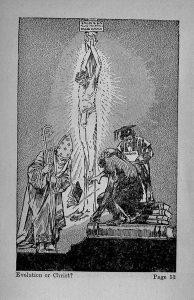
On page 114 we find the following image.
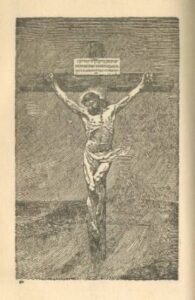
J.F Rutherford was the second president of the incorporated Watch Tower Bible and Tract Society of Pennsylvania. Rutherford played a major role in the Jehovah’s Witnesses organization and the formation of their doctrine.
It was Rutherford himself that would move the belief away from from the cross but to the stake.
He wrote in his 1936 book Riches
“Jesus was crucified, not on a cross of wood, such as exhibited in many images and pictures, and which images are made and exhibited by men; Jesus was crucified by nailing his body to a tree”.
Riches page 27
Clearly Rutherford had no problems with the term crucified rather it was on the what was Jesus crucified which bore the objection.
Also the cross was used as a symbol that was included on the cover of “The Watch Tower” all the way up until October of 1931.

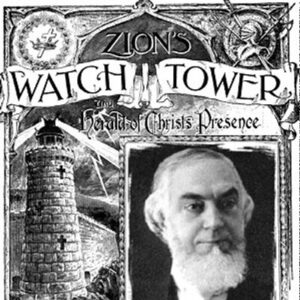
The cross symbol was removed and not included on the cover of the renamed “The Watchtower” for the 15th October 1931 edition. .
Until the publication of the NWT in the 1950’s NT and the full bible (OT and NT) in the 1960’s most JW actually used the KJV. The KJV translates stauros as cross.
The JW website states that “God rejects worship that uses images or symbols, INCLUDING THE CROSS”
God rejects worship that uses images or symbols, including the cross. God commanded the Israelites not to use “the form of any symbol” in their worship, and Christians are likewise told to “flee from idolatry.”—
JW.org
This itself is not an argument against the cross. It is only an argument against the worship of images or symbols.
But we must also ask what has happened to the JW’s own followers who believed in and were taught the cross before the cross was dropped and replaced with the stake.
It’s important to take note of the actual language used in the claim of the JW.org website
“According to A Critical Lexicon and Concordance to the English and Greek New Testament”
A critical lexicon. This indicates one singular critical lexicon. Even though they do not state which critical lexicon this is.
When we look at some well known Greek concordances we see that Stauros which is strong’s Greek word 4716, while it can mean upright stake or pole it also does indeed have the meaning cross
Thayers
a cross
σταυρός, σταυροῦ, ὁ (from ἵστημι (root sta); cf. Latinstauro, English staff (see Skeat, Etymological Dictionary, under the word); , § 216; , p. 1126);
1. an upright stake, especially a pointed one (, , , ).
2. a cross;
a. the well-known instrument of most cruel and ignominious punishment, borrowed by the Greeks and Romans from the Phoenicians; to it were affixed among the Romans, down to the time of Constantine the Great, the guiltiest criminals, particularly the basest slaves, robbers, the authors and abetters of insurrections, and occasionally in the provinces, at the arbitrary pleasure of the governors, upright and peaceable men also, and even Roman citizens themselves
Strong’s
an upright stake, a cross (the Rom. instrument of crucifixion)
So the Greek lexicons actually state BOTH meanings. Stauros means both a stake and a cross.
I will also address this particular claim later in this writing.
So what does stauros really mean?
This really is the crux of the matter (excuse the pun). While I do not think this is so much a theological issue, what matters is that Jesus did in fact die and that he did in fact resurrect, I do think it opens up the questions can we trust the Bible? And is the Bible accurate? So I do think the issue is at least worthy of study and do not think it is simply a waste of time. I think that any group that brings doubt to either of these issues needs to be addressed. The Jehovah’s Witnesses actually do rather make this a big issue. I will not be making much of an argument in this writing for the traditional T shape cross as I actually think that there is a compelling case that the cross of Jesus was actually an X shape but I wouldn’t make that claim as yet. The argument will be more centred around the use of more than one piece of timber as opposed to the singular stake that the JW assert. Anyway…
The JW website offers the following evidence for stauros meaning stake.
The Greek word rendered “cross” in many modern Bible versions (“torture stake” in NW) is stau·rosʹ. In classical Greek, this word meant merely an upright stake, or pale. Later it also came to be used for an execution stake having a crosspiece. The Imperial Bible-Dictionary acknowledges this, saying: “The Greek word for cross, [stau·rosʹ], properly signified a stake, an upright pole, or piece of paling, on which anything might be hung, or which might be used in impaling [fencing in] a piece of ground. . . . Even amongst the Romans the crux (from which our cross is derived) appears to have been originally an upright pole.”—Edited by P. Fairbairn (London, 1874), Vol. I, p. 376.
This most certainly would not include a tree as was stated by Rutherford in Riches.
However, this is also simply VERY VERY disingenuous. Not only have they removed words in ellipsis (….) they have cut short the writing itself. Let’s have a look at the words removed …..
“But a modification was introduced as the dominion and usages of Rome extended themselves through Greek-speaking countries.”
I think that speaks for itself. A modification was introduced to stauros as Rome extended themselves through Greek speaking countries.
Now as I said they not only removed those rather important words but also cut short the writing. So let’s see what they left off, and it’s not just a single word or even two. In fact it’s not even a single sentence but a huge portion of the writing.
“and this always remained the most prominent part. But from the time that it began to be used as an instrument of punishment, a transverse piece of wood was commonly added: not, however, always even then. For it would seem that there were more kinds of death than one by the cross; this being sometimes accomplished by transfixing the criminal with a pole, which was run through his back and spine, and came out at his mouth (adactum per medium hominem, qui per os emergat, stipitem, Seneca, Ep, xiv.) In another place (Consol ad Marciam, xx.), Seneca mentions three different forms: `I see,’ says he, `three crosses, not indeed of one sort, but fashioned in different ways; one sort suspending by the head persons bent toward the earth, others transfixing them through their secret parts, others extending their arms on a patibulum.’ There can be no doubt, however, that the latter sort was the more common, and that about the period of the gospel age crucifixion was usually accomplished by suspending the criminal on a cross piece of wood..”
The full writing therefore would in fact look like this.
“The Greek word for cross, (stauros), properly signified a stake, an upright pole, or piece of paling, on which anything might be hung, or which might be used in impaling (fencing in) a piece of ground. But a modification was introduced as the dominion and usages of Rome extended themselves through Greek-speaking countries. Even amongst the Romans, the crux (from which the word cross is derived) appears to have been originally an upright pole, and this always remained the most prominent part. But from the time that it began to be used as an instrument of punishment, a transverse piece of wood was commonly added: not, however, always even then. For it would seem that there were more kinds of death than one by the cross; this being sometimes accomplished by transfixing the criminal with a pole, which was run through his back and spine, and came out at his mouth (adactum per medium hominem, qui per os emergat, stipitem, Seneca, Ep, xiv.) In another place (Consol ad Marciam, xx.), Seneca mentions three different forms: `I see,’ says he, `three crosses, not indeed of one sort, but fashioned in different ways; one sort suspending by the head persons bent toward the earth, others transfixing them through their secret parts, others extending their arms on a patibulum.’ There can be no doubt, however, that the latter sort was the more common, and that about the period of the gospel age crucifixion was usually accomplished by suspending the criminal on a cross piece of wood.
When a text has to be edited in such a way in order to make it support your position and then offered as evidence then it is deliberately being deceiving and it must be asked as to what purpose this was done. It has to be questioned as to what agenda were the words that actually negate the position being presented removed.
Maybe that’s something the JW.org website should address.
The JW website also states
“The Bible generally uses the Greek word stau·ros′ when referring to the instrument of Jesus’ execution. (Matthew 27:40; John 19:17) Although translations often render this word “cross,” many scholars agree that its basic meaning is actually “upright stake.”
It is very true, just as JW.org correctly states that the Greek word Stauros did mean an upright stake. The BASIC meaning of the word stauros IS upright stake (not torture stake as we have already established) I will not be arguing with the “many scholars” who it must be stated remain unnamed and anonymous, on this point. It will be fully conceded that the Greek word Stauros did originally mean stake, but that is the point here, it originally meant this but very clearly later came to refer to the cross.
Another example of misleading informaton can be found in the common citing of the book New Bible Dictionary by James Dixon Douglas (J.D. Dixon)
Many websites and JW literature make reference to this book and its commentary on Stauros.
One such site states:
This is because the word “Stau·ros´ in both the classical Greek and Koine carries no thought of a “cross” made of two timbers. It means only an upright stake, pale, pile, or pole:
The site then cites the book:
“The Greek word for `cross’ (Stau·ros´) means primarily an upright stake or beam, and secondarily a stake used as an instrument for punishment and execution.” – Douglas’ New Bible Dictionary of 1985 under “Cross,” page 253.
http://searchforbibletruths.blogspot.com/2012/05/was-jesus-impaled-on-cross-or-upright.html
But as I say, this is simply deceptive. They have simply taken one portion of that commentary because it seemingly support their argument. But we shall take a look at what else the book says.
The noun occurs 28 times and the verb 46. The crucifixion of live criminals did not occur in the OT (stauroo in the LXX of Est. 7:10 is the Heb. tala, meaning `to hang’). Execution was by stoning. However, dead bodies were occasionally hung on a tree as a warning (Dt. 21:22-23; Jos. 10:26). Such a body was regarded as accursed (hence Gal. 3:13) and had to be removed and buried before night came (cf. Jn. 19:31). This practice accounts for the NT reference to Christ’s cross as a `tree’ (Acts 5:30; 10:39; 13:29; 1 Pet. 2:24), a symbol of humiliation.”
New Bible dictionary J.D Douglas page 253.
Apart from the single upright post (crux simplex) on which the victim was tied or impaled, there were three types of cross. The crux commissa (St Anthony’s cross) was shaped like a capital T, thought by some to be derived from the symbol of the god Tammuz, the letter tau; the crux decussata (St Andrew’s cross was shaped like the letter X; the crux immissa was the familiar two beams †, held by tradition to be the shape of the cross on which our Lord died (Irenaeus, Haer. 2.24.4). This is strengthened by the references in the four Gospels (Mt. 27:37; Mk. 15:26; Lk. 23:38; Jn 19:19-22) to the title nailed to the cross of Christ over his head.4
New Bible dictionary J.D Douglas page 253.
We even see an image of a crucified man on a cross in the book
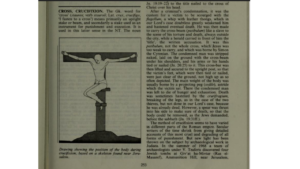
New Bible dictionary J.D Douglas page 253.
All of this can be found in the exact same book on the exact same page, in the exact same commentary as the citation by the JW’s.
The Jehovah Witnesses point to Homer, a classical Greek poet who lived around the late 8th early 7th century BC who used the word to mean stake. Although other classical Greek writers could be cited.
“Concerning this word and the word stauros, translated `cross’ in some versions, The Companion Bible says on page 186 in the `Appendixes’: `Homer [ancient Greek poet] uses the word stauros of an ordinary pole or stake, or a single piece of timber. And this is the meaning and usage of the word throughout the Greek classics. It never means two pieces of timber placed across one another at any angle, but always of one piece alone. Hence the use of the word xulon [or xylon, meaning a timber] in connection with the manner of our Lord’s death, … The evidence is thus complete, that the Lord was put to death upon an upright stake, and not on two pieces of timber placed at any angle.'” (“The Truth that Leads to Eternal Life,” Watchtower Bible & Tract Society: Brooklyn NY, 1968, pp.142-143).
Which he did, as correctly stated by the Watchtower Bible & Tract Society. Yet again this point is not disputed, nor is it required to be.
Homer used the word stauros to mean a stake in “the Odyssey” which is dated to around the 8th century BC
Without he had driven stakes [staurous] the whole length, this way and that, huge stakes, set close together, which he had made by splitting an oak to the black core. “ (Homer, “The Odyssey,” 14.11).
HOWEVER, we do have to take into account that Homer wrote in classical Greek. The Bible was not written in classical Greek but koine Greek something that the JW seem able to ignore. We cannot simply take the meaning of the word in a different dialect as in classical Greek and insist that it must mean the same or that it cannot also have a different or secondary meaning in a different dialect namely Koine Greek.
But what it does show is that Stauros did mean Stake and maybe the point previously referred to may be moot, as Stauros, it must be stated does, even to this day, have the meaning stake, of this there simply is no denying. But to stop there, as the JW organisation does is, simply wrong. There is much more information that needs to be examined and plenty more evidence to be presented.
It is simply incorrect to say that the word can have no other meaning than the one first applied. This is a fallacy that the JW commit.
We know that the Romans later conquered the Greeks. This was done a long time after Homer but also before the arrival of Jesus the Messiah. Despite being under the authority of the Roman empire, Greek remained the common language used by those that used to belong to the Grecian empire. The Romans however did install much of their authority onto these peoples, including the Roman means of punishment, namely crucifixion. Crucifixion in Latin is crucifixio. Crucifixion (and this is rather important) was not a part of Grecian custom, they did not utilise the punishment of crucifixion and so they had no technical term for it. So, they had to “come up with “ a term that would suit.
The Greek language that did not have a word for crucifixion now required one as crucifixion was a punishment that was utilised by the Roman empire including in areas where Greek was the common language. While a word had to be derived for crucifixon, it was also required that a word to refer to the object on which the crucifixion took place, which was most common a cross.
The Greek speaking world had a few options open to them. Just as today in modern languages when something new is introduced into our culture.
1) Invent a new word.
Like the word Internet for example.
1970s (denoting a computer network connecting two or more smaller networks): from inter- ‘reciprocal, mutual’ + network.
The word internet was invented in the 1970’s to name something that had previously not existed but now did.
2) Use the Roman word either directly or Grecianising it
We do this all the time in modern languages.
For example, damsel” is an anglicisation of the Old French damoisele (modern demoiselle), meaning “young lady”.
3) Completely change the meaning of an already existing word.
An example of a word completely changing meaning would be the word gay. Today the word Gay means a homosexual person. However, the original meaning of the word meant to be happy or cheerful.
Let’s take the 1941 warner brothers film the Gay Parisian.
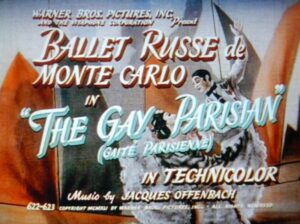
The meaning of the word Gay has changed since the film was made. It would be incorrect to take a modern understanding of the word Gay and interject that meaning back onto the film that was made before the meaning of the word had changed. It would totally distort the true meaning of the film. The film has absolutely nothing to do with homosexuality whatsoever.
The same would be true if we took the meaning of the word gay from 1941 and interjected it into the modern term LGBT. We would now have the meaning Lesbian happy bisexual transgender. Although i’m sure the LGBT community are happy this rendering would completely change and distort the actual meaning of the term. This would again simply be an incorrect thing to do as the word Gay in this term does not refer to someone being happy or cheerful.
4) Use a previously used word adding a new meaning to it.
Just like the word mouse. Mouse originally (and still means)
1.a small rodent that typically has a pointed snout, relatively large ears and eyes, and a long tail.
However the word mouse also has another, more modern meaning.
2.a small handheld device which is moved across a mat or flat surface to move the cursor on a computer screen.
The computer mouse was invented by Douglas C. Engelbart in 1964 and was publicly unveiled in 1968.
A previously used word with a totally different meaning was used. Since the introduction of the computer mouse, the word mouse has had 2 meanings and not understanding that the word has 2 meanings could lead to confusion, a non functioning computer or a pet that doesn’t really do much apart from sit in its cage.
If someone said that they had just bought a new mouse for their computer and you took only the BASIC and original meaning of the word and applied it to their statement you would get a completely incorrect understanding of what the person has just purchased. It would also work the opposite way if they said that they had just purchased a pet mouse and you applied the modern meaning of the word. You are only going to confuse the true meaning of the statement and get a very incorrect understanding. The thought of someone buying a computer mouse to keep in a cage as a pet is somewhat funny.
This is how language adapts and changes.
This adaption has been named by Linguists as the diachronic development of languages.
“Diachronic linguistics refers to the study of how a language evolves over a period of time. Tracing the development of English from the Old English period to the twentieth century is a diachronic study”
https://www.thoughtco.com/diachronic-linguistics-term-1690385#:~:text=Diachronic%20linguistics%20refers%20to%20the,century%20is%20a%20diachronic%20study.
Again it is simply disingenuous to say that we can only take the BASIC meaning or the original meaning or even the modern meaning of a word and say no other meaning should or can be applied. In order to correctly understand the meaning of the usage of a word we must allow the context in which the statement is made to dictate which meaning is being applied.
The Greeks chose to use a previously used word, stauros, and ADD a meaning unto it.
The Greek word Stauros was used and the meaning cross was added to the meaning stake therefore, Stauros could, from then on be rendered stake or cross depending on the context in which the word was used.
Anyone who seems to doubt what the word means and what the Greeks themselves understood what stauros meant only need to go look at a Church building of the Greek orthodox church and they will see a cross and not a stake adorning its exterior. The Greeks fully understood the word stauros to mean a device of more than one piece of timber, in this case in the shape of a cross .

Santa Sophia (Greek Orthodox Cathedral of Aghia Sophia), London
Biblical evidence
There is not much biblically supporting evidence for the cross apart from the translation of cross itself, however, we do have a couple of passages that make much more sense when the cross is understood to be the correct translation.
Firstly we have the comment of Thomas who wanted to see the print of the nails (plural) in the hands of Jesus.
John 20:25 The other disciples therefore said unto him, We have seen the Lord. But he said unto them, Except I shall see in his hands the print of the nails, and put my finger into the print of the nails, and thrust my hand into his side, I will not believe.
Nails indicating more than one nail was used. The Greek translated as nails is ἥλων hēlōn, which is plural.
The NWT has nails.
John 20:25 So the other disciples were telling him: “We have seen the Lord!” But he said to them: “Unless I see in his hands the print of the nails and stick my finger into the print of the nails and stick my hand into his side, I will never believe it.”
This would be unlikely if the hands of Jesus were placed together above him. Had the hands of Jesus been above his head rather than outstretched, one single nail would most likely have been used just as the JW own imagery would indicate. This is probablistic evidence for the arms stretched out upon a cross.
The NWT also uses the plural nails contrary to their own imagery
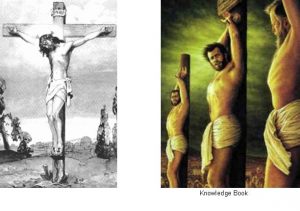
Watchtower publication Knowledge That Leads to Everlasting Life
We also have the wording regarding the placement of the sign at his crucifixion. Had the hands of Jesus been placed up and above his head then the passage regarding the placement of the sign at his death becomes rather confusing.
Matthew 27:37 And set up over his head his accusation written, THIS IS JESUS THE KING OF THE JEWS.
The language used here would indicate that the sign went above his head. If the arms of Jesus were above his head then although it would technically be correct to say the sign was above his head if it was placed above the heads as they would have been above his head the language used would be rather strange. It would be much more likely and grammatically correct that it would be stated above his hands. However, this is not in itself concrete proof just a simple grammatical argument.
We can also look at the language used by Jesus to signify the ultimate death of the disciple Peter.
John 21:18 Verily, verily, I say unto thee, When thou wast young, thou girdedst thyself, and walkedst whither thou wouldest: but when thou shalt be old, thou shalt stretch forth thy hands, and another shall gird thee, and carry thee whither thou wouldest not.
Here Jesus talks about stretching ekteneis his hands which is a possible alluding to the outstretched arms of crucifixion. It is understood that Peter was also crucified, like Jesus (but upside down).
Probably the best support Biblically for the cross however is where we are told Jesus carried his Cross. This is often overlooked and its importance often simply brushed by.
John 19:17 And he bearing his cross went forth into a place called the place of a skull, which is called in the Hebrew Golgotha:
I’m sure most people have seen pictures or films that depict Jesus literally carrying the full cross upon his back.
However, that likely isn’t what is being portrayed at all. It is much more likely, that this was a biblical reference to the very historically attested to form of Roman punishment known as patibulum (cross-beam)-bearing where the criminal would be forced to carry not the full cross but the cross beam of the cross on their back and shoulders through the city or public places to the place of their crucifixion upon the beam that they had just carried. I will look into the evidence for this in just a moment.
The Watchtower claims that crux which is the Latin translation of Stauros also meant a stake and only later came to mean cross.
“…the original meanings of these words [stauros and crux] were later expanded to include the cross” (Watchtower, 15 February 1960, p. 127)
“True, the Romans did use an instrument of execution known in Latin as the crux. And in translating the Bible into Latin, this word crux was used as a rendering of stauros. Because the Latin word crux and the English word cross are similar, many mistakenly assume that crux was necessarily a stake with a crossbeam” (15 August 1987 Watchtower, p. 23).
The English word cross is derived from the Latin crux.
The JW claim that the T shape was introduced much later in history.
“Constantine was a pagan worshiper of the sun god, and the symbol of this false god was the cross or the letter T, the initial letter of the false god Tammuz. If what Constantine saw in vision was a cross, then it was the sign of his god, for Jesus Christ was not hanged upon a cross but was hanged upon a simple stake. It was from Constantine’s time onward that the symbol of the apostate Christianity which he professed to accept was the cross.” What has Religion Done for Mankind? (1951) p.270
Again, I shall not go into too much detail in the argument for or against the shape T in this writing and shall address this in the extended version , rather all that needs to be shown for the argument regarding the cross whatever shape that be, is to show the 1) Stauros was used to refer to the crux, the Roman instrument of execution 2) the Roman instrument of execution the crux, could consist of more than one piece of timber at the time of the execution of Jesus.
The crux referred to the instrument on which the Romans implemented their crucifixions. The Romans didn’t really have any particular preference to a certain shape on which they perform their executions. They would execute using many different shaped devices.
The Romans called a single beam device a crux simplex and a multiple beam device a crux compacta. The simple fact that the Romans had to distinguish between a single beamed crux and a multiple beamed crux clearly indicates that not all executions were performed on a single beamed device and neither were they performed all on a device containing more than one beam.
The following is found on the watchtower online library:
“That the word “cross” appears in many English translations of the Bible does not prove that Christ’s death instrument was in the shape that the churches claim. The word “cross” stands for a number of shapes. There is the simple upright stake, called in Latin crux simplex; the crux commissa, which was shaped like the letter “T”; the crux decussata, which was shaped like the letter “X,” and the crux immissa, which was like the letter “T” but with the crossbar lowered. So when the English word “cross” is used in Bible translations made by the churches, how are you to know which of these forms is meant?”
https://wol.jw.org/en/wol/d/r1/lp-e/1968084
(“The Cross Is of Pagan Origin,” The Watchtower, February 1, 1968, pp.93-95, p.94)
If we read on we might find the reason behind the objection to the cross.
“The Greek word from which the English word “cross” is translated by the churches is staurosʹ, but to the Bible writers it did not stand for the cross that churches display as the symbol of Christianity. It meant a plain upright stake. On this the book An Expository Dictionary of New Testament Words by W. E. Vine states on page 256 of volume one: “Stauros denotes, primarily, an upright pale or stake. On such malefactors were nailed for execution. Both the noun and the verb stauroō, to fasten to a stake or pale, are originally to be distinguished from the ecclesiastical form of a two beamed cross. The shape of the latter had its origin in ancient Chaldea, and was used as the symbol of the god Tammuz.”
We have evidence of the cross or crux compacta that certainly pre date Constantine
One such being from Justin Martyr.
Justin Martyr
“Further, God pointed out m another way the
strength of the mystery of the cross when He said by
Moses in the blessing wherewith He blessed Joseph: Of
the blessing of the Lord is his land, of the seasons of
heaven and its dews, and of the abyss of streams from
below-and fruits in season from the course of the sun;
and of the conjunctions of months, and of the top of
ancient mountains, and of the top of hills, and of perennial
streams, and of fruits of a land of plenty. And let the
things accepted of Him who appeared in the bush come
on the head of Joseph and on his pate. Glorified among
his brethren as first-born; as of a bull is his glory; his
horns are the horns of an unicorn; with them shall he
push nations together even at the very end of the earth. 3
2. For no one could say or prove that the horns of a
unicorn are of any other matter or form than of the
figure which represents a cross. For the one piece of
wood stands upright, from which the upper part is raised
up into a horn, when the other piece of wood is fitted on,
and the ends seem like horns joined to that one horn.
And the piece fixed in the middle’ itself on which they that are crucified are upborne also projects like a horn, and
itself looks like a horn when fashioned together and fixed
in with the other horns“
Justin Martyr Dialogue with Trypho XCI
Although Justin Martyr doesn’t specifically make a reference to a cross shape the fact that he refers to “the other beam” clearly indicates more than one beam and therefore whatever shape the more than one beam made it was more than one single beam as the JW would assert.
In response to Justin’s statement the JW’s state:
“But do not writers early in the Common Era claim that Jesus died on a cross? For example, Justin Martyr (114-167 C.E.) described in this way what he believed to be the type of stake upon which Jesus died: “For the one beam is placed upright, from which the highest extremity is raised up into a horn, when the other beam is fitted on to it, and the ends appear on both sides as horns joined on to the one horn.” This indicates that Justin himself believed that Jesus died on a cross.
However, Justin was not inspired by God, as were the Bible writers. He was born more than eighty years after Jesus’ death, and was not an eyewitness of that event.”
https://wol.jw.org/en/wol/d/r1/lp-e/101976850
MINICIUS FELIX
Crosses, moreover, we neither worship nor wish for. You, indeed, who consecrate gods of wood, adore wooden crosses perhaps as parts of your gods. For your very standards, as well as your banners, and flags of your camp, what else are they but crosses gilded and adorned? Your victorious trophies not only imitate the appearance of a simple cross, but also that of a man affixed to it. We assuredly see the sign of a cross, naturally, in the ship when it is carried along with swelling sails, when it glides forward with expanded oars; and when the military yoke is lifted up, it is the sign of a cross; and when a man adores God with a pure mind, with hands outstretched. (Octavius, chapter 29 [c. A.D. 185–190])
Tertullian
Every piece of timber which is fixed in the ground in an erect position is a part of a cross, and indeed the greater portion of its mass. But an entire cross is attributed to us, with its transverse beam, of course, and its projecting seat…Well, then, this modeler, before he did anything else, hit upon the form of a wooden cross, because even our own body assumes as its natural position the latent and concealed outline of a cross. Since the head rises upwards, and the back takes a straight direction, and the shoulders project laterally, if you simply place a man with his arms and hands outstretched, you will make the general outline of a cross. (Ad Nationes, chapter 12 [c. A.D. 197])
Premising, therefore, and likewise subjoining the fact that Christ suffered, he foretold that his just ones should suffer equally with him—both the apostles and all the faithful in succession; and he signed them with that very seal of which Ezekiel spoke: “The Lord said unto me, Go through the gate, through the midst of Jerusalem, and set the mark Tau upon the foreheads of the men.” Now the Greek letter tau and our own letter T is the very form of the cross, which he predicted would be the sign on our foreheads in the true Catholic Jerusalem. (Against Marcion, book 3, chapter 22 [A.D. 207])
ARCHELAUS
There, Moses, when he was assailed, stretched forth his hands and fought against Amalek; and here, the Lord Jesus, when we were assailed and were perishing by the violence of that erring spirit who works now in the just, stretched forth his hands upon the cross, and gave us salvation. (The Acts of the Disputation with the Heresiarach Manes, chapter 44 [c. A.D. 277])
More importantly though to the argument is that there are historical writings that predate the death of Jesus that show that Stauros was being used to describe the Roman instrument of execution.
Greek historian Polybius who lived from 200- 118 BC describing an event that occurred in 183BC
“All the baggage fell into the hands of the enemy, and Hannibal himself was made a prisoner. They [the Roman soldiers] at once took him up on the cross (stauron) on which Spendius was hanging, and after the infliction of exquisite tortures, took down the latter’s body and fastened Hannibal, still living, to his cross (stauron), and then slaughtered thirty Carthaginians of high rank round the corpse of Spendius”. (Polybius, Historiae 1.86.6;
Here Polybus used the word Stauron to refer to the instrument of execution used by the Romans.
Chariton written somewhere between the 1st century Bc and the 1st century AD
“They found the others already hanging on their crosses (staurous), and he was just mounting his cross (epi bainonta tou staurou). From far off they each shouted appeals: ‘Spare him!’ ‘Come down!’ ‘Do not hurt him!’ ‘Let him go!’ So the executioner stopped his work, and Chaereas descended from the cross (katebaine tou staurou), regretfully, for he had been glad to be leaving his miserable life and unhappy love” (Chariton, Chaereas and Callirhoe, 4.3.5-6;
Again here stauros very clearly being used to describe the instrument of execution.
Philo of Alexandria 25bc -50AD wrote about the instrument of execution also using Stauros
The relations and friends of those who were the real victims were led away to prison, were scourged, were tortured, and after all the ill treatment which their living bodies could endure, found the cross (stauros) the end of all, and the punishment from which they could not escape” (Philo of Alexandria, In Flaccum 70-72;
Plutarch who lived between 45AD and 127AD
“But will you nail him to a cross (eis stauron kathélóseis) or impale him to a stake (skolopi péxeis)?
What does Theodorus care whether he rots above ground or beneath?” (Plutarch, Moralia, Ad Vitiositas 499D; author lived between AD 45-125).
Plutarch not only referred to the instrument of execution by using stauros he also differentiated the stauron from the stake(skolopi)
Although many other examples could be cited as evidence the examples presented show adequate proof that the Greek stauron was being used to refer to the Roman instrument of execution not just at the time of Jesus but also before.
So If it can be shown that the Roman instrument of execution could include a “cross” , a device consisting of more than one piece of timber, then it would provide ample support that stauros could be used to describe the instrument of execution used by the Romans that consisted of more than 1 piece of timber or simple stake.
It just happens that we also have that historical evidence.
Plautus 254-184 B.C wrote in his play Miles Glorisus
Credo ego istoc extemplo tibi esse eundum actutum extra portam, dispessis manibus, patibulum quom habebis.
“I suspect you’re doomed to die outside the gate, in that position: Hands spread out and nailed to the patibulum” (Miles Gloriosus, Lines 359-360).
Here Plautus clearly states that the arms would be stretched out (not above the head) and nailed to the patibulum or the cross beam.
In another play Mostelleria, Plautus uses the term double nailed.
Ego dabo ei talentum, primus qui in crucem excucurrerit; sed ea lege, ut offigantur bis pedes, bis brachia. ”
I’ll give two hundred pounds to the first man to charge my crux and take it — on condition his legs and arms are double-nailed, that is” (Mostellaria, 359-360).
Double nailed is another clear allusion to requiring more than one nail which indicates the crux being a cross shape and not a single beam.
And again Plautus highlights the punishment of patibulum, the carrying of the cross beam by the criminal and then being nailed to the crux.
Patibulum ferat per urbem, deinde adfigatur cruci. “Let him bear the patibulum through the city; then let him be nailed to the crux” (Carbonaria, fr. 2).
2 very clear and distinct parts clearly showing 2 not one beam.
But we also have more evidence
Seneca (c. 4 B.C.-A.D. 65)
Cum refigere se crucibus conentur, in quas unusquisque vestrum clavos suos ipse adigit, ad supplicium tamen acti stipitibus singulis pendent; hi, qui in se ipsi animum advertunt, quot cupiditatibus tot crucibus distrahuntur. At maledici et in alienam contumeliam venusti sunt. Crederem illis hoc vacare, nisi quidam ex patibulo suo spectatores conspuerent! ”
Though they strive to release themselves from their crosses—those crosses to which each one of you nails himself with his own hand–yet they, when brought to punishment hang each one on a single stipes; but these others who bring upon themselves their own punishment are stretched upon as many crosses as they had desires. Yet they are slanderous and witty in heaping insult on others. I might believe that they were free to do so, did not some of them spit upon spectators from their own patibulum!” (De Vita Beata, 19.3).
Video istic cruces non unius quidem generis sed aliter ab aliis fabricatas: capite quidam conversos in terram suspendere, alii per obscena stipitem egerunt, alii brachia patibulo explicuerunt. ”
Yonder I see crosses, not indeed of a single kind, but differently contrived by different peoples; some hang their victims with head toward the ground, some impale their private parts, others stretch out their arms on a patibulum” (De Consolatione, 20.3).
Tacitus (c. A.D. 56-c. 120)
Rapti qui tributo aderant milites et patibulo adfixi. ”
The soldiers stationed to supervise the tribute were seized and nailed to the patibulum” (Annals, 4.72).
Lucian
“Men weep and bewail their lot, and curse Cadmus with many curses for putting Tau into the alphabet; for they say that their tyrants, taking his body as a model (somati phasi akolouthésantas) and imitating his shape (mimésamenous autou to plasma), have fashioned similar-looking timbers (skhémati toioutói xula) to crucify (anaskolopizein) men upon them, and the vile device is even named (eponumian) after him (i.e. sTAUros). Now, with all these crimes upon him, does not Tau deserve to die many times over? As for me, I think the only just thing to do would be to punish Tau on what has been made in his own shape (tó skhemati tó hautou), for the cross (ho stauros) owes its existence to Tau, but its name to man (hupo de anthrópón onomazetai)” (Lis Consonantium, 12).
53. Being crucified is auspicious for all seafarers. For the cross, like a ship, is made of wood and nails, and the ship’s mast resembles a cross. It is also auspicious for a poor man. For a crucified man is raised high and his substance is sufficient to keep many birds. But it means the betrayal of secrets. For a crucified man can be seen by all. On the other hand, it signifies harm for rich men, since the crucified are stripped naked and lose their flesh.
artemidorus oneirocritica (interpretation of Dreams) 2nd Century AD
By the time of the Hellenistic period, Stauros had taken on the meaning Cross, even in classical Greek.
Lets look at one of the leading classical Greek Lexicons
Puteoli Graffito dated to arround the 2nd Century AD shows a man on a crossbeam
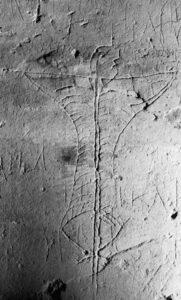
We also have the Alexamenos graffito where Jesus is depicted as being crucified with arms stretched out. Dated to around 200AD.
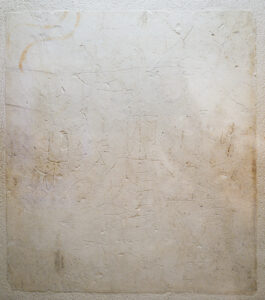
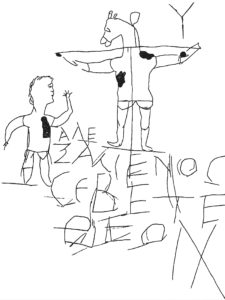
There are even more examples that can be used which I shall include in the extended version of this writing.
As it has been shown that instruments of execution that consisted of more than one piece of timber were being used by the Romans at the time of Jesus then it would have to be shown by the JW’s that another word and not Stauros was used to refer to that particular instrument of execution.
In sum, the claim that σταυρός “means only stake” is untenable in light of Koine usage and Roman practice. Ancient sources describe executions with outstretched arms on a patibulum, nails affixing limbs, and placards placed above the head—precisely the features reflected in the Passion narratives. Lexicographically (LSJ, BDAG), historically (Plautus, Seneca, Plutarch, Philo), and contextually (John 19:17; 19:19; 20:25; Matt 27:37), the evidence converges: by the first century, stauros naturally referred to the cross as the Roman instrument of crucifixion. We cannot dogmatize the precise geometry, but the best reading is not a solitary stake. On lexical, textual, and historical grounds, translating stauros as “cross” is justified.
If you liked this study please subscribe here
You can buy my books on Amazon there is a link here
Help me keep this site free for all. Join our Patreon membership here